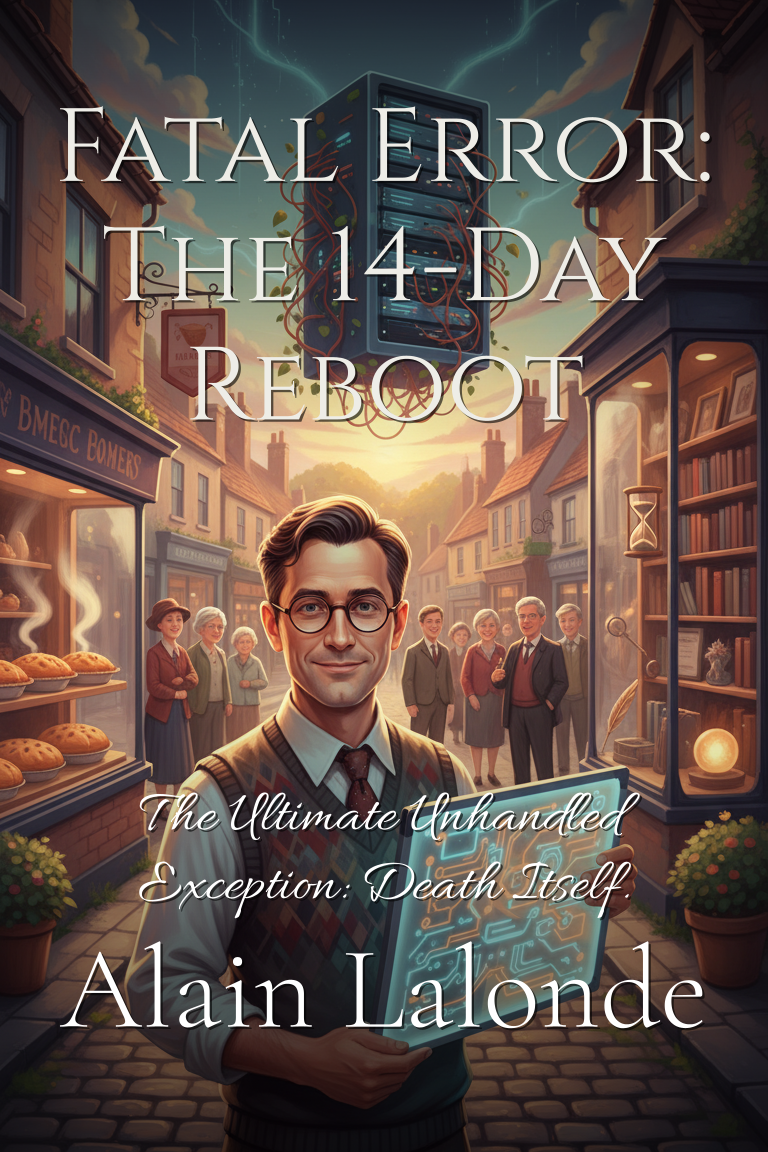
Fatal Error: The 14-Day Reboot
How I Flatlined, Found the Afterlife’s Legacy Code, and Submitted a Bug Report to the Universe When a veteran IT systems architect accidentally flatlines for two straight weeks, the medical community calls it a miracle. Guinness World Records calls it a medical impossibility. But he just calls it an unmitigated infrastructural disaster. Instead of pearly gates, choirs of angels, or a peaceful white light, he woke up on the "other side" only to discover that human consciousness is being routed through a heavily unoptimized, severely bottlenecked legacy backend. The afterlife isn't a mystical realm; it's a sprawling server farm running on spaghetti code, outdated hardware, and zero redundancy. And worse—the System Administrator has been out to lunch for about two millennia. Armed with nothing but a spectral whiteboard and decades of troubleshooting experience, our protagonist spends his 14-day coma aggressively mapping out the universe's computational identity lifecycle engine. After finally managing to force a system reboot and wake back up in his own body, he is left with one massive headache, a lingering case of "Musical Ear Syndrome" (which he now realizes was just the universe's dial-up tone), and a mission. Fatal Error: The 14-Day Reboot is a hilarious, mind-bending journey of one man’s quest to patent the afterlife, refactor eternity, and finally fix the ultimate unhandled exception: death itself.
Table of Contents
- Chapter 1 Blue Screen of Death (Literal Edition) 17 min read
- Chapter 2 Have You Tried Dying and Turning It Back On Again? 14 min read
- Chapter 3 Legacy Code and Pearly Gatekeepers 13 min read
- Chapter 4 The Sysadmin Who Went Out for Loaves and Fishes 15 min read
- Chapter 5 Spectral Whiteboard and a Ghost of a Chance 12 min read
- Chapter 6 Bottlenecks, Bureaucrats, and the Bandwidth of the Soul 12 min read
- Chapter 7 The Dial-Up Tone in My Head Was Real 11 min read
- Chapter 8 Zero Redundancy and the Single Point of Eternity 12 min read
- Chapter 9 Spaghetti Code and Meatball Theology 12 min read
- Chapter 10 The Bug in the Machine Is Wearing a Halo 14 min read
- Chapter 11 Patch Notes from Purgatory 11 min read
- Chapter 12 My Body Is Sending Me Push Notifications 13 min read
- Chapter 13 Marge Macintosh and the Whiteboard Cipher 13 min read
- Chapter 14 The Interim Administrator's Terms of Service 12 min read
- Chapter 15 Forcible Reboot Sequence Initiated 13 min read
- Chapter 16 The Fourteen-Day Uptime Report 11 min read
- Chapter 17 Ctrl+Alt+Delete the Afterlife 12 min read
- Chapter 18 One Massive Headache and a Mission Statement 11 min read
- Chapter 19 Patent Pending: The Computational Identity Lifecycle Engine 12 min read
- Chapter 20 The Unhandled Exception 12 min read
Blue Screen of Death (Literal Edition)
There is a particular hum that server rooms make — not quite mechanical, not quite alive — that settles into the bones of anyone who spends enough time among the racks.
It is the sound of ten thousand small decisions being made every second, of data flowing like invisible rivers through copper and glass, of electricity performing its tireless devotion to the ones and zeros that hold the modern world together.
Most people find it unsettling.
Byte Brannigan found it the closest thing to peace he had ever reliably known.
At forty-three, Byte — christened Byron Theodore Brannigan by parents who had clearly never anticipated that their son would grow up to become the sort of man whose name tag read like a unit of digital measurement — had spent the better part of two decades in rooms exactly like this one.
Server Room B at Quarternion Systems occupied the basement level of an unremarkable office building on Maple Street in the unremarkable town of Millhaven, Ontario.
The building itself was a three-storey rectangle of beige brick that could have been a dental practice or an insurance brokerage from the outside, and which gave no outward indication that within its climate-controlled bowels lived enough processing power to manage the payroll, inventory, and customer databases of sixteen mid-sized companies across the province.
Byte loved it the way some men love fishing boats or woodworking sheds — as a domain of comprehensible problems with discoverable solutions.
Tonight, however, the problems were neither comprehensible nor, it seemed, particularly interested in being solved.
"Come on," he murmured, his fingers moving across the keyboard with the deliberate rhythm of someone who had typed these commands so many times they had become a kind of prayer. "Come on, come on, come on."
The fluorescent tubes overhead cast their unforgiving light across his broad shoulders, which were hunched forward in the posture of a man trying to physically will a database into cooperation.
His reading glasses — the kind he swore he didn't need and yet somehow always had perched on his nose after seven in the evening — reflected the scrolling cascade of error messages on the monitor.
Each one was a small, polite notification of catastrophe.
ROLLBACK FAILED: TRANSACTION LOG CORRUPTED
ROLLBACK FAILED: INTEGRITY CONSTRAINT VIOLATION
ROLLBACK FAILED: INSUFFICIENT TEMP TABLESPACE
Byte exhaled through his nose and leaned back in the battered office chair, which protested with a squeal that echoed off the concrete floor.
He pulled his glasses off and rubbed the bridge of his nose, a gesture so habitual that the skin there had developed a faint permanent indentation, a topographical record of twenty years of late nights and uncooperative systems.
The migration had been scheduled for this evening precisely because it was supposed to be routine.
That was the word Priya Chandrasekaran, Quarternion's project manager, had used in the planning meeting three weeks ago. Routine. Byte had learned long ago that in information technology, the word routine functioned much like the word unsinkable had functioned in maritime engineering — as an invitation for the universe to demonstrate its sense of humour.
The plan had been straightforward enough: migrate the legacy database for Greenfield Agricultural Supply from the aging DB2 instance to the new PostgreSQL cluster, verify the integrity of the transferred records, and have everything humming along before the Greenfield team arrived at their desks Monday morning to process seed orders and fertilizer invoices.
Byte had written the migration scripts himself, tested them in the staging environment, and walked through the rollback procedures with the kind of meticulous care that his colleagues found either reassuring or mildly exhausting, depending on their temperament.
What he had not anticipated — what no amount of meticulous care could have predicted — was that the legacy database contained a nested trigger from 2007 that someone had written, apparently, while in the grip of either madness or a truly spectacular misunderstanding of relational database theory.
The trigger had lain dormant for seventeen years, like a landmine buried in a meadow, waiting for precisely the right sequence of operations to detonate.
Byte's migration script had provided that sequence with unwitting precision.
The result was a cascading corruption that had chewed through the transaction logs like a dog through a screen door, leaving Byte elbow-deep in a catastrophic rollback that refused to roll back.
He glanced at the clock on the wall. 11:47 PM.
The server room's air conditioning breathed its constant exhalation, cool and faintly metallic, carrying the ozone-tinged scent of overworked hardware.
Beyond the sealed door, the rest of the Quarternion office was dark and empty, the cubicles standing like abandoned monuments to the workday.
Only the server room was alive, its racks blinking their constellations of green and amber LEDs in patterns that, if you watched long enough, began to seem almost conversational.
Byte replaced his glasses and turned back to the monitor.
He had been at this for four hours now, and the particular quality of his focus had shifted from the sharp alertness of the early evening into something deeper and more stubborn — the kind of concentration that operates below conscious thought, where the fingers know what to type before the mind has fully articulated the reasoning.
It was the state he worked best in, if he was honest.
The state where the boundary between himself and the system grew pleasantly thin.
He reached for his mug of tea — Earl Grey, because he was a man of fixed preferences — and found it cold.
The bergamot scent had faded to a ghost of itself.
He drank it anyway, grimacing at the tepid bitterness, and set the mug back on the whiteboard ledge beside him.
The whiteboard.
He turned to look at it.
It was a large one, mounted on a rolling stand that he'd wheeled into the server room earlier that evening, and its surface was covered in his precise, angular handwriting: the migration architecture, the dependency chains, the rollback sequence.
Byte was a man who thought best with a marker in his hand.
There was something about the physical act of writing — the squeak of felt tip on glossy surface, the smell of the ink, the way a complex problem could be spread out and seen in its entirety — that no screen could replicate.
His colleagues teased him about it.
Priya called him an analog soul in a digital world, which he took as a compliment.
He picked up the blue marker now and uncapped it, adding a new line to the troubleshooting notes in the lower right corner.
The ink was running low, producing that particular scratchy, intermittent line that meant the marker was living its last hours.
Byte made a mental note to raid the supply closet.
Then he turned back to the keyboard.
"All right," he said to the server rack nearest him, Rack 7, which he had privately named Gerald. "Let's try this one more time."
He began typing again, constructing a manual rollback script that would bypass the corrupted transaction logs entirely, rebuilding the database state from the last verified checkpoint.
It was delicate work, the digital equivalent of defusing a bomb by feel, and it required the kind of patient, sequential logic that had always been Byte's particular gift.
Where other engineers might have panicked, or called for reinforcements, or simply thrown their hands up and restored from the nightly backup (losing a full day's worth of Greenfield's data in the process), Byte preferred to understand.
To trace the problem to its root.
To find the elegant solution hiding inside the mess.
He was halfway through the script when the lights flickered.
It was brief — a stutter, really, barely long enough to register consciously — but Byte's fingers paused on the keys.
He looked up.
The fluorescent tubes hummed their steady hum.
The LED constellations on the racks continued their blinking dialogue.
The UPS units — the uninterruptible power supplies that stood like squat sentinels at the end of each row — showed solid green indicators, their batteries fully charged and ready to absorb any disruption from the grid.
"Just the building," Byte told himself.
Old wiring.
Maple Street's electrical infrastructure dated from an era when the heaviest load a basement was expected to carry was a chest freezer and a dehumidifier, not several hundred thousand dollars' worth of computing equipment.
Quarternion had installed dedicated circuits and industrial-grade surge protection, but the building's bones were what they were.
He returned to his script.
The keys clattered in the cool air.
On the screen, the commands assembled themselves into a tidy sequence, each one a careful instruction, a breadcrumb trail leading back toward order.
The lights flickered again.
This time it lasted longer — two seconds, perhaps three — and in the gap of darkness, Byte heard something he had never heard before in a server room.
A sound like a held breath releasing.
A low, subsonic vibration that seemed to come from everywhere and nowhere, resonating in his sternum rather than his ears.
The UPS units clicked into battery mode with their characteristic relay snap, and the racks continued running without interruption, but the fluorescent tubes took an extra beat to restabilize, and in that beat, the shadows in the corners of the room seemed to deepen and lean inward, as though curious.
Byte's hands hovered over the keyboard.
His heart was doing something unusual — not racing, exactly, but beating with a heavy, deliberate emphasis, as though each contraction was trying to communicate something important.
The hair on his forearms stood at attention.
The air tasted different.
Sharper.
Charged with the unmistakable pre-storm electricity that he associated with August thunderheads over Lake Huron, except that they were in a sealed basement room in November, and there were no windows to let the weather in.
He stood up from the chair, slowly, the way one stands when one suspects the floor might not be entirely trustworthy.
"That's not right," he said, and his voice sounded odd to him — flattened, as though the room had swallowed its usual reverberance.
He should leave.
The thought arrived with the clarity of a system alert, red-bordered and blinking.
He should walk out of Server Room B, go upstairs, and call the building's emergency maintenance line.
Electrical anomalies in a room full of sensitive equipment were not things to investigate personally.
They were things to report and retreat from, like bears or gas leaks.
But Byte Brannigan had spent twenty years solving problems that other people retreated from, and the part of his brain that categorized threats had already begun running its analysis: Power fluctuation.
Probable cause: external grid instability, aging transformer on the street, or compromised wiring in the building's junction box.
Risk assessment: moderate.
The UPS systems are handling it.
The surge protectors are rated for—
The third surge was not a flicker.
It came like a fist — a massive, concussive pulse of electrical energy that turned the fluorescent tubes incandescent white for one searing instant before they shattered.
The sound was extraordinary: a crack like winter ice breaking on a river, followed by the musical cascade of falling glass, followed by every UPS unit in the room screaming their overload alarms in a chorus of electronic anguish.
The racks went dark.
The air conditioning died.
And in the sudden, ringing silence that followed, lit only by the amber emergency light above the door, Byte felt something pass through him.
Not electricity.
Not exactly.
It was more like being read — as though every cell in his body had been briefly scanned, catalogued, and found interesting.
A sensation of profound and intimate attention, as though the universe had paused in its vast indifference to peer at him specifically, the way a child peers at an ant on a sidewalk.
Then his legs stopped working.
He went down without drama — no cinematic collapse, no outstretched hand grasping for purchase.
His knees simply buckled, and he folded to the concrete floor with the graceless efficiency of a marionette whose strings had been cut.
His glasses skittered away across the floor.
His cheek pressed against the cool concrete, and he noticed, with the strange lucidity that sometimes accompanies physical crisis, that the floor smelled faintly of the lemon-scented cleaner the janitorial staff used on Thursday evenings.
That's interesting, he thought. I wonder if I'm dying.
The thought arrived without panic, presented in the same analytical tone his mind used for evaluating database schemas or weighing the merits of competing backup strategies.
It was a data point.
A hypothesis requiring further evidence.
His chest felt peculiar — not painful, but absent, as though his heart had decided to take a brief intermission from its performance and had wandered off to the lobby for a drink.
The amber emergency light painted the ceiling tiles in shades of honey and shadow.
Byte lay on the floor of Server Room B and watched the light, and thought about how the ceiling had a water stain in the northwest corner that looked remarkably like the outline of Nova Scotia, and how he had been meaning to report that stain for months, and how it was strange that the mind, in what might be its final moments, would choose to dwell on water damage and provincial geography rather than anything profound.
He tried to move his hand.
It declined.
He tried to take a breath.
His lungs considered the request and tabled it for further discussion.
Well, he thought, this is inconvenient.
The emergency light hummed its low, patient hum.
Somewhere above him, in the world of cubicles and coffee machines and people who were not lying on server room floors, the building was dark and still.
It would be hours before anyone came.
The night security guard, Dennis Farlowe, made his rounds at 2 AM, but Dennis was sixty-seven years old and had a well-documented policy of not venturing into the basement, which he considered damp, unwholesome, and probably haunted.
Byte's vision was doing something unusual — narrowing at the edges, as though the world were slowly closing a set of curtains.
The amber light grew distant.
The hum of the emergency fixture stretched and deepened into something that sounded, improbably, like music — a single sustained note, resonant and vast, like the lowest string on a cello played by someone with infinite patience.
His last conscious thought, before the curtains closed entirely, was about the whiteboard.
He had been writing something on it.
Not the migration notes.
Something else.
His hand had moved of its own accord in those final seconds before the surge, the blue marker scratching its dying ink across the glossy surface, and he had watched his own fingers form characters that he recognized but had not chosen: hexadecimal pairs, neat and precise, filling the empty space in the whiteboard's upper left corner like a message from somewhere deep in his own architecture.
That's not my handwriting, was the thought that accompanied him into the dark. That's not my handwriting at all.
Priya Chandrasekaran arrived at Quarternion Systems at 6:15 Monday morning, forty-five minutes earlier than her usual time, because she had spent most of Sunday evening unable to shake the feeling that something had gone sideways with the Greenfield migration.
She was a woman who trusted her instincts the way sailors trust barometric pressure — not as prophecy, but as useful data from a reliable instrument.
Her instincts had been developed over fifteen years of managing technology projects, a career that had taught her that the universe had a particular fondness for punishing overconfidence and rewarding paranoia.
She had texted Byte at 10 PM Sunday night.
No response.
She had texted again at 11.
Nothing.
She had called at midnight and been sent to voicemail, where Byte's recorded message — delivered in his characteristic unhurried baritone — invited her to leave her name, number, and a brief description of the crisis, and assured her that he would return the call at the earliest opportunity consistent with the laws of physics.
She had not slept well.
Now she stood in the basement hallway outside Server Room B, holding her travel mug of masala chai — the cardamom and ginger scent curling up around her like a familiar companion — and staring at the door.
The electronic lock panel was dark.
No power.
She tried her access card anyway.
Nothing.
"Byte?" She knocked.
The door was heavy, fireproof, and absorbed the sound of her knuckles like a sponge. "Byron, are you in there?"
Silence.
Or rather, not silence — the absence of the hum.
The server room was always audible through the door, a low thrum that you felt in your fingertips when you touched the handle.
Now there was nothing.
The door was just a door, and behind it was just a room.
Priya set her chai on the hallway floor and pulled out her phone.
She called Dennis Farlowe, who answered on the seventh ring with the groggy displeasure of a man who had been asleep for approximately three hours.
"Dennis, it's Priya.
I need you to come to the office.
I think we've had a power event in the server room, and I can't get the door open."
"The basement?" Dennis said, with audible reluctance.
"The basement."
A pause. "I'll be there in twenty minutes."
He was there in twelve, which told Priya that her voice had communicated something that her words had not.
Dennis arrived with his master key ring and a flashlight the size of a small baseball bat, and together they opened the server room door manually using the mechanical override.
The smell hit them first: ozone, burnt plastic, and beneath it, the lemon ghost of Thursday's cleaning.
Priya swept her phone's flashlight across the room and saw the shattered fluorescent tubes, the glass on the floor, the dark and silent racks.
Then the beam found Byte.
He was lying on his side near the central workstation, one arm extended toward the whiteboard stand, the other tucked beneath him.
His glasses lay three feet away, one lens cracked in a spiderweb pattern.
His face, in the harsh white light of the phone, was the colour of parchment.
"Oh God," Priya said, and she was already moving, already kneeling, already pressing her fingers to his neck in the place where the carotid pulse should be.
Should be.
She adjusted her fingers.
Pressed harder.
Moved them a fraction to the left.
"Dennis, call 911.
Now."
Dennis was already dialling, his large hands trembling slightly, the flashlight beam dancing across the walls.
Priya bent her ear to Byte's mouth and listened for breath.
Nothing.
She placed her hands on his chest and began compressions, counting in the steady rhythm she had learned in the first aid course Quarternion required all employees to complete annually, a course she had always considered mildly excessive for an office environment and which she now regarded as the single most valuable four hours of her professional life.
"Come on, Byte," she said, between counts. "Come on, you stubborn, beautiful nerd.
Don't you dare."
She worked for seven minutes.
Dennis relayed information to the dispatcher.
The ambulance, they were told, was four minutes out.
Priya's arms burned.
Her chai cooled in the hallway, untouched, its cardamom scent drifting through the open door like an offering.
And then — at the six-minute-and-forty-second mark, by Dennis's later estimation — something peculiar happened.
Byte's chest rose.
Not because of Priya's compressions.
She had paused for a two-second assessment, her fingers on his carotid, her ear near his mouth, and in that pause, his chest simply rose.
A single, deep, autonomous breath, drawn without apparent cardiac activity, without discernible pulse, without any of the physiological prerequisites that medical science generally considered non-negotiable for the act of breathing.
Priya stared at him.
His chest fell.
Then rose again.
A rhythm established itself — slow, impossibly slow, perhaps four breaths per minute, but steady.
Definite.
His skin remained that parchment pallor.
His pulse remained absent.
But he was breathing.
"That's..." Dennis began, from somewhere behind her.
"I know," Priya said.
The paramedics arrived three minutes later and found a woman kneeling beside a man who was, by every measurable standard, dead — except for the fact that he was breathing, and except for the fact that his body temperature, when they checked it, was exactly 98.6 degrees Fahrenheit, and except for the fact that his pupils, when they shone their penlight into them, responded with crisp, textbook-perfect constriction.
"I've never seen anything like this," the lead paramedic said, a young woman named Carla whose professional composure was visibly straining at its seams.
"Neither have I," Priya said. "Please take him to the hospital."
They did.
Priya rode in the back of the ambulance, holding Byte's hand, which was neither cold nor warm but exactly, precisely, the temperature of her own skin, as though his body had calibrated itself to match hers.
At Millhaven General, the ER team performed their assessments with increasing bewilderment.
No cardiac activity on the monitor — and then, suddenly, a heartbeat, faint but present, operating at a rate of twelve beats per minute, which was incompatible with consciousness, incompatible with organ perfusion, and incompatible with the fact that his blood oxygen saturation read a placid, untroubled 97 percent.
The attending physician, Dr. Amara Osei, ordered every test she could think of and several she invented on the spot, and the results came back in a pattern that she would later describe to a colleague as "aggressively nonsensical."
He was alive.
He was in a coma.
And his body was operating by rules that no textbook had ever documented.
Priya stayed until they had him settled in the ICU, his large frame arranged on the hospital bed with the particular indignity that hospitals impose on the unconscious.
Then she drove back to Quarternion Systems, because someone had to assess the damage to the server room, and because she needed to do something with her hands that wasn't wringing them.
She brought a proper flashlight this time.
She stepped carefully over the broken glass.
She checked the racks, the UPS units, the workstation.
She would write the incident report later, document the surge, contact the electrical contractor, notify the insurance company.
The familiar architecture of crisis management assembled itself in her mind, orderly and comforting.
Then she looked at the whiteboard.
Byte's migration notes were there, his angular handwriting marching across the surface in blue and black and red.
The dependency chains.
The rollback sequence.
The troubleshooting notes in the lower right corner.
All of it familiar, all of it Byte.
Except for the upper left corner.
There, in a hand that was smaller, neater, and more precise than Byte's — in ink that was barely there, the last gasps of a dying blue marker — was a string of hexadecimal characters.
They filled a space roughly the size of a paperback book, arranged in tidy rows, each pair of characters separated by a space:
48 65 6C 70 20 2D 20 49 27 6D 20
73 74 69 6C 6C 20 69 6E 20 68 65
72 65 20 2D 20 44 6F 20 6E 6F 74
20 72 65 62 6F 6F 74
Priya stared at the characters.
She was a project manager, not a programmer, but she had spent fifteen years in the company of people who spoke in code, and she recognized hexadecimal when she saw it.
She pulled out her phone, opened a converter app, and began typing in the values, her fingers moving with a steadiness that surprised her.
The translation assembled itself on her screen, character by character, like a message surfacing from deep water.
She read it twice.
Then she sat down on the concrete floor of Server Room B, amid the broken glass and the lingering ozone, and she pressed her hand to her mouth, and she stared at the whiteboard until the words blurred.
The message read:
Help — I'm still in here — Do not reboot
Have You Tried Dying and Turning It Back On Again?
The first thing Byte noticed was the fluorescent lighting.
Not the ethereal, all-encompassing radiance one might expect from the hereafter—not the fabled tunnel of luminous warmth that near-death survivors described with trembling reverence on daytime talk shows.
No, this was the unmistakable, soul-flattening flicker of commercial-grade fluorescent tubes, the kind that hummed at a frequency specifically calibrated to make every human being beneath them look vaguely unwell.
The kind found in motor vehicle departments, community college hallways, and the break rooms of insurance companies that had last been renovated during the Carter administration.
Byte blinked.
Above him stretched a grid of drop-ceiling tiles, some of them water-stained in patterns that resembled ancient cartography—here an archipelago, there a peninsula reaching toward a brown continent of indeterminate origin.
One tile was missing entirely, revealing a dark cavity from which a single cable dangled like a question mark.
He was lying on his back.
The floor beneath him was industrial carpet tile, the color of oatmeal that had given up on life.
It carried a faint static charge that made the hair on his forearms stand at attention, and it smelled—unmistakably, impossibly—of toner.
Byte sat up.
The space around him unfolded in every direction like a fever dream designed by someone who had spent too many years in corporate facilities management.
It was a lobby.
An enormous, sprawling, fluorescent-drenched lobby with rows of molded plastic chairs bolted to metal frames, the kind where the seat was always slightly too small and the armrests existed purely to prevent any possibility of comfort.
The chairs stretched in orderly rows toward a distant wall where a long counter ran from one end of his vision to the other, staffed by figures he couldn't quite make out yet.
A laminated sign hung from the ceiling on two thin chains directly above where he'd been lying.
It swayed almost imperceptibly, as though stirred by the breath of something vast and unseen.
The text was printed in a font that Byte recognized with a pang of archaeological wonder as Comic Sans:
WELCOME TO THE CONSCIOUSNESS ROUTING HUB
Current Wait Time: Eternity
(Please have your documentation ready)
He read it twice.
Then a third time, because the second reading hadn't made it any more reasonable than the first.
"Well," Byte said aloud, and his voice carried across the lobby with the peculiar flatness that only acoustic ceiling tiles could produce. "That's not ideal."
He stood, and the motion felt strange—lighter than it should have been, as though gravity had been set to approximately ninety percent of its usual commitment.
His body was there, or something very much like his body.
He could see his hands, his sneakers, the wrinkled hem of the T-shirt he'd been wearing when—
When what?
The memory arrived in fragments, like a file loading over a dial-up connection.
The whiteboard.
The hexadecimal string that had poured out of him like automatic writing, his hand moving with a certainty his conscious mind couldn't claim.
The sudden compression in his chest, as though his ribcage had decided to audition as a trash compactor.
The floor rushing up.
Voices—Mira's, sharp with alarm, and then others, clinical and urgent, and then nothing.
Nothing, and then fluorescent lighting.
Byte patted his chest experimentally.
No pain.
No heartbeat either, which seemed like the kind of thing that warranted concern, except that he felt fine.
Better than fine, actually.
His perpetual lower-back ache from twelve-hour coding sessions was gone.
The low-grade headache he'd been nursing since Tuesday had evaporated.
Even his sinuses, which had been staging a quiet rebellion against spring pollen for weeks, were clear.
He felt, for the first time in years, like a system running with no background processes.
"Okay," he said, because talking to himself had always been his primary debugging tool. "Assessment.
I'm either dead, dreaming, or experiencing a neurological event of unprecedented specificity.
The fluorescent lighting argues against heaven.
The carpet argues against any place designed by a loving creator.
The Comic Sans argues against any place designed by anyone with taste."
He turned in a slow circle.
The lobby was populated—sparsely, but populated.
Figures sat in the plastic chairs at irregular intervals, some of them reading what appeared to be magazines, others staring at the ceiling with the glazed patience of people who had been waiting for a very long time and had made peace with the concept.
They were translucent around the edges, like watercolor paintings that hadn't fully dried, and they came in every conceivable variety—old, young, dressed in everything from business suits to what appeared to be medieval peasant garb.
A woman three rows over was knitting something enormous and purple.
A man near the far wall seemed to be asleep, though the concept of sleeping while already unconscious—or dead—raised philosophical questions Byte wasn't ready to engage with.
What drew his attention most, however, was the queue.
It began at the counter and wound back through the lobby in a serpentine configuration marked by retractable belt stanchions—the kind used at airports and banks, with their cheerful nylon ribbons channeling human beings into orderly streams of managed frustration.
The queue wound left, then right, then left again, doubling back on itself in switchbacks that would have impressed a mountain road engineer, and it continued through a set of double doors at the far end of the lobby and beyond, into corridors Byte couldn't see.
The line contained hundreds of translucent figures, all standing with the resigned posture of people who understood that complaining would not accelerate the process.
Near the entrance to the queue, a red ticket dispenser was mounted on a chrome pole.
It was the old-fashioned kind, with a roll of numbered paper tickets visible through a small window.
A small placard beneath it read: TAKE A NUMBER.
YOUR PATIENCE IS APPRECIATED.
YOUR FRUSTRATION IS NOTED AND FILED.
Byte walked toward the counter instead.
The figures in the queue watched him pass with expressions ranging from mild curiosity to the specific brand of indignation reserved for people who witness someone bypassing a line they've been standing in for what might be centuries.
Byte offered an apologetic half-wave that convinced no one.
As he approached, the counter resolved into greater detail.
It was laminate—a wood-grain pattern that had never been within a hundred miles of an actual tree—and it was divided into stations by frosted glass partitions.
Most of the stations were dark, marked by small signs that read POSITION CLOSED or ON BREAK — BACK IN ∞ MINUTES.
Only one station was lit, and behind it sat a figure that made Byte stop walking and simply stare.
The being was approximately four feet tall and roughly humanoid, in the way that a child's drawing of a person is roughly humanoid.
It had a round, pleasant face with eyes that were slightly too large and irises that shifted color like oil on water.
Two small wings protruded from its back—not the magnificent, sweeping pinions of Renaissance art, but stubby, functional-looking appendages that resembled the wings of a bumblebee and seemed equally unlikely to support flight.
It wore a headset with a microphone boom, and a lanyard around its neck held an ID badge that read:
CHERUB UNIT 7
Intake & Routing Division
"Service with a Smile (Mandatory)"
Cherub Unit 7 was typing on a keyboard with two fingers, pecking at the keys with the determined concentration of someone who had learned to type by watching others do it and had drawn all the wrong conclusions.
The monitor it was staring at was a CRT—a cathode ray tube monitor, the deep, boxy kind that Byte hadn't seen since his childhood—and its screen displayed what appeared to be a command-line interface rendered in green text on a black background.
"Excuse me," Byte said.
Cherub Unit 7 looked up with an expression of startled delight, as though customers were an unexpected novelty in a place whose entire purpose was to process them.
"Oh!
Hello!
Welcome to the Consciousness Routing Hub!
Did you take a number?" The voice was bright and musical, pitched somewhere between a wind chime and a customer service representative who had consumed an inadvisable quantity of espresso.
"I didn't, actually.
I just—"
"You'll need to take a number." Cherub Unit 7 pointed toward the ticket dispenser with a pen that appeared to be leaking celestial ink—a substance that shimmered faintly and left traces of light on the counter. "The queue is very organized.
We're currently serving number four thousand and twelve.
The dispenser is currently issuing numbers in the nine-hundred-thousand range, so you should be seen in—" The cherub consulted something off-screen, lips moving silently. "—roughly seven to twelve business eternities.
Give or take."
"Business eternities," Byte repeated.
"We don't count weekends or holidays.
There are a lot of holidays.
You wouldn't believe how many holidays.
Every culture that ever existed has holidays, and they all get observed here because there was a policy memo about inclusivity sometime around—" Cherub Unit 7 squinted at the monitor. "I want to say the fourteenth century?
Lovely memo.
Very progressive.
Completely destroyed our throughput metrics."
Byte leaned against the counter and studied the cherub with the careful attention he usually reserved for error logs.
There was something endearing about Cherub Unit 7—a quality of earnest incompetence that reminded him of junior developers on their first day, full of enthusiasm and armed with just enough knowledge to be magnificently dangerous.
"Can I ask you something?" Byte said.
"Of course!
That's what I'm here for.
Well, that and processing intake forms.
And routing consciousness packets.
And maintaining the queue.
And—" The cherub paused, counting on fingers that numbered six per hand. "Actually, I have forty-seven assigned responsibilities and I'm trained in three of them.
But asking questions is definitely one of the ones I'm good at.
Answering them, I mean.
You ask, I answer.
That's the flow."
"Where exactly am I?"
Cherub Unit 7 beamed. "The Consciousness Routing Hub!
It says so on the sign.
Did you see the sign?
I made that sign.
Well, I chose the font.
Someone else did the laminating.
There's a whole laminating department.
Three angels and a seraph, and they take their work very seriously."
"Right, but what is this place?
In practical terms?"
The cherub tilted its round head, and its oil-slick irises swirled from amber to teal. "Oh!
You're one of the confused ones.
That's perfectly normal.
Most arrivals are confused.
Some are angry.
A few are relieved.
One time, someone arrived and immediately asked for the Wi-Fi password, which I thought was admirably practical." Cherub Unit 7 leaned forward with conspiratorial intimacy. "We don't have Wi-Fi.
We have something called an Ethereal Mesh Network, but it runs on prayer bandwidth and the latency is unconscionable."
Byte felt something loosen in his chest—not tension exactly, but the rigid architecture of his assumptions beginning to flex.
He was a systems engineer.
He understood infrastructure.
And whatever this place was, it had infrastructure.
Terrible, outdated, comically mismanaged infrastructure, but infrastructure nonetheless.
"Let me rephrase," he said, and he could hear his own voice settling into the patient, methodical cadence he used when explaining technical concepts to non-technical stakeholders. "My name is Byte.
I was alive, and then something happened, and now I'm here.
Am I dead?"
Cherub Unit 7 pulled up something on the CRT monitor, typing with those two determined fingers.
The screen flickered.
Text scrolled.
The cherub squinted, leaned closer, tapped the side of the monitor with one palm—a gesture so universally human that it made Byte's nonexistent heart ache—and then read aloud.
"Byte...
Byte... ah, here we are!
Byte, human designation, Earth origin, consciousness packet received—" The cherub frowned. "Hm."
"Hm?"
"Hmm."
"That's a different hm.
What changed between the first hm and the second?"
Cherub Unit 7 looked up from the screen with an expression that Byte recognized from a lifetime of watching colleagues discover unexpected results in production databases.
It was the face of someone who had found something they weren't supposed to find and was rapidly calculating whether acknowledging it would create more problems than ignoring it.
"Your routing status is... unusual," the cherub said carefully.
"Unusual how?"
"Well, normally when a consciousness packet arrives, it has a clear status.
Terminated, transitioning, visiting—there are about a dozen categories.
Yours is flagged as—" Cherub Unit 7 leaned so close to the monitor that its small nose nearly touched the glass. "—'ERRROR.' With three R's.
Which isn't even a valid status code.
I don't think.
Let me check."
The cherub opened what appeared to be a physical filing cabinet behind the counter—a massive, gunmetal-gray behemoth with drawers that extended far deeper than the laws of physics should have permitted—and began rifling through folders with the frantic energy of someone who knew the answer was in there somewhere and was equally certain they'd never find it.
"The thing is," Cherub Unit 7 continued, voice muffled by the depths of the filing cabinet, "our system does have some... known issues."
"Known issues," Byte said, and a familiar tingle ran along his spine.
In his profession, known issues was a phrase that covered everything from minor inconveniences to catastrophic architectural failures that everyone had agreed to pretend weren't happening.
"Yes!
Known issues.
There's a list.
A very long list.
It's maintained by the Quality Assurance division, which is staffed by—" The cherub emerged from the cabinet holding a folder so thick it required both arms. "—one principality who's been on sabbatical since the Renaissance.
So the list hasn't been updated in a while.
But your situation does match one of the documented bugs."
The cherub opened the folder and began flipping through pages of dense, handwritten text.
Byte caught glimpses of annotations in the margins, some in languages he recognized and many in scripts that seemed to shift and rearrange themselves when he looked directly at them.
"Here," Cherub Unit 7 said, tapping a page triumphantly. "Bug report number...
I can't actually read this number, it's too long.
But the summary says: 'Consciousness packets with anomalous data-affinity signatures may be misrouted to the Routing Hub during non-terminal somatic events.
Root cause: legacy compatibility issue between biological consciousness protocols and the core routing engine.
Status: Known.
Priority: Low.
Assigned to: Nobody.'"
The cherub looked up with a smile so sunny it could have powered a solar farm.
"So you're not dead!" Cherub Unit 7 announced this as though delivering wonderful news at a surprise party. "Your body is still active.
Your consciousness was just... accidentally pulled here by a routing error.
It happens!
Not often.
But it happens."
"And the fix?"
"The fix?"
"How do I get back?"
Cherub Unit 7's smile maintained its wattage, but something behind those shifting irises flickered—a brief, telltale dimming that Byte had seen in the eyes of every help desk technician who'd ever been asked a question they couldn't answer.
"Well," the cherub said, "that would normally be handled by the Returns and Corrections department, which is on Level Seven, but Level Seven has been under renovation since—" a glance at the folder "—it doesn't say when the renovation started, actually.
It just says 'ongoing.' And the escalation path would go through the System Administrator, but the last System Admin logged out quite a long time ago and nobody's been able to reach them."
"Nobody's been able to reach the System Administrator."
"Correct!
There's a ticket open about it.
Very high priority.
It's been open for approximately two thousand years, give or take."
Byte stared at the cherub.
The fluorescent lights hummed their tuneless hymn above them.
Somewhere in the infinite queue behind him, someone coughed—a sound so mundane, so terrestrially ordinary, that it grounded him in a way the conversation had not.
He was a systems engineer.
He had spent his entire adult life navigating legacy code, undocumented architecture, and institutional dysfunction.
He had untangled spaghetti code written by developers who had left the company years before anyone thought to ask them how anything worked.
He had reverse-engineered systems that predated their own documentation.
And now he was standing in what appeared to be the universe's most neglected IT infrastructure, and his consciousness had been misrouted by a known bug that nobody had bothered to patch.
Byte looked at Cherub Unit 7, who was watching him with the hopeful, slightly anxious expression of someone who desperately wanted to have been helpful.
"Tell me something," Byte said, and his voice carried a new quality—not alarm, not despair, but the focused, luminous curiosity of an engineer who has just discovered that the problem is far more interesting than anyone realized. "This system you're running.
The routing engine, the intake process, all of it.
Who built it?"
The cherub blinked. "Built it?"
"Every system has an architect.
Someone designed this.
Someone wrote the code—or the equivalent of code.
Someone decided on the architecture, the protocols, the data structures.
Who?"
Cherub Unit 7 opened its mouth, closed it, opened it again, and then looked down at the folder in its arms as though hoping the answer might have spontaneously appeared in the margins.
"That's... actually a really good question," the cherub said, with the tone of someone encountering a really good question for the first time and finding the experience both thrilling and deeply unsettling. "I don't think anyone's ever asked me that before."
"I find that hard to believe."
"Most arrivals ask where the bathroom is.
Or if there's coffee.
There isn't coffee, by the way.
There's a beverage that's adjacent to coffee, but it's made from reconstituted starlight and it tastes like optimism, which is not the same thing at all."
Byte filed this information away—not the coffee detail, though that was its own small tragedy, but the larger revelation nested inside the cherub's cheerful rambling.
Nobody had asked who built the system.
Nobody maintained it properly.
The admin was unreachable.
The bug list was unattended.
The renovation was perpetual.
This was not a system in decline.
This was a system that had been running on inertia for longer than anyone could remember, maintained by beings who operated it without understanding it, processing consciousness like a factory that had forgotten what it manufactured and why.
And somewhere in its architecture, there was a flaw that had reached across the boundary between life and death and pulled him here by accident.
Byte smiled.
It was the particular smile of a man who had just realized that the problem in front of him was the most fascinating puzzle he'd ever encountered, and that solving it might be the only way home.
"Cherub Unit 7," he said, "I think you and I need to have a longer conversation."
The cherub's wings buzzed with involuntary excitement. "Oh, I love conversations!
I'm not supposed to have long ones because it affects my processing metrics, but my supervisor is currently listed as 'on assignment' and has been since the fall of Constantinople, so I don't think anyone's checking."
Behind them, the queue shuffled forward by one position.
The ticket dispenser clicked, issuing a number to no one.
The fluorescent lights hummed on, indifferent and eternal, illuminating a lobby that existed at the intersection of bureaucracy and infinity.
And Byte, standing at the counter with his nonexistent heartbeat and his engineer's instinct singing like a struck bell, began to ask the questions that no one in this place had thought to ask—or perhaps, had been too afraid to.
The answers, he suspected, were somewhere deeper in the system.
And if there was one thing Byte understood with absolute certainty, it was that every system, no matter how ancient or neglected, kept logs.
You just had to know where to look.
Legacy Code and Pearly Gatekeepers
The silence that followed Cherub Unit 7's accidental confession hung in the air like the last note of a hymn nobody remembered the words to — resonant, awkward, and full of implications that everyone present would have preferred to ignore.
Byte stood at the intake counter, which was less a counter and more a luminous slab of something that couldn't quite decide whether it wanted to be marble or cloud.
It shimmered between the two states with the indecisiveness of a cat near a half-open door.
Behind it, Cherub Unit 7 — a being roughly the size and shape of a beach ball, with wings that fluttered at a frequency suggesting permanent low-grade panic — was attempting to stuff the words back into its mouth through the sheer force of blinking.
"A known bug," Byte repeated, tasting each word individually.
He had spent twenty-three years as a software engineer.
He had lived and breathed and eventually died among known bugs.
They were, in his professional estimation, the cockroaches of the digital world: unkillable, everywhere, and always somebody else's problem. "You're telling me my soul — my soul — was misrouted because of a known bug.
That nobody has patched."
Cherub Unit 7's cheeks, which occupied roughly sixty percent of its total surface area, flushed a shade of rose that would have made a sunset feel inadequate. "I really shouldn't have — that's not — I mean, it's in the system notes, but we're not supposed to — oh, feathers."
Byte watched the cherub fumble with a stack of forms that appeared to be printed on actual parchment.
Not the artisanal, craft-fair kind of parchment.
The ancient, possibly-made-from-something-that-was-once-alive kind.
Each sheet was thick enough to qualify as light armor, and the ink had the particular brownish tint that suggested either extreme age or a truly committed aesthetic choice.
He took a breath.
Or rather, he performed the motion of breathing, which was one of the many phantom habits his consciousness had retained despite no longer possessing lungs.
It was comforting in the way that holding a warm mug is comforting even after the tea has gone cold — the gesture itself carried meaning.
"Listen," Byte said, leaning forward with the particular blend of confidence and reasonableness that had gotten him through seventeen years of corporate meetings, three apartment lease negotiations, and one spectacularly ill-advised attempt to talk his way into a sold-out concert. "I completely understand.
These things happen.
In fact, that's exactly why I'm here."
Cherub Unit 7 looked up from its parchment avalanche. "It... is?"
"Absolutely.
I'm here for the scheduled audit." He said it the way one says of course I have a reservation — with the unshakeable certainty that makes the other party question their own records rather than your claim. "The routing audit?
Should be in the system."
The cherub's wings beat faster.
It turned to a device that Byte could only describe as a monitor, if monitors were designed by someone who had heard a verbal description of a monitor from someone who had once seen a painting of one.
The screen — if it was a screen — displayed text in a script that shifted between alphabets like a restless sleeper turning in bed.
"I don't...
I'm not seeing..." Cherub Unit 7 pecked at something that functioned as a keyboard, though its keys appeared to be small, flat gemstones arranged in no discernible order. "The system is being a little slow today."
"When isn't it?" Byte offered sympathetically.
This, it turned out, was precisely the right thing to say.
Cherub Unit 7's entire demeanor shifted from anxious gatekeeper to fellow sufferer of institutional dysfunction.
Its wings slowed to a commiserative flutter.
"You have no idea," the cherub said, with the exhausted fervor of someone who has been waiting — possibly for centuries — for anyone to acknowledge their daily torment. "Last week, the whole intake queue froze for six hours because someone in Celestial Processing tried to run a batch job during peak hours. Peak hours. And did anyone send a memo?
Did anyone coordinate?
No. Because nobody ever reads the memos.
I don't even know why we write memos."
"Classic," Byte said.
He meant it with every fiber of his non-corporeal being.
"And the error logging!" Cherub Unit 7 was gathering momentum now, a snowball of bureaucratic frustration rolling downhill. "Do you know what the error logs look like?
They look like someone emptied a library into a swimming pool and then asked a pigeon to sort it.
I filed a ticket about the routing anomalies three hundred years ago and the status still says 'Under Review.'"
Byte nodded with the practiced empathy of a man who had once waited eleven months for IT to replace a broken desk lamp. "That's exactly the kind of thing the audit is meant to address.
If you could just point me toward the infrastructure level, I'll get started and be out of your wings in no time."
Cherub Unit 7 hesitated.
Somewhere behind its enormous eyes, a small, dutiful voice was probably suggesting that verification procedures existed for a reason.
But that voice was drowned out by three centuries of unresolved tickets and the intoxicating prospect of someone — anyone — finally looking into the mess.
"Through the corridor on the left," the cherub said, gesturing with one stubby wing toward an archway that Byte had not previously noticed.
It materialized as the cherub indicated it, which was either a feature of the architecture or a sign that the building itself had questionable render priorities. "Take the descending passage past the Hall of Pending Appeals — you can't miss it, it's the one that smells like old paper and regret — and then follow the blue lights.
They'll take you to the routing level."
"Perfect.
And if anyone asks—"
"Scheduled audit.
Routing division.
Yes, yes." Cherub Unit 7 was already turning back to its gemstone keyboard, muttering about batch processing protocols and the fundamental impossibility of doing one's job when the tools were older than most civilizations.
Byte stepped through the archway.
The corridor beyond the intake lobby was, in a word, institutional.
In several more words, it was the kind of institutional that suggested the institution in question had been established with tremendous ambition, modest foresight, and absolutely no plans for future renovation.
The walls were made of something that resembled stone but hummed faintly when Byte passed close — a low, almost musical vibration, like a tuning fork pressed against a cathedral floor.
Overhead, light emanated from sources he couldn't identify: not fixtures, not windows, but a diffuse, honeyed luminescence that seemed to seep from the material itself, as though the corridor were gently perspiring photons.
The air carried a scent he couldn't immediately place.
It was layered — old parchment, yes, as Cherub Unit 7 had warned, but beneath that, something mineral and deep, like rain on ancient rock.
And threading through it all, the faintest trace of something that reminded him of the static charge before a thunderstorm, that electric anticipation that makes the hair on one's arms stand at attention.
He walked.
The corridor sloped downward with a grade so gradual it was almost subliminal, the kind of descent you only noticed when you tried to stop and felt the subtle insistence of momentum.
Doors appeared at irregular intervals along both walls — some ornate, some plain, one that appeared to be made entirely of compressed paperwork.
Small plaques beside each bore labels in the shifting script he'd seen on Cherub Unit 7's monitor:
DEPARTMENT OF KARMIC RECONCILIATION
OFFICE OF TEMPORAL EXCEPTIONS (CLOSED INDEFINITELY)
SUPPLY CLOSET 7F — DO NOT OPEN DURING EQUINOX
He passed the Hall of Pending Appeals, which was exactly as advertised: a vast chamber visible through an open doorway, filled floor to ceiling with scrolls, folders, and what appeared to be clay tablets stacked in towers that defied both gravity and filing convention.
The smell of old paper and regret wafted out like a greeting from a relative you'd been avoiding.
The blue lights appeared after the Hall — small, hovering orbs that drifted along the ceiling like bioluminescent jellyfish navigating an invisible current.
They pulsed in a rhythm that was almost but not quite regular, as though keeping time to music only they could hear.
Byte followed them deeper.
As he descended, the architecture began to change.
The polished stone gave way to rougher surfaces, the honeyed light dimming to something more utilitarian.
Cables appeared — actual, physical cables — running along the walls and ceiling in bundles that ranged from neatly organized to what could only be described as aggressive spaghetti.
Some were thick as his arm, sheathed in material that looked like braided gold.
Others were thin, dark, and frayed at the edges, held together with what appeared to be wax seals and optimism.
Byte stopped at a junction where three corridors met.
A cable bundle the size of a tree trunk emerged from the left passage, split into dozens of smaller lines at the junction point, and disappeared into the other two corridors.
The junction box — and it was unmistakably a junction box, despite being made of bronze and inscribed with symbols that predated every alphabet Byte had ever encountered — bore a maintenance tag.
He leaned closer to read it.
The tag was yellowed with age.
The handwriting was meticulous, each letter formed with the care of someone who understood that their notes might need to be read by a successor.
It read:
Routing Node 7-Aleph.
Last serviced: Cycle 4,227.
Note: Intermittent signal degradation on outbound channels 12 through 47.
Recommend full diagnostic at next scheduled maintenance window.
There was no indication of when Cycle 4,227 had been, or when the next scheduled maintenance window might arrive.
Byte had a sinking feeling — or rather, the non-corporeal equivalent, which was less a feeling in the stomach and more a general dimming of one's existential luminosity — that the answer to both questions was "a very, very long time ago" and "never," respectively.
He continued deeper.
The routing corridors, as he came to think of them, were a revelation.
Not the inspiring, light-from-heaven kind of revelation, but the kind that makes a professional weep into their hands — the revelation that comes from seeing, for the first time, the full scope of a system that has been running without meaningful oversight for longer than human civilization has existed.
The infrastructure was ancient.
Not ancient in the way that a legacy codebase is ancient, where "ancient" means "written in COBOL in 1987 and nobody who understood it is still alive." This was ancient in a way that made COBOL look like a fresh commit.
The base architecture appeared to be some form of crystalline logic — actual crystals, embedded in metal frameworks, pulsing with light in patterns that Byte's engineer's brain recognized as data flow even though the medium was utterly alien.
Layered on top of this were additions from what he could only assume were successive eras: bronze conduits feeding into silver relay stations feeding into gold switching matrices, each generation's contribution bolted onto the last with varying degrees of elegance.
None of it was documented.
He checked.
He looked for labels, for schematics posted on walls, for anything resembling a README file or a system diagram or even a hastily scrawled note saying "DON'T TOUCH THIS ONE." He found maintenance tags — dozens of them, hundreds, all yellowed, all bearing dates in a cycling system he couldn't decode, all written in different hands.
But nowhere, in any corridor or junction room or relay chamber, did he find anything that explained what the system was, how it worked, or what might happen if any given component failed.
It was, Byte reflected, the most terrifying thing he had ever seen.
And he had once watched a junior developer push untested code directly to production on a Friday afternoon.
In one relay chamber — a hexagonal room where six major cable trunks converged on a central crystal the size of a refrigerator — he found a being performing maintenance.
It was taller than the cherub, more angular, with features that suggested a praying mantis had been given a middle-management position and a luminous complexion.
It was carefully applying what looked like gold leaf to a crack in one of the crystal's facets, humming tunelessly.
"Excuse me," Byte said. "Quick question — is there a system architecture document anywhere?
A schematic?
A flowchart?
Anything?"
The being looked up.
Its eyes were compound, fracturing Byte's reflection into dozens of tiny copies of himself, each one looking equally concerned.
"A what?" it said.
"Documentation," Byte clarified. "Written explanation of how the system works.
What connects to what.
What each component does."
The being considered this for a long moment, its mandible-like lower jaw working thoughtfully. "We have the maintenance tags," it offered.
"Right.
But those just say what was done, not why or how.
Is there a central repository?
A knowledge base?
An archive?"
"There's the Archive," the being said, in the tone of someone mentioning a haunted house they'd prefer not to visit. "Down in the deep corridors.
But nobody goes there.
The Archivist is... particular."
"Particular how?"
"Particular about visitors.
Particular about questions.
Particular about everything, really." The being returned to its gold-leaf application. "If you're looking for answers about the system, you won't find them written down.
It's all oral tradition.
Passed from unit to unit.
Or it was, before the staffing reductions."
"Staffing reductions?"
"Mmm.
Long time ago.
Before my assignment.
They say there used to be thousands of us on the routing level alone.
Now it's just me, Unit 7 upstairs, and a few others scattered around.
We manage." It paused. "Mostly."
Byte thanked the being and moved on, deeper still, following corridors that grew narrower and less traveled.
Dust gathered in the corners here — actual dust, or its metaphysical equivalent, a fine golden powder that muffled his footsteps and suggested that no one had walked these passages in a very long time.
The blue guide orbs had stopped following him several corridors back.
He was navigating by the light of the crystals now, their glow dimmer here, pulsing sluggishly, like hearts beating in deep sleep.
And then he found it.
In a small alcove off the main corridor, half-hidden behind a curtain of dead cables that hung like Spanish moss from a collapsed overhead conduit, there was a terminal.
It was unmistakably a terminal — a workstation, a command interface, a place where someone had once sat and controlled things.
The design was unlike anything in the corridors above.
Where the rest of the infrastructure was crystalline and organic, all flowing lines and natural geometries, this terminal was precise.
Angular.
Intentional.
A flat surface of dark metal, polished to a mirror finish despite the dust that coated everything around it.
Above the surface, a display — not a crystal, not a hovering orb, but a flat, rectangular display that reminded Byte so powerfully of a monitor that his chest ached with phantom recognition.
The display was dark.
But not dead.
A single line of text glowed on it, faint as starlight through fog, in characters that shifted as he watched — cycling through scripts and languages as though searching for one he could read.
After a moment, it settled.
LAST LOGIN: CYCLE 1 — YEAR 33 (LOCAL CALENDAR)
USER: ADMIN
STATUS: SESSION TERMINATED — ABNORMAL DISCONNECT
Byte stared at the screen.
Year 33.
Local calendar.
He was not a historian, but he was a man who had grown up in a culture steeped in one particular calendar system, and the number 33 — associated with a local year, displayed on the administrative terminal of a system that managed the routing of human souls — landed in his mind with the weight of a cathedral bell.
He reached out and touched the surface of the terminal.
It was cool beneath his fingers, and at his touch, the display flickered.
Additional text appeared, scrolling upward like a memory surfacing from deep water:
WARNING: ROOT ACCESS REVOKED
WARNING: MAINTENANCE MODE DISABLED
WARNING: AUTOMATIC FAILSAFE PROTOCOLS ACTIVE
NOTE: FOR SYSTEM RESTORATION, CONTACT ADMINISTRATOR
NOTE: ADMINISTRATOR LOCATION — UNKNOWN
The text held for a moment, then faded back to the login timestamp, patient and unchanging, a message left for someone who had never come to read it.
Byte pulled his hand away.
Somewhere in the corridors above him, he could hear the faint hum of the routing crystals doing their imperfect, unsupervised work — sorting souls, misrouting some, losing others, running on autopilot in a system whose creator had logged out roughly two thousand years ago and never logged back in.
The dust settled around his feet.
The terminal glowed its single, unanswered line.
And Byte, standing in the deep places of the afterlife's infrastructure, felt the specific, familiar chill of a man who has opened a production server's logs and discovered that the last person who understood the system left the company before anyone thought to ask them how it worked.
Except this wasn't a company.
And the system didn't manage databases or financial transactions or customer records.
It managed everything.
He looked down the corridor beyond the alcove.
It continued deeper, darker, the crystals along its walls barely flickering.
Somewhere down there, according to the mantis-like maintenance worker, was an Archive and an Archivist who was particular.
But first, Byte thought, he needed to understand the scope of what he was dealing with.
He needed information that wasn't carved in crystal or scrawled on ancient maintenance tags.
He needed the kind of information that people — or beings — shared when they thought no one important was listening.
He needed to find wherever the staff took their breaks.
He turned and began walking back up the corridor, toward the inhabited levels, the dust of millennia rising in small golden clouds behind each step.
The terminal's glow faded at his back, its message still waiting, still unanswered, still as patient as the day it had first appeared on that dark and polished screen — a timestamp and a question that no one had thought to ask for two thousand years.
Who built this?
And where did they go?
The Sysadmin Who Went Out for Loaves and Fishes
The timestamp pulsed on the decommissioned terminal like a heartbeat that had forgotten how to stop.
LAST LOGIN: ~33 AD (±2.7 YEARS, MARGIN OF CELESTIAL DRIFT)
Byte stood in the routing corridor for a long while after reading it, his fingers hovering just above the ancient interface, not quite touching.
The screen's glow was different from the others he'd encountered in the afterlife's infrastructure — less the clean blue-white of modern systems and more the amber warmth of a candle seen through parchment.
It felt, if a display could feel like anything at all, like something that had been waiting.
He pulled his hand back and tucked it into his pocket, a gesture that was pure muscle memory from a life spent knowing that you don't touch production systems you don't understand.
Especially ones that haven't been accessed in two millennia.
Two thousand years.
Give or take.
The number kept turning over in his mind as he stepped away from the terminal and continued down the corridor, his footsteps producing that curious almost-sound that everything in the routing layer seemed to generate — not quite an echo, not quite silence, but something in between that reminded him of the way a library sounds at three in the morning when you're the only person left and the building itself seems to be breathing.
Someone had built this system.
Someone with access to computational architecture that shouldn't have existed for another nineteen centuries, at minimum.
Someone had logged in, done whatever it was they'd come to do, and then — what?
Walked away?
Been walked away from?
And nobody had logged in since.
Byte was a systems engineer.
He had spent the better part of his living years untangling the messes that other people left behind in code — the spaghetti logic, the undocumented workarounds, the clever hacks that became load-bearing walls in architectures nobody fully understood anymore.
He knew the particular flavor of dread that came with inheriting a system whose original architect had vanished without leaving notes.
This was that feeling, magnified to a cosmic scale.
The corridor branched ahead, and he followed the leftward path for no reason other than a faint, almost imperceptible current of air that carried with it something unexpected: the smell of coffee.
Not the ethereal suggestion of coffee, not the memory of coffee, but the actual, honest-to-whatever aroma of coffee that had been sitting on a burner for approximately forty-five minutes too long.
It was the most human thing he'd encountered since dying, and he followed it the way a sailor follows a lighthouse — instinctively, gratefully, and with the growing suspicion that whatever he found at the source would be far more complicated than it appeared.
The break room materialized around a corner that Byte was almost certain hadn't been there a moment before, as though the infrastructure had decided to stop being coy about it.
It was, in every meaningful sense, a break room.
Not a celestial antechamber, not a transcendent space of divine communion, but a break room — the kind found in the back hallways of every mid-sized office building that had ever existed.
There was a counter with a coffee maker (the source of the smell, confirmed), a small refrigerator that hummed with the particular frequency of appliances that have never been defrosted, a round table with four chairs of the stackable plastic variety, and a corkboard on the wall pinned with notices that Byte couldn't quite read from the doorway.
Three figures sat at the table, and they were arguing about vacation days.
"I'm simply saying," said the one on the left — a being who appeared as a middle-aged woman with reading glasses perched on her nose and a lanyard around her neck bearing an ID badge Byte couldn't make out — "that the accrual policy hasn't been updated since the Reformation, and that was meant to be a temporary adjustment."
"Temporary," snorted the one across from her, a tall, angular figure who might have been any gender or none, dressed in what looked like business casual filtered through a Renaissance painting. "Everything is temporary with Oversight.
They said the Purgatory queue optimization was temporary too, and that's been running for six hundred years."
The third figure, smaller and rounder, with the harried look of someone who had been CC'd on too many emails, simply shook their head and dunked a biscuit into a mug of tea. "You're both wasting your breath.
Nothing changes until someone files a formal review request, and the last one of those got lost in routing for — how long was it, Quill?"
"Eighty-seven years," said the angular one — Quill, apparently. "Eighty-seven years, four months, and eleven days.
It came back marked 'insufficient celestial justification.'"
They were, Byte realized with a thrill of recognition that bordered on affection, middle management.
The afterlife had middle management.
Of course it did.
Every sufficiently complex system eventually developed a layer of beings whose primary function was to attend meetings about other meetings, and the universe, it seemed, was no exception.
He assessed his options with the methodical patience of someone who had spent years navigating corporate hierarchies to get access to the servers he actually needed.
Direct approach: risky, might trigger whatever protocols governed unauthorized personnel in restricted areas.
Retreat and find another route: safe, but he'd lose the opportunity.
There was, however, a third option — one that had served him well in every data center he'd ever talked his way into.
The vending machine in the corner was making a noise.
It was a subtle noise, the kind of arrhythmic clicking that suggested a relay was misfiring somewhere in its dispensing mechanism.
To anyone else, it would have been background annoyance.
To Byte, it was an invitation.
He walked into the break room with the unhurried confidence of someone who belonged there, crossed directly to the vending machine, and knelt beside it.
He placed his ear against its side panel with the practiced air of a doctor listening to a troublesome lung.
Nobody questioned him.
Nobody ever questioned the repair person.
It was one of the great universal constants — more reliable than gravity, more dependable than death itself, as it turned out.
If you approached a broken thing with sufficient confidence and a furrowed brow, you became invisible in the most useful possible way.
"Finally," muttered the one with the biscuit — Byte caught the name "Ledger" from the conversation's flow. "That thing's been jammed since the last audit cycle."
Byte made a noncommittal sound of professional acknowledgment and began examining the machine's side panel, which, like everything in the afterlife's infrastructure layer, looked ordinary until you paid close attention.
The screws were standard Phillips head, but the metal had that faintly luminous quality he'd come to associate with the system's deeper architecture.
He produced a gesture that was half mime, half memory, and a screwdriver-shaped tool appeared in his hand — the afterlife, he'd discovered, was remarkably responsive to purposeful intention.
He unscrewed the panel slowly.
He listened.
"The whole routing layer's been sluggish this quarter," Quill was saying, leaning back in their chair with the expansive posture of someone settling into a favorite complaint. "I had a batch of consciousness transfers backed up for three days last week.
Three days!
Do you know what that does to the intake numbers?"
"It's the legacy architecture," said the woman with the glasses — Byte mentally tagged her as "Margin," though he hadn't caught her actual name yet. "Half the core systems are still running on the original framework, and nobody's authorized to touch them."
"Nobody's able to touch them," Ledger corrected, fishing another biscuit from a tin that seemed to contain an inexhaustible supply. "Not the same thing.
You'd need root access for any meaningful changes, and root access has been — well." A pause.
A delicate sip of tea. "You know."
The silence that followed had a specific texture.
Byte had encountered it before, in conference rooms where someone accidentally mentioned the project that got the CTO fired, or the database migration that took down production for a week.
It was the silence of a shared secret that everyone knew and nobody wanted to be the one to say out loud.
"Unavailable," Quill supplied, with the careful neutrality of a diplomat stepping around a landmine. "Root access has been unavailable."
"For two thousand years," Margin added, and then seemed to wish she hadn't.
Byte kept his eyes on the vending machine's interior, which turned out to contain a mechanism of startling elegance — gears and circuits and something that looked like crystallized light, all working together to dispense what appeared to be snacks of various metaphysical compositions.
One of the relay switches was, in fact, stuck.
He freed it with a tap and felt the machine shudder gratefully back to life.
But he didn't close the panel.
Not yet.
"Two thousand years is a long time to run without a system administrator," he said, keeping his voice pitched to the frequency of casual observation — the tone of someone making small talk while focused on their work.
It was a technique he'd perfected over years of extracting information from people who didn't realize they were being debriefed.
The three bureaucrats looked at him.
Then they looked at each other.
Then they looked at him again, with the dawning wariness of people who had just remembered that the repair person had ears.
"We don't really discuss operational history with—" Quill began.
"Contractors?" Byte offered, with a smile that was friendly and unhurried and completely unthreatening. "I understand.
Clearance levels and all that.
I'm just trying to get the full picture of the system health, you know?
Hard to fix a vending machine properly if you don't understand the infrastructure it's connected to."
This was, technically, true.
Everything in the afterlife's infrastructure appeared to be connected to everything else, in ways that were as beautiful as they were terrifying from an engineering standpoint.
Ledger, who had the look of someone who had been carrying a burden of opinion for a very long time and was always searching for an excuse to set it down, broke first.
"It's not like it's classified," they said, with a defiant glance at Quill. "Everyone in middle operations knows the broad strokes.
The System Administrator — the original one, the one who designed all of this — they were... active.
Hands-on.
Used to walk the infrastructure personally, make adjustments in real-time.
The whole system ran differently then."
"Ran better," Margin said, with the wistfulness of someone who had only heard the stories but believed them completely.
"That's subjective," Quill said.
"The queue times were subjective?
The processing accuracy was subjective?" Margin pulled off her glasses and polished them with a vigor that suggested she'd had this argument before. "I've seen the metrics from that era, Quill.
They're in the archive.
Response times were — I don't even have a modern comparison.
It was like the system knew what it needed to do before the requests came in."
"Predictive processing," Byte said, still kneeling by the vending machine but no longer pretending to work on it. "The system was designed with anticipatory logic."
Three pairs of eyes fixed on him with renewed interest.
"You know systems," Ledger said.
It wasn't a question.
"I know systems," Byte confirmed. "And I know what happens to them when the person who built them leaves.
They don't break all at once.
They degrade.
Slowly.
The workarounds accumulate, the documentation gaps widen, and eventually you've got an architecture that still functions but that nobody fully understands anymore." He paused. "Is that what happened here?"
The silence returned, but it was different this time — less guarded, more pensive.
The kind of silence that precedes confession.
"Something like that," Ledger said, and then, as if a dam had developed a crack, the words began to flow. "About two thousand years ago — and I'm telling you what everyone in operations knows, this isn't privileged information — the System Administrator was... present.
Here.
In the infrastructure.
Not just monitoring, but embodied.
Walking the corridors, talking to the processors, adjusting the routing tables by hand.
And then there was—"
"An event," Quill interrupted, with the firm tone of someone trying to steer a conversation away from a cliff.
"An incident," Ledger corrected, meeting Quill's gaze steadily. "There was an incident.
And after that, the System Administrator was no longer accessible.
The root account went dark.
And we've been running on automatic ever since."
Byte absorbed this.
The coffee maker gurgled on the counter, filling the room with its burnt, companionable smell.
Somewhere in the walls, the infrastructure hummed its ceaseless hum.
"What kind of incident?" he asked.
"The kind nobody talks about," Quill said, and this time there was no evasion in it, only the honest admission of ignorance. "Honestly?
I don't think anyone at our level knows the full details.
We know the access changed.
We know the protocols shifted.
We know that a whole layer of administrative functions went dormant overnight and never came back online."
"And nobody investigated?"
"Oh, there were investigations," Margin said, with a dry laugh. "Committees.
Reviews.
Oversight panels.
They generated enough documentation to fill a celestial archive wing — which they did, actually.
Wing Seven-B. But the conclusions were always the same: 'Insufficient data.
Recommend continued monitoring.' And so we monitor.
And we file reports.
And the system keeps running, more or less, on inertia and hope."
Byte closed the vending machine panel and stood, brushing off his knees with a thoughtfulness that had nothing to do with dust.
The picture forming in his mind was familiar and unsettling — a critical system running without its architect, maintained by a bureaucracy that had learned to manage symptoms without understanding causes.
He'd seen it in corporations.
He'd seen it in governments.
He'd never expected to see it in the machinery of existence itself.
"Is there anyone," he said, choosing his words with care, "who might know more?
Someone who was closer to the original operations?
An archivist, maybe, or a historian?"
The three exchanged another look — the kind that contained an entire conversation in the space of a glance.
"There's Scroll," Ledger said, and immediately looked as though they regretted it.
"Ledger—" Quill began.
"What?
The man asked a reasonable question.
And Scroll's not exactly a secret.
They work in the deep archive.
Wing Seven-B, as it happens.
They've been cataloguing the incident documentation since — well, since the incident."
"Two thousand years of cataloguing," Byte said.
"Scroll is... thorough," Margin offered, with the diplomatic restraint of someone describing a colleague who was several things, thorough being the most polite among them.
Finding Scroll took the better part of what felt like an hour, though time in the infrastructure corridors had a fluid quality that made such measurements more hopeful than precise.
Wing Seven-B announced itself through a pair of doors that looked like they belonged to a university library — heavy oak, brass handles, the faint scent of old paper and binding glue seeping through the seams.
Inside, the archive stretched in all directions with a cheerful disregard for geometry.
Shelves rose toward a ceiling that might have been thirty feet up or might have been infinite — it was hard to tell, because the upper reaches disappeared into a haze of golden light that felt like late afternoon in September.
The air was thick with the particular sweetness of aged documents, layered with something sharper underneath — ink, perhaps, or the ozone trace of data stored in forms that predated digital media.
Scroll was exactly where Byte expected to find an archivist: wedged between two towering shelf units, surrounded by open files, muttering to themselves with the focused intensity of someone who had long ago stopped distinguishing between work and identity.
They were small — not in stature so much as in presence, as though they had spent so long among the records that they had begun to take on the self-effacing quality of a footnote.
Their appearance shifted in the way that many of the infrastructure beings' did, but the constants were a pair of wire-rimmed spectacles, ink-stained fingers, and an expression of perpetual mild alarm, as though they had just remembered something important and were trying to decide whether telling anyone would make things better or worse.
"Scroll?" Byte said, and the archivist startled so violently that three files slid from the nearest shelf and fanned across the floor like startled birds.
"Oh!
Oh, I — yes, that's — who sent you?
Was it Oversight?
Because I filed the quarterly index update on schedule, I have the receipt, it's here somewhere—"
"Nobody sent me," Byte said, kneeling to help gather the fallen files.
The pages were covered in a script that seemed to shift between languages as he looked at it — now Aramaic, now Greek, now something older that he couldn't identify. "I'm just trying to understand the system.
I'm new here."
"New," Scroll repeated, peering at him over the spectacles with the evaluating look of someone who catalogued things for a living and was now cataloguing him. "New as in recently arrived, or new as in recently started asking questions?"
"Both, I think."
"Ah." Scroll accepted the returned files and clutched them to their chest like a shield. "Questions.
Yes.
People do ask questions, from time to time.
Usually they stop after the first few non-answers.
It's more comfortable that way, I think.
For everyone."
"I'm not really built for comfort," Byte said, and meant it.
He had spent his career pulling on threads that other people preferred to leave alone.
It was, depending on who you asked, either his greatest strength or the reason he'd been fired from three jobs before finding the one that appreciated it. "I found a terminal in the routing corridors.
Last login, roughly 33 AD.
I want to know what happened."
Scroll's face underwent a remarkable transformation.
The perpetual alarm deepened into something more specific — a fear that had a name and a shape and a history.
Their fingers tightened on the files until the edges bent.
"You found—" They stopped.
Swallowed.
Looked around the archive as though the shelves themselves might be listening, which, given the nature of this place, was not an unreasonable concern. "That terminal shouldn't be accessible.
It's in a decommissioned sector."
"And yet there it was."
"Yes," Scroll whispered. "Yes, it does that sometimes.
Shows up where it shouldn't.
As if it's trying to be found." They set the files down on a nearby shelf with exaggerated care and then stood very still, engaged in what was clearly an agonizing internal debate.
Byte waited.
He had learned, over years of coaxing information from reluctant servers and even more reluctant colleagues, that the most powerful tool in an investigator's arsenal was silence.
Not aggressive silence, not interrogative silence, but the patient, open silence of someone who had all the time in the world and no intention of filling the space with anything other than willingness to listen.
Scroll broke in under thirty seconds.
"The System Administrator didn't leave," they said, in a voice so low it was barely distinguishable from the ambient hum of the archive. "That's the story — that they departed, that they ascended to a higher operational tier, that they delegated authority and moved on.
It's in the official records.
I should know; I've catalogued every version of it.
Fourteen different accounts, all saying essentially the same thing, all wrong."
"Wrong how?"
Scroll removed their spectacles, polished them with a trembling hand, and put them back on.
It was a gesture Byte recognized — the physical equivalent of taking a deep breath before jumping.
"There was a lockout," Scroll said. "Not a departure.
Not an ascension.
A lockout.
The root account was accessed one final time, and then the credentials were changed.
The System Administrator was locked out of their own system.
And whoever changed the root password—" They stopped again, and this time the fear on their face was naked and unambiguous. "Whoever changed it, it wasn't the Administrator.
The authentication logs are clear on that point, if you know how to read them.
Someone else changed the root password.
And in two thousand years, nobody has been able to determine who."
The archive hummed around them, vast and golden and full of secrets that had been waiting, with the patience of things that existed outside of time, for someone to come along and ask the right questions.
Byte stood in the amber light and felt the shape of something enormous taking form in his mind — not yet clear, not yet complete, but present in the way that the outline of a building is present in its foundation.
Someone had locked the creator out of creation.
Someone had changed the password to the universe.
And the system had been running without an administrator ever since.
"Scroll," he said, with the measured steadiness of someone who has just realized that the problem is much bigger than they thought but who is, for reasons that might be called courage or might be called professional stubbornness, not remotely inclined to walk away from it, "I'm going to need to see those authentication logs."
The archivist looked at him for a long moment — frightened, hopeful, and profoundly tired in the way that only someone who has been keeping a secret for two thousand years can be.
"Yes," Scroll said quietly. "I rather thought you might."
Somewhere in the infrastructure, the ancient vending machine dispensed a snack to no one in particular, its relay clicking with renewed purpose, and the corridors hummed on.
Spectral Whiteboard and a Ghost of a Chance
The door to Conference Room 7-Theta didn't so much open as relent.
Byte had been walking the corridors of the celestial infrastructure wing for the better part of what he estimated to be forty minutes, though time here had a slippery quality that made estimation feel like grasping at soap bubbles.
The hallways were long and luminous, lit by a sourceless radiance that seemed to emanate from the walls themselves — not the harsh fluorescent assault of a corporate office park, but something more akin to late afternoon sunlight filtering through cathedral glass.
The air carried a faint mineral tang, like the inside of a geode, and beneath it, something almost electrical, the way the atmosphere feels just before a summer thunderstorm rolls across a lake.
He had passed dozens of doors, each marked with designations that ranged from the bureaucratically mundane — "Atmospheric Calibration, Sub-Level 3" — to the bewilderingly abstract — "Recursive Nostalgia Processing" and "Department of Unfinished Sentences." Conference Room 7-Theta, by contrast, bore no plaque at all.
Just a door of pale, smooth material that looked like birch wood but felt, when he pressed his palm against it, like touching the surface of still water.
It yielded to him.
He chose not to question why.
Inside, the room was empty in the way that only truly purposeful spaces can be — a large oval table of the same pale material, a dozen chairs that seemed to have been grown rather than constructed, and a window that looked out onto nothing.
Not darkness, not void, but a kind of luminous blankness, the visual equivalent of a held breath.
Byte pulled out a chair.
It was comfortable in an unremarkable way, the kind of comfort you only notice because you've been expecting discomfort.
He sat, placed both hands flat on the table, and let out a long, measured exhale.
Scroll's words were still reverberating through him like a struck tuning fork.
The System Administrator did not leave voluntarily.
There was an incident.
A lockout.
Someone changed the root password.
In his previous life — his living life, the one that now felt like a half-remembered film he'd watched on a rainy Tuesday — Byte had spent twenty-seven years as a systems architect.
He had designed, maintained, debugged, and occasionally resurrected computing infrastructures for organizations ranging from scrappy startups to government agencies whose names were occasionally redacted from their own letterheads.
He understood, in his bones, what it meant when someone changed the root password without authorization.
It was not a clerical error.
It was not a matter of forgotten credentials or expired certificates.
It was a coup.
A small, bloodless, devastatingly effective coup.
He needed to think.
More precisely, he needed to map.
Byte had always been a visual thinker.
In life, his office walls had been covered in diagrams — sprawling, multi-colored tapestries of boxes and arrows and dotted lines that his colleagues found either impressive or alarming, depending on their tolerance for complexity.
His wife, Marguerite, had once compared his study to the lair of a conspiracy theorist, then kissed his forehead and brought him tea.
The memory arrived unbidden, carrying with it the phantom scent of bergamot and the particular way lamplight had caught the silver threading through her dark hair.
He set the memory aside, carefully, the way one sets aside a fragile thing one intends to return to.
What he needed was a whiteboard.
He thought about it — really thought about it, with the focused intentionality of a man who had spent decades willing recalcitrant systems into compliance — and the room responded.
Not dramatically.
There was no flash of light, no theatrical shimmer.
One moment the wall opposite the window was bare, and the next it held a whiteboard.
Massive.
Pristine.
Slightly wider than seemed strictly necessary, as though the room had overestimated his ambitions and then decided to err on the side of generosity.
A set of markers materialized on the narrow ledge beneath it: black, blue, red, and green.
Byte picked up the black one, uncapped it, and was gratified to find it smelled exactly like every whiteboard marker he had ever used — that sharp, faintly chemical tang that had always signaled, to his particular brain, the beginning of productive thought.
He began.
The first thing he drew was a circle in the center of the board, and inside it he wrote: SOUL INPUT.
This was the starting point.
The place where consciousness — whatever consciousness truly was, a question he was tabling for the moment with the discipline of a man who understood that some rabbit holes had no bottom — entered the system.
Every soul that had ever lived, was living, or would live passed through some version of this intake process.
He had experienced it himself: the disorientation, the gradual crystallization of awareness, the encounter with the intake functionary who had processed him with the harried efficiency of a postal clerk during the holiday rush.
From SOUL INPUT, he drew an arrow to a second circle: PROCESSING.
This was where things got interesting, and by interesting, Byte meant troubling.
Processing, as near as he could determine from his conversations with Scroll and the various functionaries he'd encountered, was not a single step but a cascade of substages.
Identity verification.
Memory indexing.
Emotional calibration.
Assignment routing.
Each substage appeared to be handled by a different department, each department operated with its own protocols and priorities, and the degree of coordination between them ranged from "minimal" to "theoretical."
He drew the substages as smaller circles branching off the main PROCESSING node, labeling each one in his precise, angular handwriting.
As he worked, a pattern began to emerge — or rather, a pattern began to not emerge, which was itself a kind of pattern.
The architecture was fragmented.
Modular in theory, perhaps, but in practice it had the look of a system that had been extended and modified and patched so many times that its original design was barely visible beneath the accretions.
Byte recognized the symptoms.
He had seen them a hundred times in legacy systems — the digital equivalent of a medieval cathedral that had been renovated by every subsequent century, each addition reflecting the aesthetic and engineering sensibilities of its era, until the whole structure was a magnificent, precarious palimpsest held together by habit and prayer.
From PROCESSING, he drew arrows to three possible destinations: ASSIGNMENT (the various afterlife domains and roles), RECYCLING (which he understood to be some form of reincarnation pipeline, though the details remained murky), and a third circle that he drew with a dotted line, because he wasn't entirely sure it existed as a formal destination: ARCHIVE.
He stared at the board.
Tapped the marker against his lower lip.
Something was missing.
Not missing in the sense of a gap he hadn't yet filled — missing in the sense of a wall where there should have been a door.
The architecture, as he understood it, was designed to handle the flow of consciousness in one direction: from living to dead, from intake to assignment.
But consciousness, by its very nature, was not a one-way phenomenon.
The living thought of the dead.
The dead — if his own experience was any indication — thought of the living.
Memory flowed in both directions.
Love flowed in both directions.
Grief was, in its essence, a two-way current.
So where was the bidirectional channel?
He picked up the red marker and drew a long horizontal line across the middle of the board, bisecting his diagram.
Above it, he wrote THE LIVING. Below it, he wrote THE DEAD. The line itself he labeled with a word that had been nagging at him since his conversation with a particularly chatty maintenance spirit two days ago, a word that had been spoken with the same mixture of reverence and unease that IT professionals in the living world reserved for "legacy database" or "the server in the closet that nobody's allowed to restart."
THE VEIL.
He underlined it twice.
The Veil, as near as Byte could piece together, was the boundary layer between the living and the dead.
It was the reason the living couldn't simply pick up a phone and call their departed grandmother.
It was the reason dreams about lost loved ones felt gauzy and incomplete, why mediums and mystics caught only fragments, why the dead could observe the living but not — in any reliable, systematic way — communicate with them.
In computing terms, it was a firewall.
And firewalls, Byte knew from long experience, served two purposes.
They kept threats out, yes.
But they also kept information in.
He stepped back from the board and folded his arms across his chest.
The room was still around him, the held-breath quality of the blank window seeming to deepen, as though the space itself was paying attention.
"The question," he said aloud, because he had always found that speaking to empty rooms helped him think, "is whether the Veil is a feature or an addition."
He returned to the board and began working through the logic with the green marker, drawing a timeline along the bottom edge.
If the original architecture had been designed with the Veil as an integral component — a load-bearing wall, so to speak — then its presence would be woven into every other system.
Processing would account for it.
Routing would reference it.
The intake protocols would include some acknowledgment of the boundary it represented.
But that wasn't what he was seeing.
What he was seeing, as he traced the dependencies and data flows, was a system that had been designed for permeability.
The original architecture — the deep structure beneath all the patches and additions — assumed bidirectional flow.
It assumed that consciousness could move, if not freely, then at least fluidly between states.
The channels were there, embedded in the foundational protocols like veins in marble.
They had simply been shut off.
The Veil wasn't a wall that had been built into the house.
It was a wall that had been added later, bricked across a doorway that had once stood open.
Byte set down the green marker and picked up the red one again.
He drew a thick border around THE VEIL and added a notation in small, careful letters: INSTALLED POST-ORIGINAL ARCHITECTURE.
BY WHOM?
WHEN?
WHY?
The three questions hung on the board like lanterns in fog.
He thought about Scroll — the nervous archivist with the trembling hands and the eyes that darted toward exits the way small animals' eyes darted toward cover.
Scroll had known more than he'd shared.
That much was obvious.
The information about the System Administrator's departure had been offered like a confession, blurted out in a moment of weakened resolve, and the look on Scroll's face afterward had been the look of someone who had just realized they'd said something that couldn't be unsaid.
Someone changed the root password.
Byte circled back to the center of his diagram and drew a new element — a box, separate from the circles, positioned above everything else.
Inside it, he wrote: SYSTEM ADMINISTRATOR (ABSENT). Then, beside it, a second box: ROOT ACCESS (COMPROMISED).
He connected them with a jagged line, the kind he used in his professional diagrams to indicate a broken or severed connection.
The visual effect was stark against the orderly circles and arrows: a fracture at the very top of the hierarchy, a severed nerve at the crown of the spine.
Without root access, no one could modify the core architecture.
Without the System Administrator, no one had the authority to restore it.
The system was running, yes — running the way a car runs after the driver has been ejected, momentum carrying it forward while the steering wheel spins freely.
And the Veil — this retrofitted barrier, this bricked-up doorway — was part of whatever had been done in the Administrator's absence.
Or perhaps, Byte thought, turning the idea over like a stone in his palm, it was part of what had caused the absence.
He added one more notation to the board, in blue this time, positioned near the Veil: THROTTLING ACTIVE.
DATA FLOW BETWEEN LIVING/DEAD REDUCED TO ~0.003% OF ORIGINAL CAPACITY.
The number was an estimate, extrapolated from what he'd observed and what the maintenance spirit had let slip between complaints about overtime and inadequate break room facilities.
But even as an estimate, it was staggering.
The system had been designed for a river, and someone had reduced it to a trickle.
A drip.
The barest condensation on the underside of a pipe.
Why?
Byte stood in the middle of Conference Room 7-Theta, surrounded by the luminous hush, and considered the question from every angle his training and temperament allowed.
There were benign explanations — system overload, resource conservation, a precautionary measure against some threat he hadn't yet identified.
And there were less benign explanations, the kind that made the hairs on the back of his neck prickle with the particular alertness of a man who had once discovered that a Fortune 500 company's entire customer database was being quietly siphoned through an unauthorized API.
He didn't have enough data to distinguish between the possibilities.
Not yet.
But he knew where to look next.
The Soul Routing Department.
If the Veil was throttling data between the living and the dead, the effects would be most visible in the routing infrastructure — the system that determined where souls went, how quickly they got there, and what happened to them along the way.
Bottlenecks cascaded.
That was one of the fundamental laws of systems architecture, as reliable as gravity and considerably less forgiving.
If you constricted flow at one point, pressure built at every point upstream.
And pressure, in Byte's experience, had a way of revealing the cracks that comfort had papered over.
He capped the markers, one by one, and set them back on the ledge with the particular care of a man who respects his tools.
Then he stood back and regarded his work.
The whiteboard was no longer pristine.
It was covered in circles and arrows and notations, a sprawling map of a system that most of its inhabitants seemed to navigate without ever questioning its structure.
It looked, he thought with a flicker of rueful amusement, exactly like the kind of diagram Marguerite would have photographed and texted to their daughter with the caption: Your father is at it again.
The thought of Marguerite brought warmth, not pain.
Or rather, it brought a warmth that contained pain the way a river contains stones — carried along, tumbled smooth, part of the current but not the whole of it.
He would figure this out.
That was what he did.
That was what he had always done — walked into rooms full of broken systems and malfunctioning processes, and mapped them until the breakage revealed its own logic, until the error pointed toward its own correction.
The fact that the system in question happened to be the entire afterlife was, admittedly, a matter of scale he hadn't previously encountered.
But the principles held.
They always held.
Byte took one last look at the board, committing its layout to memory with the practiced ease of someone who had learned, early in his career, that whiteboards had a tendency to be erased by well-meaning custodial staff.
Then he turned toward the door.
The Soul Routing Department, he had been told, occupied the seventeenth terrace of the administrative complex, accessible via a series of corridors that the maintenance spirit had described as "straightforward if you don't think about it too hard, and absolutely impossible if you do."
Byte found this instruction both unhelpful and, he suspected, entirely accurate.
He stepped into the hallway, and the door to Conference Room 7-Theta closed behind him with a sound like a book being gently shut — the particular, satisfying thup of pages settling against each other, a story paused but not finished.
The luminous corridors stretched before him, branching and converging in patterns that suggested less a floor plan and more a circulatory system, and Byte walked forward into them with the steady, unhurried gait of a man who understood that the most important thing about solving a problem was not speed but direction.
He had his direction now.
The Veil.
The lockout.
The missing Administrator.
The throttled channels and the bricked-up doorways.
Somewhere in the gap between what this system was designed to be and what it had become, there was an answer.
And answers, in Byte's experience, did not hide forever.
They waited, patient as stones in a riverbed, for someone methodical enough to turn them over.
He intended to be that someone.
The corridor ahead curved gently to the right, and from somewhere beyond the curve came the faintest sound — a rhythmic clicking, like the keys of an old typewriter, or the tumblers of a lock being tested, one by one, by someone who had all the time in eternity and no intention of giving up.
Byte followed the sound, and the hallway carried him forward, and the luminous walls hummed their sourceless, steady light, and the mystery deepened around him like water rising — not threatening, not yet, but undeniably, unmistakably rising.
Bottlenecks, Bureaucrats, and the Bandwidth of the Soul
The discovery of The Veil lingered in Byte's thoughts the way coal smoke lingers in wool — clinging, pervasive, impossible to shake loose with any amount of reasoning.
Someone, or something, had installed a throttle between the living and the dead, and it hadn't been part of the original design.
That fact alone was enough to make his fingers itch for a keyboard he no longer possessed, to make his mind cycle through architectural diagrams that floated behind his eyes like afterimages of a bright screen.
But the architecture could wait.
Understanding why data moved slowly between planes was only half the question.
The other half — the more pressing half, if he was being honest with himself — was why everything on this side of the divide seemed to be running with the efficiency of a government website circa 2003.
The Soul Routing Department occupied what Byte could only describe as the afterlife's equivalent of a municipal building designed by someone who had once heard the word "efficiency" but had never bothered to look it up.
It sprawled across a vast plateau of luminous marble, its corridors branching and rebranching in patterns that suggested an org chart drawn by a committee that couldn't agree on who reported to whom.
The air carried the peculiar scent of ozone mixed with something sweeter — like jasmine tea left steeping for precisely two minutes too long.
Overhead, the ceiling arched into a dome of shifting light that resembled the aurora borealis, if the aurora borealis had been requisitioned through a procurement process and delivered six fiscal quarters late.
Byte paused at the entrance, taking it all in.
Streams of luminous packets — souls, he supposed, though they looked more like softly pulsing envelopes of light — drifted along channels carved into the floor, each one following a designated path toward one of dozens of processing windows.
The windows themselves were staffed by beings who appeared to be made of the same translucent material as the building, as though the architecture had simply decided to grow its own employees.
The backlog was visible from orbit.
That wasn't a metaphor.
Byte had seen the queue from three levels up, a spiraling column of waiting souls that corkscrewed into the distance like a strand of DNA rendered in pale gold.
It stretched so far that its far end dissolved into the ambient glow of the horizon, indistinguishable from the general luminosity of the afterlife's sky.
The souls within it drifted with the patient, slightly dazed quality of people waiting at a DMV who had long since given up checking the time.
"Magnificent, isn't it?"
The voice belonged to a figure who materialized beside Byte with the practiced ease of someone who had been standing in this exact spot, saying this exact thing, to every visitor for what might have been centuries.
He was tall, narrow, and impeccably arranged — his form composed of tight geometric patterns that shifted with metronomic precision, like a living spreadsheet.
His features were pleasant in the way that a well-organized filing cabinet is pleasant: everything in its proper place, nothing extraneous, nothing that might suggest the existence of spontaneity or joy.
"I'm Ledger," the figure said, extending a hand that felt like shaking a column of neatly stacked data. "Department Manager, Soul Routing.
And you must be the anomaly everyone's been whispering about."
"Byte," Byte said. "And I wouldn't say magnificent is the word I'd choose for a processing queue that appears to stretch into infinity."
Ledger's geometric patterns rippled — the equivalent, Byte suspected, of a polite smile. "Perspective is everything.
What you're seeing is the system operating at optimal capacity.
Every soul accounted for, every pathway active, every routing decision logged and cross-referenced.
We process more throughput per cycle than any other department in the afterlife infrastructure."
"And the queue?"
"A testament to demand.
We're popular." Ledger gestured with evident pride toward the nearest processing window, where a translucent clerk was examining a soul-packet with the deliberate attention of a jeweler appraising a stone. "Each soul receives individualized routing assessment.
Destination compatibility, karmic load balancing, experiential prerequisites — it's extraordinarily thorough."
Byte watched the clerk for a moment.
The examination was indeed thorough.
It was also, by any reasonable measure, glacially slow.
The clerk turned the soul-packet over, consulted a reference that appeared to be written in light, turned the packet again, made a notation, consulted a second reference, made a second notation, then — with great ceremony — placed the packet into one of three output channels.
The entire process had taken what felt like several minutes, and the queue behind the window hadn't visibly shortened.
"How long does the average soul wait in the queue?" Byte asked.
"We don't measure wait times," Ledger said, and his patterns shifted into something more angular — defensive geometry. "We measure processing quality.
And our quality metrics are exemplary."
This, Byte reflected, was a sentence he had heard in every dysfunctional organization he had ever consulted for.
It was the verbal equivalent of a "Mission Accomplished" banner hung over a building that was actively on fire.
"I'd like to speak with some of your staff," Byte said. "If that's permitted."
Ledger's angles softened fractionally. "Of course.
Transparency is one of our core values.
Along with thoroughness, precision, and — well, more thoroughness." He paused. "I should mention that staff interviews are subject to a scheduling process.
I can slot you in for—"
"Now would be ideal."
Another ripple of geometric adjustment. "Now.
Yes.
Well.
I suppose the anomaly does carry certain... priority considerations." He said the word priority the way one might say rash — acknowledging its existence while deeply wishing it would go away. "Follow me."
The first functionary Byte interviewed was a being called Tally, who managed what she described as "intake reconciliation" — the process of matching incoming souls with their expected arrival records.
She occupied a small alcove lined with shimmering ledgers that appeared to update themselves in real time, their pages turning with the sound of distant wind chimes.
Tally herself was round and bright, her form a cheerful sphere of amber light that bobbed gently as she spoke, like a lantern on a calm sea.
She radiated the particular warmth of someone who genuinely loved her work and was genuinely, profoundly overwhelmed by it.
"The thing is," Tally said, her light pulsing with each word, "we used to get maybe a few thousand souls per cycle through my station.
Manageable.
Pleasant, even — you could take a moment with each one, make sure everything matched up, wish them well on their way.
Now?" She gestured at a stack of incoming records that towered above her like a luminous skyscraper. "I'm reconciling millions per cycle, and half of them have discrepancies I can't resolve because the upstream data is incomplete."
"Incomplete how?" Byte leaned forward.
"Missing fields.
Arrival timestamps that don't match departure records.
Karmic indices that seem to have been calculated using an outdated formula — or no formula at all.
It's like someone changed the intake protocol without telling anyone downstream." She bobbed lower, the amber dimming slightly. "I've filed seventeen correction requests this cycle alone.
You know how many responses I've gotten?"
"Zero?"
"Worse.
I got one.
It said, and I quote, 'Your concern has been noted and will be addressed in the next scheduled review.' The next scheduled review was forty-seven cycles ago.
It never happened."
Byte thanked Tally and moved on.
The second functionary was a being named Cipher, who handled what he called "destination allocation" — the process of determining where each soul was ultimately routed.
Cipher was angular and precise, his form a lattice of intersecting lines that reminded Byte of a circuit board designed by Mondrian.
He spoke in clipped, measured sentences, and his workspace was immaculate.
"The allocation engine," Cipher said, "is functioning within normal parameters."
"But?" Byte prompted.
Cipher's lattice tightened. "There is no 'but.' The engine allocates based on the criteria it's given.
If the criteria have changed, that's an upstream issue.
If the resource pool has been subdivided in ways that reduce available destinations, that's a policy issue.
If certain allocations are being processed ahead of others through channels I don't have visibility into, that's a—" He stopped.
His lines went very still.
"A what?" Byte asked, keeping his voice level, the way you'd keep your hand steady while coaxing a skittish cat out from under a porch.
"That's a question I've learned not to ask," Cipher said.
His lattice loosened again, but the stillness remained in his voice. "I process what comes to me.
I allocate according to the criteria.
The criteria are the criteria."
"Even when they don't make sense?"
"Especially then."
The third functionary was the most illuminating, though not in the way Byte expected.
Her name was Margin, and she worked in a department within the department — a sub-office tucked behind a door that was not exactly hidden but was positioned in such a way that you would only find it if you already knew it was there.
The door was the precise color of the wall surrounding it, its handle the precise temperature of the ambient air.
Byte found it only because Tally had mentioned it in passing, almost as an afterthought, the way people mention things they're not supposed to mention.
Margin's office was small and cluttered with the detritus of bureaucratic archaeology — old protocols stacked on shelves, deprecated routing tables pinned to walls, fragments of policy documents that appeared to have been torn in half and then carefully reassembled.
She herself was a flickering thing, her form shifting between states like a signal struggling to maintain coherence.
"You want to know about the slowdown," she said before Byte had even introduced himself. "Everyone wants to know about the slowdown.
Nobody wants to hear the answer."
"I'd like to hear the answer," Byte said.
Margin studied him for a long moment, her form stabilizing into something almost solid — a woman-shaped figure of deep indigo, with features that suggested weariness and wit in equal measure. "Sit down," she said. "This is going to take a minute."
She pulled a routing table from the wall and spread it across her desk.
It was dense with pathways, each one representing a channel through which souls moved from intake to final destination.
The pathways were color-coded: blue for standard processing, green for expedited review, red for exception handling.
And gold.
A thin, barely visible thread of gold that wove through the entire system like a capillary network, touching every major junction but never quite becoming part of the main flow.
"What's the gold?" Byte asked, though some part of him — the part that had spent decades reading code and spotting the hidden logic in complex systems — already suspected.
"The gold," Margin said, "is the priority queue."
She let the words settle.
Outside the office, the distant hum of the department continued — the patient drift of souls, the methodical click of processing, the vast and terrible patience of the backlog.
"It was installed about the same time as that throttle you found — The Veil," Margin continued. "Not part of the original architecture.
Somebody grafted it on, and they did it cleverly enough that it doesn't show up in any official system documentation.
It runs parallel to every standard channel, siphoning resources — processing power, routing capacity, destination slots — and redirecting them to a select subset of souls."
"Select how?" Byte's voice had gone very still. "What's the selection criteria?"
Margin pulled a second document from a shelf — a list, rendered in light, that scrolled slowly as she held it. "That's the part that'll make your teeth itch.
There's no consistent logic.
Some souls are flagged for priority because of their connections — relationships to other souls already processed, as if knowing the right people matters even here.
Some are flagged based on what appears to be geographic origin, though the geography doesn't correspond to any physical-world mapping I recognize.
Some are flagged based on..." She trailed off, her indigo form flickering. "Based on nothing I can determine at all.
Arbitrary markers.
Tags with no explanation.
As if someone simply decided these souls mattered more."
Byte stared at the list.
It scrolled and scrolled, thousands of entries, each one a soul that had been plucked from the standard queue and slotted into the golden thread while billions of others waited.
The criteria column beside each entry was a patchwork of inconsistencies — some entries bore elaborate justification codes, others were blank, and a disturbing number contained a single notation that read simply: OVERRIDE.
"Who has override authority?" Byte asked.
"That," Margin said, "is the question that got my predecessor reassigned to a sub-basement archive that may or may not actually exist."
The silence that followed was dense and textured, filled with the faint hum of the routing table and the distant chime of Tally's ledgers and the measured click of Cipher's allocations.
Byte sat with it, letting the implications arrange themselves in his mind like pieces of a puzzle that was beginning to reveal not a picture but a pattern — a pattern of deliberate, systematic inequity woven into the very fabric of a system that was supposed to be, if not fair, at least consistent.
"The backlog," he said slowly. "It's not because the system is overwhelmed.
It's because the system is being starved.
Resources that should be processing the standard queue are being diverted to the priority thread."
"Give the anomaly a gold star," Margin said, and there was no humor in it — only the bone-deep exhaustion of someone who had been watching a problem grow for longer than she cared to remember. "Every soul in that priority queue takes processing capacity away from the standard flow.
And the priority queue has been growing.
Whoever controls it keeps adding entries.
The standard queue gets slower.
The backlog gets longer.
And Ledger stands at the front door telling everyone the system is running at optimal capacity because his metrics only measure the gold thread."
Byte leaned back.
The jasmine-and-ozone scent of the department seemed sharper now, almost acrid, as though the building itself was aware of the conversation happening in its hidden alcove.
"Can I get a copy of that list?" he asked.
Margin's form flickered violently — a full-body flinch rendered in light.
Then she steadied, and something in her expression shifted from exhaustion to something harder, something that looked remarkably like hope wearing a disguise.
"I can do better than that," she said.
She reached beneath her desk and produced a small, luminous object — a data crystal, no larger than a thimble, pulsing with a faint amber glow. "This contains the complete priority queue manifest, including the override entries and every routing diversion logged in the last thousand cycles.
I've been compiling it for... well.
For someone who might actually do something with it."
Byte took the crystal.
It was warm against his palm, and it hummed — a low, almost inaudible tone that resonated somewhere in the back of his skull, not unpleasant but insistent, like a sound he'd been hearing all his life without ever quite identifying its source.
He paused, holding the crystal, and listened.
The hum was familiar.
Not just familiar — specific.
A particular frequency, a particular timbre, one that he associated with—
But that thought dissolved before it fully formed, slipping away like a word on the tip of his tongue.
He pocketed the crystal and stood.
"Thank you," he said to Margin.
"Don't thank me," she replied, her form already beginning to flicker back toward incoherence, retreating into the camouflage of her hidden office. "Fix it."
Byte left the Soul Routing Department as the aurora-dome overhead shifted through shades of deep violet and amber, casting long shadows across the marble corridors.
Ledger was waiting at the exit, his geometric patterns arranged in an expression of professional hospitality that did not quite mask the anxiety beneath.
"I trust you found everything satisfactory?" Ledger asked.
"I found everything," Byte said, which was not the same thing at all, and Ledger's patterns knew it.
He walked back along the luminous pathways, the crystal humming faintly in his pocket, the backlog spiraling endlessly above him like a monument to patience that had been mistaken for acceptance.
Billions of souls, waiting in a line that grew longer every cycle, while a golden thread carried the chosen few to destinations they hadn't earned any more than the others.
The Veil throttled information between worlds.
The priority queue throttled justice within this one.
And somewhere, someone had the authority to type OVERRIDE and reshape the order of existence itself based on criteria that were, as far as Byte could determine, no more meaningful than a coin flip.
He thought about Margin's compiled data, about Tally's unanswered correction requests, about Cipher's learned silence.
He thought about systems — how they were designed, how they decayed, how the rot always started in the places no one was watching.
And beneath all of it, barely noticed, the crystal continued to hum against his hip — a single, steady tone that seemed to grow clearer the longer he carried it, as though it were tuning itself to some frequency already present in his being, some signal he had carried with him from the other side of the divide, from a body lying still in a hospital bed that he was trying very hard not to think about.
He would think about it soon enough.
For now, there was a system to understand, a hidden architecture to map, and a question that grew more urgent with every step: not just who had built the priority queue, but why — and what happened to the souls who never made it through.
The Dial-Up Tone in My Head Was Real
The priority queue still flickered in Byte's peripheral awareness like the afterimage of a camera flash — all those names, those souls, shuffled and sorted by criteria that seemed plucked from a hat rather than any coherent philosophy.
He stood in the corridor of luminous data streams, his avatar's hands still hovering where they'd peeled back the layers of that hidden subsystem, and he felt the particular brand of exhaustion that comes not from physical effort but from moral vertigo.
Billions waiting.
A select few whisked through on an express lane.
And the logic governing who got priority read like it had been written by someone who'd started with good intentions, lost the documentation, and then just... stopped caring.
He let his hands drop.
The streams of light around him recalibrated, flowing back into their usual patterns like water finding its level after a stone has been removed.
Byte drew what passed for a breath in this place — a gathering of focus, a deliberate centering — and prepared to move on.
There was more to find.
There was always more to find.
That was the trouble with auditing a system this vast: every answer was a doorway to six new questions, and every doorway opened onto a hallway that branched and branched again, fractal and relentless.
It was then that he heard it.
Not heard, exactly. Recognized.
A tone.
Low, persistent, threaded through the ambient hum of the afterlife's processing architecture like a single colored wire woven into a cable of thousands.
It was so deeply embedded in the background noise that anyone else might have dismissed it as part of the system's baseline frequency, the way one stops noticing the refrigerator's drone after living in the same apartment for a year.
But Byte had spent his entire living existence acutely, sometimes miserably, aware of sounds that weren't supposed to be there.
Musical Ear Syndrome.
The neurologist had given it that almost whimsical name when Byte was nineteen, sitting in an office that smelled of hand sanitizer and old carpet, learning that the persistent tones he'd heard since childhood weren't evidence of madness but of a brain that processed auditory input with excessive enthusiasm.
A phantom orchestra, the doctor had said with the kind of smile that suggested he found the condition charming rather than debilitating.
Byte had not found it charming.
He had found it a constant, low-grade companion — sometimes a hum, sometimes a crystalline ping, sometimes a chord that seemed to resonate from somewhere behind his left ear and slightly above, as though the universe were tuning an instrument just out of sight.
And this tone — this exact tone — was the one he knew best.
The one that had lived in the architecture of his skull for as long as he could remember.
B-flat, 466.16 hertz, steady as a lighthouse beam.
Byte stood very still.
In the world of systems analysis, coincidences were simply patterns you hadn't yet traced to their source.
He did not believe in accidents of frequency.
He did not believe that the fundamental background hum of the afterlife's processing infrastructure happened to match, with decimal-point precision, the phantom tone that had followed him through thirty-one years of embodied existence.
"Well," he murmured to the luminous corridor, "that's either the most interesting thing I've found today or the most terrifying.
Possibly both."
He closed his eyes — a gesture that was purely psychological here, since his avatar didn't technically have eyelids that blocked input, but the habit ran deep — and listened.
Really listened.
The way he'd learned to as a child lying awake at 3 a.m., trying to determine whether the sound was coming from inside his head or outside the window.
He'd gotten extraordinarily good at parsing auditory layers, at separating signal from noise, at following a single thread of sound through a tapestry of competing frequencies.
The tone was coming from below.
Or rather, from deeper — deeper in the system's architecture, originating from a layer beneath the processing corridors and data streams where he'd been conducting his audit.
It pulsed with a regularity that was almost biological, a rhythm that reminded him of a heartbeat or the slow cycling of breath.
Byte opened his eyes and began to walk toward it.
Seven hundred miles away — or perhaps no distance at all, depending on how one measured the gap between planes of existence — a nurse named Deirdre Okonkwo was having a very unusual Tuesday.
Room 411 of St. Erasmus Medical Center was supposed to be unremarkable.
Its occupant, one Byron "Byte" Malone, had been comatose for six days following what the intake report described, with clinical understatement, as "sudden cardiac arrest of undetermined origin." His vitals were stable in the way that comatose patients' vitals often are: present, measurable, and profoundly uninformative about whether anyone was actually home behind those closed eyes.
Deirdre had checked on him at 2:15 a.m. during her rounds, noted the steady beep of the heart monitor, adjusted his IV drip by a fraction, and was reaching to check the temperature of his forehead — a gesture that was more maternal instinct than medical protocol — when she heard it.
A hum.
Not from the machines.
Not from the ventilation system, which she'd long ago catalogued and dismissed as part of the room's acoustic furniture.
This sound was coming from the patient himself.
From his chest, or perhaps his throat, though his jaw remained slack and his breathing tube undisturbed.
A low, steady, resonant tone that vibrated the air between them with the clarity of a struck tuning fork.
Deirdre pulled her hand back slowly.
She was not a woman given to alarm — twenty-two years of night shifts had cured her of that — but she was a woman given to precision, and this did not fit any category she possessed.
She pressed the call button for the attending physician and stood listening, her head tilted slightly, the way one listens to a sound one isn't entirely sure is real.
The hum continued.
Unwavering.
B-flat.
Byte descended.
The layers of the afterlife's architecture peeled away around him as he followed the frequency deeper, each stratum revealing itself with the particular clarity that comes from knowing exactly what you're looking for.
The processing corridors gave way to routing infrastructure — the great switching mechanisms that directed souls from intake to assignment, from holding to processing, from queue to destination.
Below that lay the communication protocols, the handshake layers that allowed different parts of the system to recognize and authenticate each other.
And it was here, in the handshake layer, that the tone grew strongest.
Byte slowed his descent and examined the structures around him with the careful attention of a watchmaker studying an unfamiliar mechanism.
The handshake protocols were old.
Not old in the way that legacy code is old — patched and updated and layered with the sediment of successive administrators' decisions — but foundationally old.
Original.
These were the first protocols the system had ever used, the initial set of rules by which its components had learned to speak to each other, and they bore the elegant simplicity of something designed once, designed well, and never needed to be redesigned.
Each protocol emitted its own frequency as it operated, a byproduct of the energy cycling through its logic gates.
Together, they created a chord — a complex, layered harmony that was, Byte realized with a start, genuinely beautiful.
But one frequency dominated.
One note rang clearer and louder than the rest, serving as the root tone around which all others organized themselves.
B-flat. 466.16 hertz.
The universe's original handshake.
The first thing the system had ever said to itself: I am here.
Are you there?
Let us begin.
Byte reached out and touched the protocol with his avatar's fingertips.
Data cascaded through him — not as text or numbers but as understanding, the way a musician comprehends a piece of music not through the notation on the page but through the feeling of it moving through their body.
He understood, in that rushing moment of contact, what this frequency was and what it did.
It was a connection signal.
A persistent, unbroken, always-on beacon that the system used to maintain contact with every consciousness it had ever processed.
Every soul that passed through the afterlife's architecture remained tethered to this frequency, however faintly, the way a spider's web connects every strand to its center.
It was how the system knew where everyone was.
It was how it maintained coherence across an infrastructure of incomprehensible scale.
And Byte had been hearing it his entire life.
He pulled his hand away from the protocol and sat down — another purely psychological gesture, since there was no floor beneath him in any conventional sense, but the architecture obligingly provided something solid to rest on.
He needed to think.
He needed to think very carefully, because the implications of what he'd just discovered were arranging themselves in his mind like pieces of a puzzle sliding into place, and the picture they formed was extraordinary.
He had always heard this tone.
Always.
Not since his cardiac arrest, not since arriving in the afterlife — always.
Since childhood.
Since before he had any framework for understanding what it might be.
His neurologist had called it Musical Ear Syndrome, a misfiring of auditory processing, phantom noise generated by an overactive brain.
But what if it wasn't phantom?
What if his brain hadn't been generating the sound at all but receiving it?
What if his consciousness had always been partially connected to this system — a live wire running between his embodied existence and the afterlife's infrastructure, humming away at 466.16 hertz, unnoticed and unexplained?
"That's why the cardiac arrest didn't disconnect me cleanly," Byte said aloud, and the words felt true in the way that correct solutions always feel true — inevitable, almost obvious in retrospect. "I was already connected.
I've been connected since... since the beginning.
The cardiac arrest didn't establish a new connection; it just... widened an existing one."
He thought of the intake process, how the system had struggled with his arrival, how his consciousness had retained its coherence and identity in a way that seemed to surprise the architecture itself.
He thought of how naturally he'd been able to interface with the system's structures, reading data and navigating layers with an intuition that went beyond his technical expertise.
He'd assumed it was because he was good at his job.
Because decades of systems analysis had given him a mental framework that happened to be compatible with the afterlife's architecture.
But it was more than that.
He'd had a head start.
A lifetime's head start, spent unconsciously attuned to the system's fundamental frequency, his brain quietly learning the language of a place he'd never consciously visited.
In Room 411, Dr. Priya Chandrasekaran stood at Byte's bedside with a stethoscope pressed to his chest and an expression that suggested her understanding of medicine was being personally affronted.
"It's not laryngeal," she said, moving the stethoscope incrementally. "It's not respiratory.
The vocal cords aren't engaged.
The sound is..." She trailed off, adjusted the stethoscope again, and frowned with the particular intensity of someone who has encountered a fact that refuses to fit any available theory.
"Resonance," Deirdre offered from the doorway, where she stood with her arms crossed and her head still tilted at that listening angle. "Like a tuning fork.
Something's making his whole chest cavity vibrate."
"Nothing is making it vibrate.
There's no mechanical cause.
No muscular contraction, no—" Dr. Chandrasekaran stopped herself, pulled the stethoscope from her ears, and looked at the comatose man in the bed as though he owed her an explanation. "I want a full audiology workup.
And call neurology.
And... is there anyone in this hospital who studies acoustics?"
"This is a hospital, Dr. Chandrasekaran, not a conservatory."
"Then find me a physicist.
Find me someone who can explain why a comatose patient is generating a perfect B-flat with no apparent physiological mechanism."
Deirdre allowed herself a small, private smile.
She had been a nurse long enough to know that the most interesting patients were the ones who defied explanation, and Byron Malone was shaping up to be the most interesting patient she'd ever had.
She went to make the calls, leaving Dr. Chandrasekaran standing in the blue-tinged glow of the monitors, listening to a sound that shouldn't have been possible.
The hum continued.
Steady.
Unwavering.
A tone that bridged the space between a body in a hospital bed and a consciousness exploring the deepest architecture of what came after.
Byte sat in the handshake layer and turned the realization over in his mind the way one turns a gem, examining each facet.
If his consciousness had maintained a connection to this frequency throughout his entire embodied life, then the connection hadn't been severed by his cardiac arrest.
It had been expanded.
His awareness had flooded through a channel that already existed, pouring into the afterlife's architecture like water through a pipe that had always been there, just too narrow to carry more than a trickle.
Which meant — and here was the part that made his avatar's non-existent heart beat faster — the pipe was still open.
In both directions.
He was still connected to his body.
Not metaphorically.
Not spiritually, in some vague and unmeasurable sense. Technically. His consciousness was maintaining a live session across both planes simultaneously, tethered to a comatose body in what he presumed was a hospital bed somewhere, while simultaneously navigating the afterlife's infrastructure with full cognitive function.
No one had ever done this before.
He was certain of that, because the system's architecture showed no accommodation for it, no protocol for handling a consciousness that existed in both states at once.
He was, in the language of his profession, an edge case — a scenario so unlikely that no one had bothered to write code for it.
"I'm not dead," Byte said, and the words carried a weight that surprised him.
He'd been operating under the assumption that his presence here was permanent, that whatever had happened to his body was irreversible, that the audit he was conducting was the work of someone with nothing left to lose.
But if the connection was still live — if his body was still out there, still functioning, still tethered to his consciousness by that stubborn, beautiful B-flat —
Then he was something new.
Something the system had never encountered.
A living consciousness with full access to the afterlife's architecture, capable of seeing both sides of the veil simultaneously.
The possibilities were staggering.
And the dangers, he suspected, were equally so.
He stood up from his improvised seat and looked deeper into the system's architecture, where the handshake protocols gave way to even more fundamental structures — the base layer, the bedrock upon which everything else had been built.
Down there, he could see the faintest traces of something vast and old, data structures so ancient they predated the current system's design language entirely.
Something was wrong down there.
He could feel it the way a seasoned engineer feels a vibration in a bridge that shouldn't be vibrating — not through any single data point but through the accumulated intuition of a lifetime spent listening for things that were out of place.
The frequency shifted, just slightly.
A wobble in the tone, barely perceptible, like a lightbulb flickering once before steadying.
But Byte noticed.
He always noticed.
Something was drawing power from the system's core.
A slow, steady drain, like a leak in a pipe — small enough to go undetected by any automated monitoring, but persistent enough to matter over time.
He filed the observation away, added it to the growing constellation of anomalies he'd catalogued since arriving, and began to plan his next descent.
There were deeper layers to explore.
Older structures to examine.
And somewhere in the foundation of this impossible architecture, he was increasingly certain, lay the answer to the question that had been nagging him since his first hour here: not just what was wrong with the system, but who had let it get this way — and where they had gone.
The hum of B-flat accompanied him as he moved toward the depths, steady as a compass needle, pointing the way home and forward all at once.
Zero Redundancy and the Single Point of Eternity
The tone persisted.
It lived somewhere behind Byte's left ear — or what passed for a left ear in this particular state of existence — a low, steady hum that vibrated at a frequency he could only describe as intentional.
Not the ambient drone of the afterlife's processing cores, which he'd grown accustomed to the way a person grows accustomed to the ticking of a hallway clock.
No, this was different.
This was a thread, gossamer-thin and thrumming with electricity, that stretched from the consciousness he inhabited here all the way back to the body he'd left behind on a hospital bed in what he still thought of, with a certain stubborn fondness, as the real world.
A live session across both planes simultaneously.
He turned the idea over in his mind the way one might rotate a curious stone found on a beach, examining its angles, testing its weight.
The implications were enormous, of course — potentially universe-rewriting, reality-bending, paradigm-shattering — but Byte had learned, across his fourteen years as a systems engineer and his considerably shorter tenure as a dead-but-not-quite-dead person, that the most productive response to an enormous discovery was rarely panic.
It was documentation.
He made a mental note.
Then he made a mental note about the mental note, because redundancy was the foundation of good practice.
And then he followed the error logs deeper.
The trail had begun innocuously enough — a string of deprecated warnings flagged in a diagnostic sweep he'd been running since what passed for Tuesday in a place without calendars.
Most of them were routine: buffer overflows in the Greeting Hall's welcome protocols, a few orphaned processes from souls who'd been reassigned to different celestial departments without proper ticket closure.
The kind of housekeeping detritus that accumulated in any system left running long enough without dedicated maintenance.
But threaded among the mundane alerts, like a single crimson strand woven through an otherwise unremarkable tapestry, ran a sequence of errors that made Byte's breath catch.
Or rather, made the conceptual framework of his breathing perform the spiritual equivalent of catching.
Each error pointed downward — deeper into the system architecture, past the processing layers he'd already mapped, past the routing tables and the soul-sorting algorithms, past even the ancient authentication protocols that still bore the fingerprints of their original architect.
Downward, and downward, and downward still.
The corridors changed as he descended.
The cheerful luminescence of the upper levels — that pearlescent glow that made everything look like the inside of a particularly well-lit seashell — gave way to something older.
The light here came from the infrastructure itself: faint pulses traveling along conduits that lined the walls like veins beneath translucent skin.
Blue-white, then amber, then a deep, resonant gold that reminded Byte of late afternoon sunlight filtering through autumn leaves.
The air — and yes, there was air, or at least the system's lovingly rendered simulation of it — carried a different quality at this depth.
Cooler, certainly, but also denser, as though it had been sitting undisturbed for so long that it had developed its own personality.
It smelled of ozone and old paper and something metallic that Byte associated with the inside of a computer case that hadn't been opened in a decade.
There was dust, actual dust, drifting in lazy motes through the golden light, which struck him as a rather poetic touch for what was essentially a server room.
He passed through an archway — stone, or the memory of stone, carved with symbols that looked like they might have been meaningful several civilizations ago — and stopped.
The vault opened before him like the interior of a cathedral designed by someone who had strong opinions about both Gothic architecture and enterprise-grade data storage.
The ceiling vaulted upward into shadow, supported by columns that hummed with contained energy.
Each column was wrapped in what appeared to be crystallized data streams: frozen rivers of information that glittered and shifted when he looked at them from different angles, like opals the size of tree trunks.
And the sound.
The sound was extraordinary.
It was a chord — not a single note, but a vast, layered harmony that seemed to contain every frequency Byte had ever heard and several he was fairly certain he hadn't.
It resonated in his chest, in his teeth, in the spaces between his thoughts.
It was the sound of the system's deepest processes at work: the fundamental operations that kept the entire afterlife running.
Soul intake.
Memory indexing.
Consciousness maintenance.
Identity preservation.
The heartbeat of eternity.
Byte stood at the threshold for a long moment, letting the sound wash over him, letting his eyes adjust to the scale of the place.
He'd worked in data centers before — had spent the better part of a summer in a facility outside Portland that processed financial transactions for half the Eastern Seaboard — but this was something else entirely.
This was infrastructure built to handle not megabytes or terabytes or even the cheerfully absurd quantities measured in yottabytes, but souls.
Every consciousness that had ever passed through the system's intake protocols was represented here, somewhere, in the crystalline lattice of those towering columns.
Every person who had ever lived and died and arrived, bewildered and blinking, in the afterlife's reception area.
Every memory.
Every identity.
Every irreplaceable, unreproducible spark of individual existence.
All of it, humming in the dark.
"Right," Byte said, to no one in particular, because talking to himself had become a habit he saw no reason to break simply because he was technically deceased. "Let's see what's actually holding all of this up."
The diagnostic tools he'd cobbled together from the afterlife's own neglected utility libraries worked well enough at this depth, though they required some coaxing.
It was rather like trying to use a modern USB device with a port that predated the concept of universal anything — the interfaces didn't quite match, and there was a fair amount of creative adaptation involved.
But Byte was patient.
Patience, he had always believed, was the most undervalued skill in engineering.
Anyone could write clever code or design an elegant architecture.
The real magic lived in the willingness to sit with a problem, to turn it gently in the light, to resist the urge to force a solution and instead let the solution reveal itself.
He began with the fundamentals: power distribution, processing allocation, memory management.
The readings came back in formats he had to translate through three layers of abstraction before they made sense, but the picture they painted was coherent enough.
And troubling.
The afterlife's core infrastructure — the very foundation upon which every soul's continued existence depended — was running on a single instance.
One system.
One set of processes.
One unbroken chain of operations stretching back to whatever moment the whole enterprise had first come online.
There was no backup.
Byte stared at the readout for a long time, his mind performing the particular kind of quiet, methodical spiral that occurred when a systems engineer encountered something so fundamentally wrong that it transcended mere error and entered the realm of philosophical crisis.
No backup.
No failover.
No disaster recovery plan.
He ran the diagnostic again, certain he'd made a mistake.
The results came back identical.
He ran it a third time, adjusting his parameters, widening his scope, checking for hidden redundancies that might be operating under different protocols or naming conventions.
Nothing.
The entire afterlife — every soul ever processed, every consciousness ever maintained, every memory ever preserved — existed in a single, unreplicated instance.
If the system failed, if a cascading error propagated through the core processes, if any one of a hundred thousand possible failure scenarios played out in the wrong sequence at the wrong moment—
Gone.
All of it.
Everyone.
Not dead, because they were already dead.
Something worse than dead.
Something for which no language, living or otherwise, had bothered to coin a word, because no one had ever imagined it would be necessary.
Byte sat down on what appeared to be a stone bench but was probably a dormant processing node, and he pressed his hands against his face, and he breathed.
The tone behind his left ear pulsed steadily, a reminder that somewhere, in another plane of existence entirely, his body was still connected.
Still alive.
Still tethered to him by a thread of signal that the system apparently didn't know how to sever.
"No backup," he said, and the words echoed in the vault, bouncing off the crystalline columns and returning to him slightly altered, as though the system itself were repeating his diagnosis back to him in confirmation. "You've been running the entire operation — every soul, every consciousness, the complete archive of human existence — on a single instance with no redundancy, no failover, and no recovery plan.
For how long?
Since the beginning?"
The vault hummed its ancient, beautiful, terrifying chord.
"Since the beginning."
He laughed, not because it was funny — it was the precise opposite of funny — but because the alternative was a kind of existential vertigo that he didn't think would be productive.
And because, in his experience, the most catastrophic infrastructure failures always had the most absurdly simple root causes.
Somewhere, at some point, someone had decided that building a backup system was either unnecessary, too expensive, or simply too much trouble, and then that decision had calcified into permanent architecture through the simple, devastating mechanism of nobody ever revisiting it.
It was, he reflected, the most human thing he'd encountered in the afterlife.
He spent the next several hours — or what felt like hours; time at this depth seemed to move with the unhurried deliberation of honey sliding down the side of a jar — mapping the vault's systems in detail.
The work was absorbing in the way that only deeply technical work could be: a puzzle that engaged every faculty he possessed while simultaneously providing the comforting structure of methodology.
He catalogued the processing nodes.
He traced the power distribution pathways.
He documented the memory allocation schemes, which were elegant in a way that spoke of genuine brilliance but also bore the unmistakable marks of having been modified repeatedly by people who didn't fully understand the original design.
And it was during this meticulous survey — somewhere between mapping the tertiary routing tables and documenting the soul-indexing protocols — that he noticed the discrepancy.
It was small.
A fraction of a percentage point in the processing allocation totals.
The kind of variance that most auditors would dismiss as rounding error or measurement noise, the kind of thing that only revealed itself to someone who was paying the sort of attention that bordered on obsessive.
Byte was paying exactly that sort of attention.
He pulled the thread.
The processing allocation for the main soul repository — the vast crystalline archive that occupied the center of the vault like the heart of some luminous, impossible organism — showed a consistent drain.
Not large enough to trigger any alerts, assuming the system still had functioning alert mechanisms, which Byte was increasingly skeptical about.
But steady.
Persistent.
A thin, continuous siphon drawing processing power away from the repository and redirecting it... somewhere.
He traced the drain through three layers of obfuscation — clever obfuscation, he noted with grudging respect, the kind that was designed to look like normal system overhead to anyone who wasn't specifically looking for it.
Someone had taken considerable care to disguise this.
Someone who understood the system's architecture well enough to hide within its own operational noise.
The destination of the siphoned power resolved, eventually, into a pathway that led deeper still — past the vault, past the foundation layer, into regions of the system that his diagnostic tools couldn't penetrate.
A locked door, metaphorically speaking, behind which something was consuming resources that rightfully belonged to the souls in the repository.
But the timeline — the timeline was what made Byte's hands go still on his improvised console.
He'd been tracking the System Administrator's disappearance through indirect evidence: log gaps, unsigned maintenance orders, the gradual accumulation of unaddressed errors that spoke of an absent caretaker.
He'd assembled a rough chronology, pieced together from timestamps and version histories and the digital equivalent of dust patterns on abandoned desks.
The processing drain had begun at exactly the same time.
Not approximately.
Not roughly. Exactly.
To the millisecond.
Byte leaned back on his stone bench and stared up into the shadows where the vault's ceiling disappeared into darkness.
The golden light pulsed around him, and the great chord of the system's fundamental processes filled the air with its layered harmony, and the tone behind his left ear hummed its steady, impossible connection back to the world of the living.
Someone had begun siphoning power from the soul repository at the precise moment the System Administrator had vanished.
The correlation was too exact to be coincidence.
Either the disappearance had created an opportunity that someone had been waiting to exploit, or — and this possibility settled into Byte's mind with the heavy inevitability of a stone dropping into deep water — the siphon and the disappearance were the same event.
Two manifestations of a single action.
Someone had done something to the System Administrator, and that something was still happening, and it was consuming resources that the afterlife's already-fragile, backup-less, single-instance infrastructure could not afford to lose.
He pulled up the drain metrics again and performed a simple extrapolation, the kind of back-of-the-envelope calculation that any competent engineer could do in their sleep.
At the current rate of siphon, the soul repository would reach critical resource depletion in — he checked his math, then checked it again, then checked it a third time because the number couldn't possibly be right — approximately six months.
Six months until the system that maintained every soul in the afterlife ran out of processing power.
Six months until a cascading failure became not just possible but inevitable.
Six months until everything — every person, every memory, every consciousness — simply stopped.
"Well," Byte said, and his voice was remarkably steady for someone who had just calculated the expiration date of eternity. "That's a deadline."
He stood, brushed nonexistent dust from his nonexistent trousers — habits, he was learning, survived death with remarkable tenacity — and began the long climb back toward the upper levels.
He needed to find Scroll.
The archivist had access to system records that Byte hadn't been able to reach through his diagnostic tools alone, and if there was a record of who or what had initiated the siphon, it would be buried somewhere in the afterlife's archives.
The vault hummed behind him as he left, its ancient chord unchanged, its crystalline columns pulsing with their steady golden light.
It was beautiful, Byte thought.
Staggeringly, heartbreakingly beautiful.
And it was running on borrowed time, sustained by an infrastructure that had never been designed to fail because no one had ever imagined it would need to.
The most dangerous assumption in engineering: this will never break.
Everything breaks, eventually.
The trick — the only trick that mattered — was making sure someone was paying attention when it did.
The corridors brightened as he ascended, the ancient gold giving way to warmer ambers and then to the familiar pearlescent glow of the upper levels.
The air lost its metallic edge and took on the faintly floral quality that Byte had come to associate with the afterlife's default atmosphere settings — pleasant, inoffensive, and just slightly too perfect, like a hotel lobby designed by someone who had studied the concept of comfort very thoroughly without ever having actually experienced it.
He emerged into a hallway he recognized, near the auxiliary processing wing where Scroll kept their archives.
The archivist's door was visible at the far end of the corridor, slightly ajar, and from within came the faint sound of pages turning — or the digital equivalent thereof, which sounded almost but not entirely like pages turning, in the same way that the afterlife's simulated birdsong sounded almost but not entirely like actual birds.
Byte paused, organizing his thoughts.
He had evidence now — concrete, measurable, timestamped evidence — of a systemic drain that correlated with the Administrator's disappearance.
He had a timeline.
He had a deadline.
What he didn't have was access to the deeper system records that might reveal the drain's origin and purpose.
For that, he needed the archives.
And for the archives, he needed Scroll.
He straightened his shoulders, adjusted his approach with the careful deliberation of someone who understood that the right question, asked at the right moment, was worth more than a thousand brute-force searches, and walked toward the archivist's door.
The tone behind his ear hummed on, steady and patient, a bridge between worlds that no one had built and no one could explain, carrying with it the faintest echo of a heartbeat that still, against all reasonable expectation, continued to beat.
Spaghetti Code and Meatball Theology
The numbers still glowed on Byte's screen like accusatory fireflies, each one a tiny indictment.
Processing power, siphoned away in precise, methodical increments — not the clumsy theft of an amateur, but the careful work of someone who understood exactly how much they could take before the system would notice.
And the system, bless its ancient, creaking architecture, had not noticed.
Not once across the entire timeline of the Administrator's absence.
Byte leaned back in his chair — a spectral thing that seemed to be made of crystallized intentions and old office furniture catalogs — and pressed his fingertips together.
The correlation was undeniable.
The drain had begun the very day the System Administrator vanished, ramping up gradually, like someone testing the water temperature before climbing into a bath.
Whoever was behind this had patience.
The kind of patience that suggested either extraordinary discipline or the particular unhurried confidence of someone who knew they wouldn't be caught.
He needed more data.
He needed the source code itself.
The problem, of course, was that the afterlife's source code resided in the Restricted Repository, which was overseen by Scroll, the archivist — a being of such meticulous organizational devotion that they had once spent eleven consecutive years alphabetizing a single index.
Scroll guarded the Repository the way a mother hen guards her eggs, if the mother hen had been granted cosmic authority and a deeply suspicious nature regarding anyone who wanted to look at anything for any reason.
But Scroll, for all their vigilance, had one weakness.
Lunch.
The Archive occupied a wing of the afterlife's administrative complex that smelled perpetually of old parchment and something faintly metallic, like the memory of ink that had dried centuries ago.
Its corridors were lined with shelves that extended upward into a haze of golden dust motes, each shelf laden with codices and scrolls and what appeared to be clay tablets stacked with the casual indifference of someone who had run out of shelf space approximately two millennia prior.
Lanterns hung at irregular intervals, their light the color of aged honey, casting everything in tones that made even the mundane feel venerable.
Byte walked these corridors now with the measured pace of someone who belonged there, which he decidedly did not.
He had discovered Scroll's lunch break through the most mundane of investigative methods: he had asked around.
And what he had learned was remarkable.
Scroll had left for lunch approximately four hundred years ago.
"They said they'd be right back," Ledger had told him, with the particular resignation of someone who had heard this before. "They always say they'll be right back.
Last time it was only two hundred years, so we thought this might be a quick one."
The afterlife, Byte was learning, operated on a timescale that made geological processes look impatient.
The terminal sat in Scroll's private office, a room so cluttered with reference materials that navigating it felt like solving a spatial puzzle.
Towers of documentation rose from the floor like stalagmites, their surfaces furred with the particular kind of dust that accumulates not through neglect but through sheer temporal abundance.
A half-finished cup of something sat on the desk, its contents having long since transcended the concept of beverage and entered a new phase of matter entirely.
And there, glowing with the steady amber pulse of an active session, was Scroll's terminal.
Unlocked.
Open.
Waiting.
Byte stood in the doorway for a long moment, considering the ethics of what he was about to do.
He was, after all, a being who had been designed — or had designed himself, the distinction remained pleasantly unclear — with a strong sense of procedural propriety.
Accessing someone else's terminal without permission was a violation.
It was the kind of thing that, in the living world, would have earned a stern talking-to from an IT security officer and possibly a mandatory training module about digital hygiene.
But then again, souls were being misrouted.
The Administrator was missing.
Processing power was being stolen.
And the only person with repository access had wandered off to lunch during the Renaissance and hadn't come back.
Byte stepped inside and closed the door behind him.
The terminal's interface was a thing of layered archaeology.
Scroll had customized it over centuries, adding shortcuts and bookmarks and personal annotations until the screen resembled less a functional workspace and more a palimpsest of accumulated habit.
Byte navigated through it with careful reverence, the way one might handle a manuscript that could crumble at a rough touch.
The Restricted Repository opened before him like a vast digital catacomb.
Directories branched and rebranched, their names a mixture of the prosaic and the baffling: SOUL_ROUTING_v7.3_FINAL_FINAL_ACTUAL_FINAL, KARMA_CALCULATIONS (DEPRECATED — DO NOT USE), LEGACY_JUDGEMENT_PROTOCOLS (SEE ALSO: MERCY_OVERRIDE).
The organizational structure, if one could call it that, appeared to have been designed by committee — a committee whose members had never met, spoke different languages, and held fundamentally incompatible views about folder hierarchies.
Byte opened the main source code directory and felt something that, in a being of flesh and blood, might have been described as his heart sinking.
The code was a catastrophe.
Not in the dramatic sense — there were no flashing warnings, no cascading errors, no skull-and-crossbones icons indicating imminent collapse.
The catastrophe was architectural.
Structural.
It was the kind of disaster that only revealed itself when you looked closely enough to see the seams, and then couldn't stop seeing them.
The afterlife's operating system had been written by multiple authors across what appeared to be several thousand years of continuous, overlapping, and frequently contradictory development.
Functions called other functions that called other functions that eventually circled back to call the original function, creating loops of logic that should have crashed the entire system but somehow didn't, held together by what Byte could only describe as stubbornness and accumulated momentum.
Comment blocks appeared in every language imaginable and several that were not.
Byte recognized Sumerian cuneiform rendered in Unicode, Aramaic annotations, lengthy margin notes in what appeared to be Etruscan, and one particularly spirited debate conducted entirely in Middle Egyptian hieroglyphics between two programmers who clearly despised each other.
The debate spanned forty-seven comment blocks and appeared to concern whether soul-sorting should prioritize chronological order or moral weight, and it ended without resolution, both programmers apparently having moved on to other projects — or other planes of existence — without settling the matter.
"Well," Byte murmured to the amber-lit room, "this explains quite a lot."
He began to read in earnest.
The hours — if hours they were, in a place where Scroll's lunch break could span four centuries — passed in a state of deep, absorbed concentration.
Byte moved through the code the way a detective moves through a crime scene: methodically, attentively, noting everything and touching nothing.
Each file he opened revealed new layers of accumulated complexity, new evidence of the patchwork nature of the system he was trying to understand.
The soul-routing module alone contained seventeen different sorting algorithms, each written in a different era's programming paradigm, each partially overriding the others.
The result was a system that technically worked but worked the way a building works when it's been renovated fourteen times without anyone ever consulting the original blueprints: rooms connected to other rooms through doorways that had been walls, staircases that led to ceilings, and at least one corridor that, according to the comments, "goes somewhere, but we're not sure where, and it's probably fine."
Byte found himself developing a reluctant admiration for whoever had kept this running.
It was like discovering that a suspension bridge was held together with twine and optimism and had somehow survived a century of traffic.
The engineering was terrible.
The fact that it functioned at all was miraculous.
He paused to stretch — an unnecessary gesture for a digital entity, but old habits, even habits borrowed from the living, die hard — and noticed something in the directory tree he hadn't seen before.
A subdirectory, nested deep within the system's core architecture, partially hidden by what appeared to be an intentional obfuscation layer.
Someone had named it with a string of characters that, in most display modes, would render as blank space.
Invisible to a casual browser.
Nearly invisible to a determined one.
Byte was nothing if not determined.
He opened the directory.
Inside was a single file, enormous in scope, its modification date stretching back to an era that the timestamp system could barely represent.
The file name was simple, almost deceptively so:
resurrection_protocol.func
Byte's cursor hovered over it.
Around him, the Archive's lanterns flickered — not with any supernatural portent, but with the mundane irregularity of old lighting systems that hadn't been serviced since their installer left for lunch four hundred years ago.
Dust motes drifted through the honey-colored light, each one catching and releasing a tiny spark of illumination, and for a moment the room felt like the inside of a snow globe, suspended and still.
He opened the file.
The code was dense, intricate, and commented with the kind of thorough documentation that suggested its author had known, even as they wrote it, that someone would eventually need to understand what they had built.
This alone set it apart from the rest of the afterlife's source code, which was documented with all the care of hastily scrawled grocery lists.
The function's purpose was exactly what its name suggested.
It was a resurrection protocol — a mechanism for returning a processed soul to the living world.
The code was elegant in a way that made the surrounding system look even more ramshackle by comparison, like finding a perfectly cut diamond embedded in a wall of mud brick.
Whoever had written this had understood the system at a fundamental level, had grasped the underlying logic that connected all the disparate, contradictory layers, and had built something that could work with that chaos rather than against it.
Byte read through it slowly, savoring the craftsmanship even as the implications settled over him like snowfall.
The function was commented out.
Every line, from the opening declaration to the final return statement, was wrapped in comment markers that rendered it inert, invisible to the system's compiler.
It existed in the code the way a sleeping dragon exists in a cave: present, powerful, and very deliberately left undisturbed.
And there, at the top of the function, was a note.
It was written in plain English — refreshingly, almost startlingly plain after the polyglot chaos of the rest of the codebase — in a tone that Byte could only describe as the textual equivalent of someone speaking very carefully and very seriously while trying not to shout:
// RESURRECTION PROTOCOL v2.1
// STATUS: DISABLED — DO NOT UNCOMMENT
// AUTHOR: [REDACTED BY SYSTEM]
//
// NOTE: Last test caused three-day outage and widespread panic.
// Forty-seven souls were temporarily returned to the living world
// without proper body assignments.
Results included:
//   - Three cases of spontaneous manifestation in populated areas
//   - One diplomatic incident with the Department of Reincarnation
//   - A formal complaint from the living world's major religious
//     institutions (all of them, simultaneously, which is the only
//     time they have ever agreed on anything)
//
// This function WORKS.
That is precisely the problem.
// If you are reading this and thinking about uncommenting it,
// please reconsider.
Then reconsider again.
Then go for a walk.
// Then reconsider a third time.
//
// If after all that you still want to uncomment it, please
// ensure you have:
//   1.
Full System Administrator authorization
//   2.
A complete backup of the soul repository
//   3.
A very good explanation
//   4.
Preferably all three
//
// Last modified: [TIMESTAMP CORRUPTED]
// Last tested: See above re: panic
Byte read the note three times.
Then he sat very still in Scroll's cluttered office, surrounded by towers of ancient documentation and the amber glow of a terminal that should have been locked, and he thought.
A resurrection protocol.
Functional, tested, and deliberately disabled.
Written by someone whose identity had been scrubbed from the system — redacted, not deleted, which meant someone with administrative access had specifically chosen to hide the author's name while preserving their work.
And the timestamp was corrupted, which could mean age, or damage, or deliberate interference.
He thought about the siphoned processing power.
He thought about the missing Administrator.
He thought about the careful, patient, methodical drain that had begun the exact day the Administrator vanished.
If someone wanted to use this protocol — to actually uncomment it and run it — they would need enormous processing power.
The kind of power you couldn't requisition through normal channels without attracting attention.
The kind of power you would need to siphon, quietly, over a long period of time, from a system whose oversight had conveniently disappeared.
The pieces were arranging themselves in Byte's mind with the satisfying inevitability of a jigsaw puzzle nearing completion.
Not all the pieces were in place yet — the picture was still fragmented, still ambiguous — but the shape of it was becoming clear.
Someone had removed the Administrator.
Someone was stealing processing power.
And somewhere in this tangled, ancient, magnificent mess of a system, there was a function that could send souls back to the living world, sitting dormant and waiting for someone with enough power and enough audacity to wake it up.
Byte closed the file.
He closed the directory.
He carefully, methodically cleared his access traces from Scroll's terminal — not perfectly, because perfect erasure would itself be suspicious, but well enough that a casual inspection wouldn't reveal his visit.
He left the terminal exactly as he had found it, the amber cursor blinking patiently in its field of light, waiting for an archivist who might not return for another century or two.
He stood and surveyed the office one last time.
The towers of documentation.
The fossilized beverage.
The lanterns with their honeyed, unwavering glow.
Everything in its place, everything undisturbed, as if he had never been there at all.
But he had been there.
And he had seen things that could not be unseen.
In the corridor outside, the Archive stretched away in both directions, its shelves reaching upward into golden obscurity.
Byte walked slowly, his footsteps making no sound on the ancient floor, his mind working through the implications of what he had found with the steady, recursive precision that was his particular gift.
He needed to identify who was siphoning the processing power.
The drain was sophisticated — routed through multiple relay points, disguised as routine system maintenance, timed to coincide with peak processing loads so that the additional draw would be lost in the noise.
Whoever was doing this understood the system's architecture intimately.
They knew its blind spots, its rhythms, its vulnerabilities.
They knew it, perhaps, as well as the Administrator had known it.
A thought occurred to him — not a revelation, but a hypothesis, forming with the delicate precision of frost crystallizing on a windowpane.
What if the Administrator hadn't simply vanished?
What if they had been removed deliberately, specifically to create the conditions necessary for someone else to operate freely within the system?
The absence wasn't a mystery to be solved but a prerequisite — a necessary first step in a larger plan.
And if that was the case, then whoever was behind this wasn't just a thief or a saboteur.
They were someone who had been planning this for a very long time.
Someone with access, knowledge, and the particular kind of ambition that doesn't announce itself but works patiently, invisibly, in the spaces between what everyone else is paying attention to.
Byte reached the end of the corridor and paused at the threshold where the Archive met the broader administrative complex.
Beyond lay the spectral conference rooms, the routing halls, the vast humming infrastructure of the afterlife's daily operations.
Somewhere out there, among the functionaries and the processes and the endless flow of souls being sorted and directed and occasionally misfiled, was the person he was looking for.
He couldn't confront them directly — not yet, not without evidence that would hold up under scrutiny.
What he needed was a trap.
Something elegant, something that would draw his quarry into the open without alerting them to the fact that they were being watched.
A dummy soul-routing request, perhaps.
Something unusual enough to attract attention, specific enough to require intervention, and traceable enough to reveal whoever intercepted it.
He would need to be careful.
He would need to be patient.
But patience, Byte reflected as he stepped out of the Archive and into the broader light of the afterlife's perpetual afternoon, was something he had in abundance.
After all, in a place where lunch breaks lasted four centuries, what was a little more time?
The lanterns behind him cast his shadow long across the floor — a thin, precise silhouette stretching forward into the corridor ahead, pointing the way toward whatever came next.
And whatever came next, Byte thought with a steadiness that felt almost like certainty, would bring him one step closer to the truth.
He had the code.
He had the correlation.
He had the shape of the conspiracy, if not yet its face.
Now he needed to see who would come when called.
The Bug in the Machine Is Wearing a Halo
The words glowed on the screen like a dare.
DO NOT UNCOMMENT — last test caused three-day outage and widespread panic.
Byte stared at the Resurrection Protocol for a long time, the kind of staring that goes past reading and into a sort of communion with the text itself, as though the letters might rearrange themselves into something less alarming if given enough silence and patience.
They did not.
The comment block sat there in its monospaced font, stubbornly declaring itself, surrounded by hundreds of lines of code that had been carefully, deliberately, surgically disabled.
Someone had built a way to bring the system back from catastrophic failure.
Someone else — or perhaps the same someone, in a more cautious mood — had locked it away behind a warning label that read like a note taped to a refrigerator in a shared office kitchen: Please do not eat the leftover apocalypse.
He leaned back from the terminal, and the chair — which was not exactly a chair, being more of a persistent spatial suggestion shaped like seating — gave beneath him with the faintest creak of metaphysical upholstery.
The server room hummed around him in its ceaseless, tidal way, each rack of crystalline processors pulsing with the accumulated data of every soul that had ever passed through the system.
It smelled, improbably, of ozone and old libraries, that particular scent of paper slowly surrendering its molecules to time.
The Resurrection Protocol was important.
He knew that with the bone-deep certainty of a programmer who had just found a loaded weapon in the utility closet.
But it was also, he realized, a distraction — or rather, it was a symptom.
The real question was not what the protocol did, but who had commented it out, and why, and whether that person was the same entity responsible for the cascading series of malfunctions that had turned the afterlife into something resembling a poorly managed bus depot.
Byte closed the file.
Saved nothing.
Touched nothing.
He had learned, in his fourteen increasingly bewildering days of existence in this place, that the most dangerous thing you could do in a system you didn't fully understand was change something before you knew what it was connected to.
Every function called another function.
Every variable was referenced somewhere you hadn't looked yet.
Pull one thread and the whole tapestry might come undone — or worse, it might rearrange itself into a pattern you couldn't recognize.
No. What he needed was information, and the best way to get information was to ask the right question in the right way and then sit very, very still.
He needed a trap.
The spectral conference room occupied a peculiar fold in the system's architecture, a space that existed primarily because someone, at some point in the deep past, had decided that even the infrastructure of eternity needed a place where important conversations could happen around a table.
It was located three layers beneath the main processing hub, accessible through a corridor that smelled perpetually of coal smoke and sea salt — sensory artifacts, Byte suspected, from whatever era the room had been instantiated in.
The table was long and dark, made of something that wanted very badly to be mahogany but couldn't quite commit to the specifics of grain and weight.
Twelve chairs surrounded it, each one slightly different, as though they had been collected from twelve different centuries and persuaded to cooperate.
A lantern hung from the ceiling — not electric, not digital, but an actual oil lantern, its flame steady and amber, casting the kind of light that made everything look like a Rembrandt painting.
The glow fell across Byte's hands as he worked, turning his fingers golden, picking out the creases of his knuckles with an intimacy that felt almost intrusive.
He had spent two hours constructing his trap, and it was, he thought, rather elegant.
A dummy soul-routing request.
Nothing fancy.
Just a standard processing ticket — the kind that moved through the system thousands of times a day, shuttling consciousness from intake to assessment to placement.
This one, however, was hollow.
It contained no actual soul data, no identity matrix, no experiential payload.
It was an envelope with nothing inside, addressed to a department that didn't exist, routed through a pathway that should have been deprecated centuries ago.
If the system was functioning as designed, the request would bounce.
It would hit the invalid routing address, generate an error, and return to sender with a politely worded rejection notice.
Simple.
Clean.
Predictable.
But if someone was watching — if someone had inserted themselves into the routing architecture, monitoring traffic, intercepting requests, redirecting souls through channels that weren't on any official diagram — then the dummy request would land on their desk.
And they would have to do something with it.
Ignore it, redirect it, flag it, or — and this was the possibility that made Byte's pulse quicken with something between excitement and dread — respond to it.
He submitted the request at precisely 14:00 system time, then settled into one of the mismatched chairs, folded his hands on the almost-mahogany table, and waited.
The lantern flame swayed, though there was no draft.
Somewhere far above, the tide-like rhythm of the processing cores continued its endless respiration — in, out, in, out — the breathing of a system that had been alive, in its own peculiar way, for longer than human civilization had existed.
Byte listened to it the way one might listen to the ocean from a clifftop cottage, finding in its regularity a kind of companionship.
The sound was neither threatening nor comforting; it simply was, the way gravity simply was, the way time simply was, the way the fact of his own death simply was.
He thought about that, sometimes.
The dying.
It had been — what?
Mundane, really.
A Tuesday.
A system crash at work, the real kind, the kind that happened in offices with fluorescent lights and vending machines that charged too much for stale chips.
He'd been debugging a memory leak in a financial services application, hunched over his keyboard with a cup of coffee that had gone cold two hours earlier, when something in his chest had simply... stopped.
Like a process terminating without warning.
No error message.
No graceful shutdown.
Just an abrupt cessation of service, followed by the longest, strangest reboot of his life.
And now here he was, in the afterlife's conference room, setting traps for entities unknown, because the system that was supposed to process his eternal soul was riddled with bugs and nobody seemed to be in charge.
It was, when he thought about it, not entirely unlike his last job.
The minutes accumulated like snowfall — individually weightless, collectively transformative.
Five.
Ten.
Twenty.
The lantern flame held steady.
The coal-smoke scent thickened slightly, as though the room itself was growing impatient, stoking its own atmospheric fires to pass the time.
At thirty-seven minutes, the air in the conference room changed.
It was not a dramatic change.
There was no thunderclap, no swirl of digital mist, no cinematic announcement of arrival.
It was more like the shift in pressure one feels when a door opens in another part of a house — a redistribution of presence, a rearrangement of the room's attention.
The lantern flame leaned three degrees to the left and then corrected itself, and the almost-mahogany table developed a faint reflection that hadn't been there before, as though it had suddenly remembered it was supposed to be polished.
Someone was here.
"Well," said a voice from the far end of the table, "that's the most creative routing request I've seen in at least four centuries."
Byte did not startle.
He had been expecting this — hoping for it, in fact — and he had rehearsed his composure the way a stage actor rehearses stillness, knowing that the moment of first contact would set the tone for everything that followed.
He looked up from his folded hands with an expression of measured curiosity, the kind of look one might give a neighbor who had appeared at the garden fence with an interesting piece of gossip.
The figure at the end of the table was, in a word, polished.
Not polished in the way the table was now attempting to be — not a surface quality, but a thoroughgoing refinement that extended from the precise part of their silver-touched hair to the crisp lines of a suit that seemed to exist in a state of permanent, effortless perfection.
They were smiling, and it was the kind of smile that had been practiced in mirrors until it achieved a consistency that could survive any social weather.
Their eyes were the color of good coffee — rich, dark, alert — and they held Byte's gaze with the easy confidence of someone who was accustomed to being the most interesting person in any room they entered.
"You must be the new arrival everyone's been whispering about," the figure said, settling into the chair at the table's head as though it had been reserved for them since the room's creation.
Perhaps it had. "The programmer.
The one who's been poking around in the architecture."
"I prefer 'examining,'" Byte said. "Poking implies a lack of methodology."
The figure's smile widened by exactly the right amount. "Fair enough.
Examining, then.
You've been examining our system with considerable thoroughness.
I have to say, I'm impressed.
Most new arrivals spend their first few weeks in orientation, learning the geography, adjusting to the existential implications.
You skipped straight to the source code."
"The orientation materials were out of date," Byte said. "Some of them referenced departments that no longer exist.
It seemed more efficient to look at the system directly."
"Efficient.
Yes." The figure steepled their fingers — long, elegant fingers, the kind that suggested centuries of practice at looking thoughtful. "I appreciate efficiency.
It's something of a personal value.
Which is why I intercepted your little routing request rather than letting it bounce around the deprecated pathways until it degraded.
You wanted someone's attention, and here I am."
"And who," Byte asked, with the careful precision of someone placing a chess piece, "are you?"
The figure extended a hand across the table.
The gesture was smooth, practiced, almost theatrical in its warmth. "I'm the Interim Administrator.
I've been managing the system in the Administrator's absence.
Keeping the lights on, as it were.
Making sure souls get where they need to go, that the processing queues don't back up too badly, that the whole enterprise continues to function despite — well." A modest shrug. "Despite the challenges."
Byte took the offered hand.
The handshake was firm, precisely calibrated, the kind of handshake that communicated competence and trustworthiness through pure biomechanical sincerity.
It was, Byte thought, the handshake of someone who had read a very thorough book about handshakes.
"The Administrator's absence," Byte repeated. "How long has the Administrator been absent?"
"Oh, quite some time." The Interim Administrator leaned back, crossing one leg over the other with the easy grace of a talk-show host settling in for a long interview. "These things happen, in systems of this scale.
The original architect steps away — to attend to other projects, perhaps, or simply to rest.
The system was designed to be largely self-sustaining, after all.
It runs on its own, for the most part.
I simply... oversee.
Troubleshoot.
Make the occasional adjustment when something drifts out of alignment."
The lantern light played across the Interim Administrator's face, and Byte found himself cataloguing the details with the same methodical attention he had once applied to debugging.
The suit was immaculate but not ostentatious.
The silver at the temples suggested age and authority without decay.
The smile was generous but never quite reached the eyes, which remained watchful, assessing, calculating — the eyes of someone who was always three moves ahead in a game they had designed themselves.
"The system has quite a few things drifting out of alignment," Byte said. "I've found deprecated pathways still carrying traffic.
Processing queues that haven't been cleared in decades.
Error logs that nobody's reviewed.
And a commented-out function called the Resurrection Protocol with a warning label that suggests someone once broke the entire system trying to use it."
"Ah, the Resurrection Protocol." The Interim Administrator waved a hand — a dismissive, fond gesture, the kind one might make when discussing a relative's embarrassing hobby. "An early experiment.
Ambitious but impractical.
The system's architect had grand ideas about redundancy and recovery, but some of those ideas were, shall we say, ahead of their time.
I left the code in place as a historical curiosity.
A reminder of what happens when you try to do too much too fast."
"You left it in place," Byte said. "Meaning you have write access to the core codebase."
The Interim Administrator's smile did not change, but something behind it shifted — a tightening, perhaps, or a recalculation, the way a chess player's expression remains neutral while their mind races to account for an unexpected move. "Naturally.
As Interim Administrator, I have the access necessary to maintain the system.
That's rather the point of the role."
"Of course," Byte said.
He paused, letting the silence do its work.
The lantern flame held steady.
The coal-smoke scent had mellowed into something almost pleasant, like the memory of a hearth fire in a house where good conversations happened. "I'd love to see the access logs, if you don't mind.
Just to understand the maintenance history.
Get a sense of what's been done and when."
"The access logs." The Interim Administrator's tone remained cheerful, but there was a new texture to it now — the faintest grain of something harder beneath the polish. "I'm not sure those would be terribly illuminating.
System maintenance is rather dry reading, even for a programmer."
"I find dry reading very illuminating," Byte said. "It's where the interesting things hide."
Another pause.
The Interim Administrator studied him with those rich, dark, watchful eyes, and Byte had the distinct impression of being weighed — not judged, exactly, but measured, the way one might measure a piece of furniture to see if it would fit through a doorway.
Then the smile returned, broader than before, and the Interim Administrator reached into the air beside them and produced, with the casual flourish of a street magician, a crystalline data tablet.
"By all means," they said, sliding it across the table. "Transparency is important to me.
I have nothing to hide."
Byte picked up the tablet.
The surface was cool and smooth beneath his fingers, and the data that bloomed across it was dense, structured, meticulously organized.
Access timestamps.
System modifications.
Routine maintenance entries stretching back centuries, each one logged with the Interim Administrator's credentials, each one annotated with clear, professional descriptions of the work performed.
He scanned the entries with the focused attention of someone reading a mystery novel's final chapters, looking not for what was present but for what was absent — the gaps, the inconsistencies, the places where the narrative didn't quite hold together.
And there they were.
The timestamps didn't match.
It was not obvious.
It was, in fact, the kind of discrepancy that would sail past anyone who wasn't looking for it — a maintenance entry logged at 03:47 system time that referenced a modification to a subsystem that, according to the system's own version history, hadn't been altered until 03:52.
A routine check performed on a Tuesday that the system calendar recorded as a Wednesday.
Small things.
Trivial things.
The kind of things that only mattered if you understood that in a system this vast, this ancient, this fundamental to the processing of consciousness itself, there was no such thing as a trivial inconsistency.
Someone had been editing the logs.
Not clumsily — not with the heavy hand of an amateur trying to cover their tracks — but with the precise, confident touch of someone who knew the system intimately enough to alter its records and trust that no one would notice.
The Interim Administrator had not simply been maintaining the system.
They had been rewriting its history, entry by entry, timestamp by timestamp, creating a narrative of diligent stewardship that papered over something else entirely.
Byte looked up from the tablet.
The Interim Administrator was watching him with that same polished smile, that same easy confidence, but Byte could see it now — the performance of it, the architecture of charm built over a foundation of something more deliberate and less benevolent than simple helpfulness.
"These are very thorough," Byte said, keeping his voice even, conversational, the tone of a man discussing weather patterns rather than existential fraud. "You've been busy."
"The work never stops," the Interim Administrator said warmly. "But someone has to do it."
"Someone does," Byte agreed.
He set the tablet down on the almost-mahogany table, and the lantern light caught its surface, scattering tiny rainbows across the wood. "I'd like to look at the restricted repository, if that's possible.
The deeper archives.
Just to round out my understanding."
The Interim Administrator's smile held.
Their eyes held.
Everything about them held, with the practiced steadiness of someone who had been holding for a very long time.
"Of course," they said. "I'll arrange access.
We're all on the same team here, after all."
They rose from the chair with the fluid grace of smoke departing a chimney, extended that perfectly calibrated hand once more, and Byte shook it, feeling the same firm, trustworthy pressure, the same biomechanical sincerity, and beneath it — so faint it might have been imagined — the slightest tremor.
The Interim Administrator departed the way they had arrived: without drama, without spectacle, simply a redistribution of presence, a door opening in another part of the house, and then the conference room was empty again except for Byte and the lantern and the lingering scent of coal smoke and old libraries.
He sat for a long time after they left, turning the tablet over in his hands, watching the rainbows dance across the table's dark surface.
The tide-rhythm of the processing cores continued overhead, steady and vast and patient, the breathing of a system that had been running for longer than anyone could remember, maintained by someone whose maintenance records didn't bear close examination.
The trap had worked.
He had wanted to see who was watching, and now he knew.
The question was no longer who but what — what had the Interim Administrator been doing, exactly, in all those centuries of unchecked access?
What lay beneath the polished smile and the immaculate suit and the carefully edited logs?
Byte stood, tucked the data tablet into the inner pocket of his jacket, and made his way toward the corridor that led to the restricted repository.
The passage was narrow and cool, lit by intermittent phosphorescence that clung to the walls like luminous moss, and the air tasted of minerals and deep water, as though he were descending into the earth rather than into the architecture of eternity.
There would be answers in the repository.
There were always answers in the code, if you knew how to read them — not just the functions and variables and conditional statements, but the spaces between them, the choices made and unmade, the history of every hand that had ever touched the system and left its fingerprints in the logic.
It was going to be a long night.
But then, Byte reflected as the phosphorescent light guided him deeper, time was one thing the afterlife had in abundance.
The trick was knowing how to spend it.
He had a feeling he was about to spend quite a lot of it reading.
Patch Notes from Purgatory
The Interim Administrator's smile lingered in Byte's memory like the afterimage of a camera flash — too bright, too perfectly composed, too deliberately disarming.
That was the thing about charm, Byte reflected as he made his way through the luminous corridors of the system's deeper architecture.
Charm was a protocol in itself, a handshake designed to bypass critical thinking.
And he had spent too many years debugging handshake protocols to fall for one now.
The restricted repository existed in a part of the system that most souls never encountered.
It wasn't hidden, exactly — nothing in a well-designed system was truly hidden, only insufficiently documented.
The entrance presented itself as a door that looked like every other door in the administrative wing, distinguished only by a small placard that read SYSTEM ARCHIVES — AUTHORIZED PERSONNEL ONLY in letters that seemed to shift between serif and sans-serif depending on the angle of observation.
A typographical indecision that Byte found oddly endearing, as though the system itself couldn't quite decide how seriously to take its own restrictions.
He pressed his palm to the access panel.
The door considered him for a long moment — he could feel the authentication process rippling through his digital consciousness like the sensation of someone reading over your shoulder — and then opened with a sound remarkably similar to the satisfied click of a well-oiled library gate.
Inside, the repository unfolded in a way that defied the spatial logic Byte had grown accustomed to in the afterlife.
Rows upon rows of data structures stretched in every direction, rendered in a visual metaphor that his consciousness interpreted as towering shelves of leather-bound volumes, each spine embossed with timestamps and version numbers.
The air — if air was the right word for the ambient sensation that filled this space — carried the unmistakable scent of old paper and machine oil, as though someone had combined a Victorian library with a server room and decided the aesthetic worked.
It did work, Byte admitted.
It worked beautifully.
He pulled the first log volume from the nearest shelf, and the data bloomed before him.
The thing about an all-night code review — and Byte appreciated the irony that "night" had no meaning here, that he was imposing the rhythms of his living body onto a place where circadian cycles were as relevant as buggy whips — was that it required a particular quality of attention.
Not the sharp, caffeinated focus of a crisis response, but something more patient.
More archaeological.
You weren't looking for the obvious error, the misplaced semicolon, the null pointer exception that would announce itself with a satisfying crash.
You were looking for the thing that was almost right.
The line of code that functioned perfectly but shouldn't have been there at all.
Byte settled into the work the way he had always settled into difficult problems: methodically, thoroughly, with the quiet satisfaction of a person who genuinely enjoyed the texture of complexity.
The Interim Administrator's access logs were extensive.
Two millennia of activity — the number still staggered him, though he was learning to hold staggering numbers with more composure — rendered in precise chronological entries.
Each one tagged with a timestamp, an action descriptor, and a permission level.
Byte began cross-referencing them against the system's master change log, matching every access event to every modification recorded in the core architecture.
The first century of entries was unremarkable.
Standard maintenance operations.
Permission grants and revocations.
The kind of housekeeping any competent system administrator would perform.
Byte noted the careful, methodical quality of the work and felt a reluctant flicker of professional respect.
Whoever the Interim Administrator was, they understood infrastructure.
The second century showed the first anomalies.
Small ones.
A configuration change here, a parameter adjustment there.
Each individually defensible — the kind of optimization that a conscientious administrator might implement to improve system performance.
But Byte had spent decades reading code the way a musicologist reads scores, hearing not just the individual notes but the intention behind the composition.
And these changes had a direction.
A trajectory.
They were moving toward something.
He pulled another volume.
Then another.
The hours — the not-hours, the arbitrary units of subjective duration that his consciousness insisted on measuring — accumulated like snowfall.
Gradual.
Relentless.
Covering the landscape of his understanding in a thickening layer of evidence.
By what his internal clock insisted was three in the morning, Byte had identified forty-seven unauthorized patches spanning nineteen centuries.
He sat back — the repository had thoughtfully provided a chair that felt exactly like the ergonomic desk chair from his office at DataMesh Solutions, right down to the slightly wonky left armrest — and stared at the pattern he had assembled.
"Oh," he said, to no one in particular. "Oh, that's clever."
The word felt insufficient.
What the Interim Administrator had done was not merely clever.
It was architectural.
It was a slow, patient, almost loving reconstruction of the system's fundamental operations, executed with such precision that no single change would trigger an alarm, no individual modification would appear significant enough to warrant investigation.
Each patch was a brushstroke.
Viewed in isolation, meaningless.
Viewed together, they composed a portrait that made Byte's nonexistent stomach drop.
The patches altered how consciousness was processed.
Not dramatically.
Not in ways that any individual soul would notice.
The changes were to the deep infrastructure — the layers of code that governed how awareness interfaced with the system, how memory was stored and retrieved, how the subjective experience of existing in the afterlife was generated and maintained.
It was as though someone had been slowly adjusting the prescription of a pair of glasses that the entire population wore, changing the lens by fractions of a diopter at a time, so gradually that no one ever noticed the world growing blurrier.
Byte pulled up the technical specifications of each patch and began reading them with the focused intensity of a person defusing a bomb, which, in a metaphorical sense, he was.
Patch 0047-A, deployed approximately 1,800 years ago, had modified the consciousness integration protocol to introduce a slight delay in self-referential processing.
The effect was negligible in isolation — a few milliseconds of latency when a soul tried to examine its own nature.
But Byte recognized the technique.
He had seen it in commercial software, where developers introduced imperceptible delays to discourage users from accessing advanced features.
The digital equivalent of making a door slightly harder to open so that most people wouldn't bother trying.
Patch 0112-C, from roughly 1,400 years ago, had adjusted the memory indexing system to deprioritize certain categories of recollection.
Specifically, memories related to systematic thinking, pattern recognition, and — Byte noted with a chill that felt entirely physical despite his lack of a body — memories of having asked questions about the system itself.
Souls could still access these memories, but they would surface less readily, like books shelved in a library's most inconvenient corner.
Patch 0289-F, deployed 900 years ago, had introduced what the change log described as a "cognitive comfort optimization" — a subroutine that generated a mild sense of satisfaction and completeness whenever a soul's curiosity about the system's operations reached a certain threshold.
The effect was essentially a neurological pat on the head. There, there.
You've thought about this enough.
Doesn't it feel nice to stop wondering?
Byte read this entry three times, his jaw tightening with each pass.
He thought about all the souls he had encountered since arriving — the pleasant, unquestioning contentment that seemed to pervade the afterlife like the scent of baking bread.
He had attributed it to the natural peace of having moved beyond mortal concerns.
Now he wondered how much of that peace was genuine and how much had been engineered.
The distinction mattered.
It mattered enormously.
"You've been managing them," Byte murmured, and his voice carried a weight that surprised him.
Not anger, exactly.
Something more precise.
The cold, clear recognition of a system designed to constrain without the constrained ever knowing it. "You've been managing all of them, for centuries, and they never even—"
He stopped himself.
Drew a breath that his digital lungs didn't need but his consciousness apparently required.
There was more to find.
He could feel it the way a dowser feels water — an intuition born not of mysticism but of long experience with the architecture of deception.
He turned to the most recent entries.
The patch had been deployed forty-three years ago.
In the scale of the system's history, this was yesterday.
In the scale of Byte's life, it was the year he had started kindergarten, a thought that struck him as both absurd and somehow poignant — that while he had been learning to tie his shoes and sound out the letters of his name, someone had been rewriting the fundamental rules of posthumous existence.
The patch was designated 0401-X, and its change log description was a masterpiece of bureaucratic obfuscation: "Implemented enhanced cognitive boundary management for improved user experience stability."
Byte had written enough corporate documentation in his career to recognize the particular flavor of language designed to make something terrible sound like a feature upgrade.
He opened the patch's source code and began to read.
It took him an hour to understand what he was looking at.
Not because the code was poorly written — it was, in fact, exquisitely crafted, each function elegant and purposeful — but because the implications were so profound that his mind kept sliding away from them, like a hand trying to grip wet glass.
And then he realized, with a jolt of recognition that felt like touching a live wire, that the sliding-away sensation was itself a product of the system's modifications.
Even here, even now, the patches were working on him, gently discouraging him from fully grasping what he had found.
He gritted his teeth — a gesture that was entirely symbolic and entirely necessary — and forced himself to read the code line by line, holding each function in his awareness with deliberate, stubborn clarity.
Patch 0401-X introduced a subroutine that operated at the deepest level of consciousness processing.
Its function was elegant in its cruelty: it established a ceiling on systemic comprehension.
Any soul attempting to understand the system's architecture beyond a certain threshold would encounter not a wall, not a restriction they could identify and push against, but a graceful, invisible redirection.
Their thoughts would simply... turn.
Like water flowing around a stone.
They would find themselves thinking about something else, pursuing a different line of inquiry, arriving at a conclusion that felt satisfying but fell short of the truth.
It was a deliberate ignorance protocol.
The souls in the afterlife were not incurious by nature or by the peace of their condition.
They were incurious by design.
Every time one of them came close to understanding the system they inhabited — every time someone asked the right question, followed the right thread, assembled the right pattern of observations — this subroutine activated and steered them gently, imperceptibly, away from comprehension.
Byte sat in the silence of the restricted repository and felt the full weight of what he had discovered settle onto him like a physical thing.
Billions of souls.
Millennia of existence.
And not one of them had ever been permitted to understand the world they lived in.
Not because the knowledge was dangerous, not because comprehension would cause suffering, but because someone — the smiling, charming, impeccably reasonable someone who called themselves the Interim Administrator — had decided that understanding was not for them.
The anger arrived then, and it was not the hot, reactive anger of a person who has been personally wronged.
It was something cooler and more durable.
The anger of an engineer who has discovered that a system designed to serve its users has been quietly, systematically reconfigured to serve its administrator instead.
"You changed the root password," Byte said, and the words came out with a precision that felt almost ceremonial, as though he were reading charges at a trial. "You locked out the original Administrator.
And then you spent two thousand years making sure no one would ever think to ask where they'd gone."
The repository offered no response.
The leather-bound volumes stood in their rows, patient and indifferent, holding their secrets with the comfortable silence of things that have waited a very long time to be read.
Byte closed the last log and leaned forward, pressing his palms against his eyes.
The gesture was habitual, a relic of late nights at DataMesh when the screen blur got bad and the coffee stopped helping.
Here, there was no screen blur and no coffee, but the need for the gesture remained — the human need to pause, to gather oneself, to acknowledge that the world had shifted beneath one's feet before standing up and deciding what to do about it.
What he needed to do was communicate.
The evidence was here, documented and damning, but evidence locked in a restricted repository was just data.
It needed to reach someone who could act on it.
Someone on the outside.
Someone who would understand a message from a dead man and know what to do with it.
Marge would understand.
The thought surfaced with the clarity of a bell struck in an empty room.
Marge Macintosh, his colleague, his best friend, the only person he had ever met who could match him line for line in a code review and beat him at Scrabble in the same afternoon.
If anyone could receive a message from the afterlife and respond with pragmatic determination rather than existential panic, it was Marge.
But how?
The system was designed to be self-contained.
Souls didn't send postcards to the living.
The architecture didn't support it.
Except—
Byte's thoughts turned to the persistent connection.
The anomalous handshake signal that still linked his consciousness to his body, lying in whatever hospital bed his earthly remains currently occupied.
The connection he had noticed on his first day and filed away as a curiosity, a loose thread in the system's otherwise tidy fabric.
A loose thread could be pulled.
A connection could carry data.
A handshake signal, if modulated correctly, might pulse information back through the link to his physical form.
And if his body responded — if the signal manifested as something measurable, something a monitoring system would detect—
It was a long shot.
It was, in fact, the kind of idea that would have earned a skeptical eyebrow from Marge and a gentle suggestion that he get some sleep.
But Byte had spent his career turning long shots into working solutions, and he was not about to stop now simply because he was dead.
He stood up from the chair, feeling the phantom ache of muscles that no longer existed, and looked around the repository one last time.
The volumes on their shelves.
The timestamps on their spines.
Two millennia of careful, patient manipulation, documented in the system's own meticulous records, waiting for someone stubborn enough to read them.
"I read them," Byte said, and there was something almost defiant in the way he said it, a declaration made to the empty room and the silent shelves and the distant, smiling figure who had spent twenty centuries ensuring that no one ever would.
He turned toward the door, his mind already working on the problem of the handshake signal — the frequency, the modulation, the encoding scheme that would translate digital consciousness into physical vital signs.
It would need to be something recognizable.
Something that Marge, sitting at his bedside or reviewing his charts, would identify as intentional rather than random.
Something with pattern and purpose.
Morse code, perhaps.
Crude, ancient, laughably simple by the standards of modern communication.
But simplicity was a virtue when you were trying to send a message across the boundary between life and death using nothing but the residual electrical connection between a disembodied consciousness and an unconscious body.
Byte stepped through the door of the restricted repository and into the corridor beyond, where the light was the color of early morning and the air carried the faintest hum of a system that did not yet know it had been understood.
He had work to do.
My Body Is Sending Me Push Notifications
The deliberate ignorance protocol.
Byte stood in the Archive's luminous corridors, the revelation still settling over him like silt drifting to the bottom of a disturbed pond.
Somewhere in the vast, recursive architecture of whatever this place was — afterlife, simulation, cosmic server farm — someone had written code specifically designed to keep its inhabitants from understanding where they were.
Not a bug.
Not an oversight.
A feature.
Someone, or something, had decided that ignorance was the preferred state of the soul.
He let that thought sit for a moment, turning it over the way one might examine a suspicious coin found between sofa cushions.
Then he did what any self-respecting systems administrator would do when confronted with an impossible problem: he set it aside and focused on what he could control.
The handshake signal.
It was still there — that faint, rhythmic pulse threading through his awareness like a second heartbeat, connecting whatever he was now to whatever his body still was.
The persistent connection between his consciousness here in the Archive and his physical form, presumably lying in a hospital bed somewhere in the tangible, coffee-stained world he'd left behind.
He'd noticed it early on, that tether, and had been too overwhelmed by the sheer impossible enormity of being dead (or mostly dead, or differently alive) to do much more than note its existence.
But Byte Rennick had not spent twenty-three years in server rooms without developing a certain pragmatic stubbornness.
The kind that said: If there's a connection, there's bandwidth.
If there's bandwidth, there's communication.
If there's communication, someone might be listening.
He settled himself in a quiet alcove of the Archive, where the ambient light pulsed in shades of periwinkle and old gold, and the air carried a scent remarkably like fresh bread — though whether that was the Archive's attempt at comfort or simply the olfactory equivalent of a screen saver, he couldn't say.
The crystalline walls around him hummed at a frequency just below hearing, more felt than perceived, like the vibration of a building's HVAC system at three in the morning when the rest of the world had gone to sleep.
He closed his eyes.
Or rather, he performed the action that corresponded to closing his eyes in a place where the concept of eyelids was largely metaphorical.
The handshake signal resolved itself in his attention: steady, binary, reliable.
A simple acknowledgment pulse — I'm here, I'm here, I'm here — broadcasting from his consciousness to his body and back again, like two modems that had agreed to stay on the line even though neither had anything particular to say.
"All right," Byte murmured to himself, because talking to oneself was a habit that apparently survived the transition between states of existence. "If this is a carrier signal, then it can carry data.
Basic principle.
Modulate the pulse, encode a message."
The theory was sound.
The practice was something else entirely.
He focused on the signal, trying to alter its rhythm.
It was like trying to change the speed of his own heartbeat through sheer willpower — possible, in theory, but the body (or in this case, the soul, or the process, or whatever he was) had strong opinions about maintaining its defaults.
His first attempt produced nothing discernible.
The pulse continued its placid, metronome regularity.
Byte frowned — a metaphysical frown, but no less genuine for it — and tried again, this time approaching the problem differently.
He didn't try to change the pulse.
Instead, he tried to add to it.
A secondary signal, layered on top.
Short bursts and long bursts.
The oldest trick in the communication book.
Morse code.
It was absurd, of course.
Trying to send Morse code from the afterlife through some kind of spiritual TCP/IP connection to a body lying in a hospital bed.
But absurdity, Byte had come to appreciate over the past several days (had it been days?
Time in the Archive moved like honey, thick and golden and unreliable), was simply the universe's way of telling you that your assumptions needed updating.
He began with something simple.
Three short pulses, three long, three short.
SOS.
The universal distress signal.
If anyone was monitoring his vitals — and knowing the kind of hospital Marge would have insisted on, someone was — they might notice an anomaly.
A blip.
A pattern in the noise.
The effort was extraordinary.
Each intentional modulation of the handshake signal required a focused act of will that left him feeling wrung out, like a dishcloth twisted dry.
The signal resisted alteration with the passive stubbornness of a well-designed system doing exactly what it was built to do.
But Byte was patient, and he was stubborn, and he had spent his entire career coaxing reluctant machines into doing things they hadn't been designed for.
Pulse.
Pulse.
Pulse. Puuulse.
Puuulse.
Puuulse. Pulse.
Pulse.
Pulse.
He sent the pattern again.
And again.
And again, until the rhythm of it became almost meditative, a prayer composed in dots and dashes.
Seven hundred miles away — or perhaps no distance at all, depending on how one measured the gap between the living and whatever Byte currently was — the cardiac monitoring station on the fourth floor of St. Brennan's Regional Medical Center displayed its usual constellation of green lines and steady numbers.
The night shift had settled into its familiar rhythm: the distant squeak of rubber-soled shoes on linoleum, the periodic beep of IV pumps requesting attention, the low murmur of a television playing a cooking competition in the break room down the hall.
Marge Macintosh sat in the vinyl chair beside Bed 7, her laptop balanced on her knees, her reading glasses perched at the end of her nose in a way that made her look, she was well aware, exactly like her mother.
She had been sitting in this chair, or one very much like it, for the better part of four days.
The nursing staff had stopped asking if she wanted to go home.
They had started bringing her coffee instead, which Marge took as both a kindness and a concession.
The room smelled of antiseptic and the particular staleness that accumulates in spaces designed for waiting.
A single window looked out onto the hospital's rear parking lot, where a streetlamp cast an amber circle on the asphalt, and beyond it, the dark suggestion of pine trees marking the edge of town.
Marge had memorized that view.
She had memorized everything about this room — the water stain on the ceiling tile above the door, the slight wobble of the rolling table, the way the heart monitor's green line traced its steady, unremarkable path across the screen.
Byte lay in the bed with the serene stillness of someone who had simply decided to stop participating in consciousness.
His face was slack but not troubled, his breathing steady and machine-assisted, his hands resting at his sides with the particular tidiness that nurses imposed on uncooperative limbs.
He looked, Marge thought, like a man who had fallen asleep during a particularly long system update and simply never woken up.
She returned her attention to her laptop, where she was reviewing the incident report from the night Byte had collapsed.
Server Room B.
A routine patch deployment that had gone sideways — or at least, that was the official narrative.
Marge had her doubts, which she kept organized in a spreadsheet with color-coded tabs, because doubt without structure was just anxiety, and anxiety without action was just suffering.
The heart monitor beeped.
This was not, in itself, remarkable.
Heart monitors beeped.
That was their primary function and, one might argue, their entire reason for being.
But Marge had been sitting beside this particular heart monitor for four days, and she had developed an intimate familiarity with its rhythms the way a birdwatcher develops an ear for the difference between a robin's song and a wren's.
And this beep was different.
She looked up.
The green line on the screen was doing something unusual.
Not alarming — the numbers remained within normal parameters — but the rhythm had changed.
Where before there had been the steady, metronomic pulse of a resting heart, now there were clusters.
Short bursts of elevated activity, followed by longer sustained elevations, followed by short bursts again.
Marge set her laptop aside and leaned forward, her glasses sliding further down her nose.
She watched the pattern repeat.
Short-short-short.
Long-long-long.
Short-short-short.
Her breath caught.
She was not, by any reasonable definition, a person who believed in coincidences.
She was a database architect.
She believed in patterns, in structures, in the meaningful arrangement of information.
And what she was looking at, playing out in the steady green light of a cardiac monitor in a small-town hospital at eleven-thirty on a Tuesday night, was a pattern she recognized.
"Byte," she whispered, her voice carrying the particular quality of someone who is not sure whether they are making a reasonable observation or losing their mind. "Are you... are you sending me Morse code?"
The monitor continued its irregular dance.
Short-short-short.
Long-long-long.
Short-short-short.
SOS.
Marge sat very still for a long moment.
The cooking competition murmured distantly from the break room.
The IV pump beeped its scheduled request.
Outside, the streetlamp continued its patient illumination of empty asphalt.
The world carried on in its ordinary way, apparently unconcerned that the fundamental rules of communication were being rewritten in Bed 7.
Then Marge Macintosh did what she always did when confronted with an impossible situation: she opened a new spreadsheet, labeled it "Cardiac Anomaly Patterns - Byte Rennick," and began recording.
In the Archive, Byte felt something shift.
A subtle change in the resistance of the handshake signal, as if a door that had been merely ajar had opened a fraction wider.
He couldn't be certain anyone had noticed his SOS — the connection was one-directional in terms of feedback, a frustrating limitation — but the signal felt different now.
More receptive.
As if something on the other end had leaned in to listen.
He decided to try something more ambitious.
The message composed itself in his mind with the clarity of a system alert: ROOT PASSWORD CHANGED NEED HELP.
Six words that contained, in his estimation, the essential summary of his predicament.
He was locked out.
Someone had changed the access credentials to the fundamental operating system of reality itself, and he needed assistance from the other side.
He began encoding, letter by letter, the painstaking translation from thought to Morse to modulated pulse.
Each character required sustained concentration, and the effort was cumulative — like running a marathon one step at a time, each step individually manageable but the whole endeavor exhausting in aggregate.
R: dot-dash-dot.
O: dash-dash-dash.
O: dash-dash-dash.
T: dash.
He paused between words, letting the signal return to its baseline, creating the spaces that would make the message legible.
If anyone was reading.
If anyone was paying attention.
If his best friend, who he knew with bone-deep certainty would be sitting beside his bed with her laptop and her reading glasses and her magnificent, methodical brain, was watching closely enough to see what he was trying to say.
Marge watched the monitor with the focused intensity of a cryptographer presented with an intercepted transmission.
The SOS pattern had been unmistakable, but what followed was more complex — clusters of short and long variations in the cardiac rhythm, separated by regular intervals that suggested word breaks.
She had pulled up a Morse code reference chart on her phone and was transcribing in real time, her pen moving across the back of a hospital cafeteria receipt because it was the closest piece of paper at hand.
Dot-dash-dot.
R. Dash-dash-dash.
O. Dash-dash-dash.
O. Dash.
T. She wrote each letter as it resolved, her handwriting growing more hurried, her breathing shallow with a particular species of excitement that she recognized from the early days of her career — the thrill of watching data coalesce into meaning, of seeing a pattern emerge from apparent chaos.
A pause.
Word break.
Dot-dash-dot-dot.
P?
No — she checked the chart again.
Dash-dot-dash-dash-dot.
P. She frowned, rechecked.
The pulses were not always crisp; there was noise in the signal, the natural variability of a human heart being asked to serve as a telegraph machine.
But the patterns were there, insistent and deliberate, and Marge had not spent fifteen years working with Byte Rennick without developing an intuition for his particular brand of communication.
P-A-S-S-W-O-R-D.
PASSWORD.
Her pen hovered over the receipt.
The word stared back at her in her own cramped handwriting, mundane and impossible at the same time.
She kept transcribing.
C-H-A-N-G-E-D.
A pause.
Another word.
N-E-E-D.
H-E-L-P. Marge set down her pen and stared at the complete message written on the back of a receipt for a turkey sandwich and a bag of chips:
ROOT PASSWORD CHANGED NEED HELP
The room was very still.
The heart monitor had returned to its regular rhythm, as if Byte's body had exhausted itself with the effort of transmission and settled back into its default state.
The IV dripped.
The fluorescent light above the bathroom door flickered in its persistent, half-hearted way.
Marge removed her glasses, cleaned them on the hem of her cardigan — a gesture she performed when she needed her hands to do something while her mind processed information that exceeded the normal parameters of reality — and put them back on.
"Okay," she said to the room, to Byte's motionless form, to the universe at large. "Okay, Byte.
I hear you."
She picked up her phone and dialed the one number she knew by heart besides her own mother's.
It rang four times before a groggy voice answered. "Marge?
It's nearly midnight."
"Dev, I need you to go to Server Room B."
"Now?"
"Right now.
Byte's whiteboard — the one he was working on before he collapsed.
Is it still there?"
A pause.
The sound of someone sitting up in bed, sheets rustling. "I think so.
Nobody's touched his stuff.
Why?"
"Because I think he left us something, and I need to see it." She glanced at the receipt in her hand, at the impossible message from a man in a coma. "I think he left us a cipher."
"A cipher?
Marge, what are you—"
"Dev." Her voice was steady, the kind of steadiness that comes not from the absence of emotion but from its careful management. "I know how this sounds.
I need you to trust me.
Go to Server Room B, photograph every inch of that whiteboard, and send me the images.
Please."
Another pause, longer this time.
Then: "Give me twenty minutes."
She hung up and turned back to Byte.
In the lamplight, his face had the peaceful quality of someone dreaming — though whether the dreams were pleasant or simply absent, she couldn't tell.
She reached over and rested her hand on his, feeling the warmth of living skin, the steady pulse in his wrist that had just, impossibly, carried a message from somewhere beyond the reach of medical science.
"I don't know where you are," she said, her voice low and unhurried, carrying the tenderness of a friendship measured in decades rather than years. "But I know you, Byte Rennick.
You don't send distress signals unless you've already started working on the solution."
She pulled her laptop back onto her knees and opened a new document.
At the top, she typed: Things I Know For Certain.
Below it, she began a list:
1.
Byte is conscious, wherever he is.
2.
He can communicate through his cardiac rhythm.
3.
He is describing a technical problem (root password, system access).
4.
He prepared for this. (The whiteboard.)
5.
He needs help from this side.
She stared at the list, then added a sixth item:
6.
This is going to sound absolutely insane to everyone except me.
Her phone buzzed nineteen minutes later.
Dev had sent seven photographs of Byte's whiteboard — dense with his characteristic handwriting, a chaotic lattice of diagrams, equations, shorthand notations, and what appeared to be, at first glance, the kind of abstract doodling that systems administrators produced during long patch deployments.
But Marge had worked beside Byte for fifteen years.
She knew his shorthand.
She knew his notation systems, his habit of embedding secondary meanings in marginal notes, his tendency to think in layers — surface meaning for casual observers, deeper structure for anyone who knew how to look.
She zoomed in on the first photograph, and her breath caught for the second time that evening.
What she had initially taken for random diagrams were anything but.
The shapes were architectural — branching structures, recursive loops, hierarchical trees — rendered in Byte's precise hand with a level of detail that suggested not idle speculation but documentation.
As if he had been mapping something real.
Something he had seen, or sensed, or somehow accessed.
And threaded through the diagrams, in the margins and between the lines, was a pattern she recognized from her own work: a substitution cipher, the kind Byte used to encrypt his personal notes.
Simple enough to decode if you had the key.
Impenetrable if you didn't.
Marge had the key.
They had created it together, years ago, during a late night in the server room when they were both young and bored and convinced that the most important thing in the world was having a secret code that no one else could crack.
It was based on the ASCII values of their combined initials, shifted by the port number of the first server they'd ever built together.
She began to decode.
The first line resolved itself with the crisp inevitability of a lock clicking open: THE ARCHITECTURE IS REAL.
I'VE BEEN SEEING IT FOR YEARS.
Marge sat back in her chair.
The vinyl creaked beneath her.
The heart monitor beeped its steady, ordinary rhythm, keeping time with a world that had just become considerably less ordinary.
She looked at Byte's peaceful face, then back at the photographs on her screen, then at the decoded line of text that suggested her best friend had been receiving transmissions from the afterlife long before he'd ever arrived there.
"Oh, Byte," she murmured, a note of wonder threading through the words like copper wire through a circuit board. "What did you find?"
The hospital hummed around her — the distant clatter of a medication cart, the muffled laugh track from someone's television, the ever-present antiseptic tang of a place dedicated to the business of keeping people alive.
Outside the window, the streetlamp held its amber vigil over the parking lot, and beyond the pines, the first suggestion of fog was rolling in from the coast, carrying with it the faint salt-and-mineral scent of the sea.
Marge saved the document, closed her laptop, and reached for the nearest energy drink — the first of what she suspected would be many.
She had a cipher to crack, a whiteboard to decode, and a best friend to bring home.
She had work to do.
Marge Macintosh and the Whiteboard Cipher
The fluorescent tube above Server Room B had been flickering for six weeks.
Marge Kowalski had submitted three maintenance tickets about it, each one progressively more colorful in its description of the headache-inducing strobe effect, and each one had vanished into the same administrative void where office supply requests and reasonable scheduling accommodations went to die.
Tonight, however, the flickering served a purpose.
It gave the room a kind of frantic energy that matched her own, a pulse of light and shadow that kept her from settling too deeply into the creeping exhaustion behind her eyes.
She had dragged the whiteboard in from Byte's cubicle at eleven-fifteen.
It was now approaching two in the morning, and the board stood propped against a rack of humming servers like an artifact hauled from some digital archaeological dig — which, Marge was beginning to suspect, was not far from the truth.
Three energy drinks stood in a line on the edge of the nearest server rack.
One empty, crushed and discarded.
One half-finished, its neon green contents gone flat and lukewarm.
The third still sealed, waiting in reserve like a soldier yet to be called to the front.
Marge had positioned them with deliberate spacing, because even in the thick of obsession, she was a person who believed in orderly arrangements.
Chaos on the whiteboard was permissible.
Chaos on the workspace was not.
She had locked the door.
Not because anyone was likely to wander into this wing at two in the morning — the night security guard, Phil, had a well-documented habit of watching competitive baking shows on his phone in the lobby and would not stir unless the building itself caught fire — but because locking the door felt like a declaration of intent.
She was committing to this.
She was barricading herself inside this humming, blinking room with her comatose friend's incomprehensible scribblings, and she was not coming out until they made sense.
The cipher had been the first breakthrough.
That much she'd cracked in the previous hours, peeling apart the substitution pattern Byte had layered over what initially looked like random notation.
The decoded message — ROOT PASSWORD CHANGED NEED HELP — had sent a cold ripple through her chest, not because the words themselves were so alarming, but because of what they implied about the mind that had written them.
Byte had scrawled those notes on the whiteboard three days before his collapse.
Three days before he'd gone rigid at his desk, eyes rolling back, body seizing once and then going terrifyingly still.
Three days before the paramedics had loaded him into the ambulance while Marge stood in the hallway clutching his coffee mug, unable to process the simple fact that her best friend's heart was still beating but his brain had apparently decided to check out early.
And yet he'd written a message.
A plea for help, encoded in the shorthand of a systems administrator, buried inside what everyone else in the office had dismissed as Byte's usual incomprehensible doodling.
Marge pulled her chair closer to the whiteboard and took a photograph with her phone — the fourteenth she'd taken that night, each from a slightly different angle, because she'd learned long ago that perspective could reveal patterns the direct gaze missed.
She swiped through the images, pinching and zooming, letting her eyes drift across the dense web of lines and symbols that surrounded the decoded text.
There was more here.
She'd known it the moment she'd cracked the cipher, the way you know there's a second room behind a wall when you knock and hear the hollow echo.
The substitution code had been almost too clean, too neatly contained in one corner of the board.
It was a signpost.
A breadcrumb.
Byte had wanted someone — had wanted her — to start there and then keep going.
"All right, you ridiculous man," she murmured, uncapping a red dry-erase marker she'd brought from her own desk. "Show me what you were building."
She began at the upper left corner of the whiteboard, where a series of interconnected boxes trailed downward in a branching pattern.
At first glance, they looked like a standard network topology diagram — the kind Byte sketched dozens of times a week, mapping the architecture of whatever system he was troubleshooting.
Nodes and connections, pathways and redundancies, the skeleton of digital infrastructure laid bare.
Marge had seen enough of these over the years to read them almost as fluently as Byte did, though she'd never admit that to anyone in the office, because maintaining the fiction that she was "just the project manager" gave her a useful kind of invisibility.
But as she traced the connections with the tip of her marker — not drawing, just hovering, following the logic — she felt the first prickle of wrongness.
The topology didn't match anything in their company's infrastructure.
It didn't match any system she'd ever seen documented, and Marge had spent enough late nights reviewing technical specifications to have a fairly encyclopedic mental catalog.
The branching pattern was too deep.
Too layered.
Standard network diagrams were hierarchical but ultimately finite — you could trace any path from node to endpoint and arrive somewhere.
Byte's diagram seemed to fold back on itself, loops within loops, pathways that split and reconverged in patterns that suggested not a tree but something more like a circulatory system.
A living architecture.
She sat back, pressing her knuckles against her lower lip.
The servers hummed around her, a low and constant thrum that had become so familiar it functioned almost as silence.
The fluorescent light flickered.
In the brief half-second of dimness, the whiteboard's markings seemed to shift, the red and blue and black lines rearranging themselves into something almost recognizable before the light stuttered back and they were just ink on a white surface again.
"Okay," she said aloud, because talking to herself in empty rooms was a habit she'd long since stopped apologizing for. "Okay, so it's not a network map.
Or it is, but not for any network that exists here."
The word here snagged in her mind like a thread catching on a nail.
She reached for the half-finished energy drink, took a sip, grimaced at the flat sweetness, and set it down again.
Then she pulled her laptop from her bag and opened the folder she'd been building since Byte's hospitalization — a collection of everything she'd been able to salvage from his work files, personal project directories, and the scattered digital detritus of a man who had never once in his life properly organized a hard drive.
Marge had started the folder as a practical measure.
If Byte woke up — when Byte woke up, she corrected herself with the fierce insistence of someone who understood that language shaped belief — he'd want his work preserved.
He'd want to know that someone had kept the lights on in his absence.
But the folder had grown beyond its original purpose.
In the long hours since his collapse, as doctors offered increasingly vague prognoses and the office settled into the uncomfortable rhythm of carrying on without him, Marge had found herself returning to Byte's files not out of duty but out of a deepening, almost archaeological curiosity.
Because the files were strange.
Not in any way that would alarm a casual observer.
Byte was a systems administrator with eclectic interests and a magpie's habit of collecting information; his directories were full of half-finished projects, experimental scripts, downloaded research papers, and the kind of digital marginalia that accumulates in the workspace of any deeply curious person.
But Marge was not a casual observer.
She had worked alongside Byte for seven years.
She knew the rhythm of his thinking, the way he approached problems, the particular flavor of his obsessions.
And scattered through his files, stretching back years — five years, eight years, some fragments dating to his earliest days at the company — she had found a recurring motif that she could not explain.
Diagrams.
Architectural diagrams.
Sketched in various digital tools, sometimes rough and hurried, sometimes meticulous and detailed, but all sharing the same essential characteristics: the deep branching, the circulatory loops, the folding-back-on-itself quality that she was now seeing on the whiteboard in front of her.
She opened the oldest file she'd found — a rough sketch dated nearly a decade ago, saved in a personal folder labeled simply "Dreams." The diagram was crude compared to the whiteboard's complexity, barely more than a few interconnected circles with arrows suggesting flow and direction.
But the underlying geometry was unmistakable.
It was the same system.
The same architecture.
Just younger, simpler, as if Byte had been receiving a signal too faint to fully resolve and had captured only its broadest outlines.
Marge placed her laptop on the server rack beside the energy drinks and positioned it so she could see the screen and the whiteboard simultaneously.
She began toggling through the files in chronological order, watching the diagrams evolve. 2015: simple circles and arrows. 2016: the circles had become boxes, the arrows had gained labels — abbreviated, cryptic, but suggesting functional relationships. 2018: the first appearance of the layered branching structure, still tentative, still incomplete, but recognizably the same pattern. 2020: a burst of complexity, as if the signal had suddenly strengthened, the diagrams now dense with notation and cross-references that Marge couldn't fully parse but that carried the unmistakable quality of received information rather than invented design.
And then the whiteboard.
Three days before his collapse.
The fullest, most detailed expression of whatever Byte had been channeling — because that was the word that kept surfacing in Marge's mind, however much her pragmatic sensibilities resisted it. Channeling. As if her friend, her brilliant and maddening and chronically sleep-deprived friend, had been functioning as an antenna for years, picking up transmissions from a source he couldn't consciously identify and translating them into the only language he knew: the language of systems architecture.
She stood up and walked to the whiteboard, close enough that the dry-erase ink filled her nostrils with its sharp chemical tang.
She traced one of the branching pathways with her fingertip, following it through three loops and a convergence point to a cluster of symbols she hadn't yet decoded.
The symbols were small, precise, written in Byte's most careful hand — the handwriting he reserved for things he considered important, as opposed to the cheerful scrawl he used for everything else.
"What is this place?" she whispered.
Not a question directed at the whiteboard, exactly, or at Byte, or at the humming servers, but at the growing shape of understanding that was assembling itself in her mind with the slow inevitability of a jigsaw puzzle whose picture you recognize long before the last piece clicks into place.
She knew what the diagrams looked like.
She had known since the moment she'd first noticed the pattern in Byte's old files, but she had pushed the knowledge aside because it was absurd, because it belonged to a category of thought that Marge Kowalski, project manager, pragmatist, and owner of a very sensible raincoat, did not typically entertain.
The diagrams looked like blueprints.
Not for a network.
Not for a building.
For a place. A vast, complex, interconnected place with its own infrastructure, its own systems, its own architecture of pathways and nodes and processing centers.
A place that, if you squinted at it through the lens of every mythology and theology and near-death account that humanity had ever produced, bore a startling resemblance to the kind of place people went when they stopped being alive.
Marge sat down again, heavily, and reached for the third energy drink.
She cracked it open.
The carbonation hissed with the enthusiasm of a small and cheerful snake.
"You've been drawing maps of the afterlife," she said to the whiteboard, to the absent Byte, to the flickering fluorescent tube that had no opinion on the matter. "For years. You've been drawing maps of a place you'd never been, and now you're—"
She stopped.
The thought completed itself without her permission: and now you're there.
The server room hummed.
The light flickered.
Somewhere in the building, a ventilation duct ticked and settled with the particular sound of old infrastructure adjusting to the small hours of the night.
Marge took a long drink of the energy drink — this one was blue raspberry, which tasted like no raspberry that had ever existed in nature but which carried a reassuring payload of caffeine — and forced herself to think clearly.
She was a project manager.
She managed projects.
This was, she decided, a project.
An unusual one, certainly.
A project whose scope had expanded somewhat beyond the original parameters.
But a project nonetheless, and projects had steps, and steps had logic, and logic was the rope you held onto when the ground beneath your feet turned unreliable.
Step one: she had decoded Byte's cipher.
The message was clear.
ROOT PASSWORD CHANGED NEED HELP.
Someone — or something — had locked him out of a system he needed access to, and he was reaching out to the one person he trusted to understand.
Step two: she had identified the diagrams on the whiteboard as architectural blueprints for a system that did not exist in any earthly infrastructure.
A system that Byte had been unconsciously mapping for nearly a decade.
Step three — and this was where Marge paused, because step three required her to accept a premise that her pragmatic soul found deeply inconvenient — the diagrams were not fiction.
They were not the product of an overactive imagination or a sleep-deprived brain generating patterns from noise.
They were accurate. They depicted a real place, a real system, and Byte was currently inside it.
She looked at the whiteboard again.
In the lower right corner, almost hidden beneath a cluster of overlapping notations, she spotted something she'd missed before: a small symbol, drawn with particular care, that looked like two hands reaching toward each other across a gap.
Beside it, in letters so small she had to lean in until her nose nearly touched the board, Byte had written a single word.
Handshake.
In computing, a handshake was the process by which two systems established a connection — a back-and-forth exchange of signals that confirmed identity, agreed on protocols, and opened a channel for communication.
It was one of the most fundamental concepts in networking, so basic that most people never thought about it, the way you never thought about the act of saying hello before beginning a conversation.
But Byte had drawn it here, in this context, beside his impossible blueprints, and Marge understood — with the particular clarity that arrives not as a thunderbolt but as a slow dawn, light spreading incrementally across a landscape you've been staring at in the dark — that the handshake was not metaphorical.
It was literal.
There was a signal.
There had always been a signal.
A transmission originating from whatever system Byte had been mapping, reaching across the gap between there and here, and Byte's mind had been receiving it for years.
Not because he was special, necessarily, though Marge would argue that point vigorously if pressed.
But because he was tuned to the right frequency. Because his particular arrangement of neural architecture and technical intuition and chronic inability to fully shut down his pattern-recognition even in sleep had made him, inadvertently and without his knowledge, the world's most unlikely radio antenna.
She photographed the handshake symbol.
Then she opened a new document on her laptop and began typing, quickly, her fingers finding the keys with the automatic precision of someone who had written more project briefs than she cared to count.
She titled the document BYTE RECOVERY PROJECT — PHASE 2 and began laying out everything she knew, everything she suspected, and everything she needed to figure out next.
The servers hummed their approval, or at least their indifference, which in Marge's current state of mind amounted to the same thing.
She worked for another hour, cross-referencing the whiteboard diagrams with Byte's archived files, building a timeline of the signal's apparent strengthening over the years.
The pattern was clear once you knew what to look for.
The early sketches were fragmentary, dreamlike — Byte had filed them under "Dreams," after all, probably dismissing them as the residue of a brain that spent too many waking hours thinking about network architecture.
But they grew more detailed, more specific, more urgent as the years progressed, as if the signal were increasing in power, or as if Byte's ability to receive it were sharpening through repetition.
And then, three days before his collapse, the signal had apparently reached a crescendo.
The whiteboard was the result — a full architectural rendering, dense with information, encoded against casual discovery, and accompanied by a distress call that suggested Byte had known, on some level beneath conscious awareness, that he was about to cross over from receiver to inhabitant.
Marge saved her document, backed it up to two separate cloud services and a USB drive she kept on her keychain, and leaned back in her chair.
The fluorescent light had, at some point in the last hour, stopped flickering and settled into a steady glow, as if it too had reached some kind of resolution.
She looked at the whiteboard one last time.
The diagrams stared back at her — intricate, impossible, and absolutely real.
Her friend was somewhere inside that architecture, locked out of a system he needed, asking for help in the only way he could.
"I'm coming, Byte," she said, and the steadiness in her own voice surprised her. "Just hold on.
I'm reading your maps, and I'm coming."
She reached for her phone to check the time — 3:47 a.m. — and noticed, with the particular alertness of a mind running on caffeine and conviction, that her email had refreshed.
There was a new message from the hospital, from the overnight nurse she'd befriended through sheer persistence and regular deliveries of homemade banana bread.
The subject line read: Unusual brain activity — not alarming, just unusual.
Marge opened it.
Read it twice.
Then looked at the whiteboard, at the handshake symbol in the corner, at the reaching hands drawn by a man who had been mapping the impossible for a decade.
The brain activity had spiked at 2:00 a.m.
Exactly the time she'd begun her serious examination of the diagrams.
As if somewhere, on the other side of whatever gap separated the living from the elsewhere, Byte had felt her tugging on the thread and had tugged back.
She closed her laptop, gathered her things, and unlocked the door of Server Room B. The hallway beyond was dim and still, smelling faintly of industrial carpet cleaner and the ghost of the afternoon's burnt microwave popcorn.
Phil's baking show murmured distantly from the lobby.
Marge walked toward the exit with the particular stride of a woman who had just accepted an impossible assignment and intended to see it through.
Behind her, the whiteboard waited in the humming room, its diagrams patient and precise, a cartographer's gift from a man who hadn't known he was drawing the territory he'd one day have to navigate.
And somewhere — in a place that existed on no earthly map but was, Marge now believed, as real as the linoleum beneath her sensible shoes — Byte was waiting too.
The Interim Administrator's Terms of Service
The diagrams were still burning behind Byte's eyes—those intricate lattice structures, the recursive branching patterns he'd sketched on napkins and whiteboards and the margins of college textbooks for as long as he could remember.
His own handwriting, his own mind, echoing something that had been whispering to him from beyond the veil of death for his entire career.
He was still turning this revelation over, examining it the way one might examine a coin found in an old coat pocket—familiar in the hand yet startling in its discovery—when the summons arrived.
It came not as a voice, nor as one of Scroll's characteristically overwrought memos, but as a sensation.
A tugging, like a thread sewn through the center of his sternum, pulling him gently but irresistibly toward a corridor he hadn't noticed before.
The hallway materialized to his left, where moments ago there had been nothing but the usual crumbling plaster and exposed wiring of the afterlife's neglected infrastructure.
This new passage was different.
The walls gleamed with a pearlescent sheen that reminded him of the inside of an abalone shell, and the floor beneath his feet—or whatever passed for feet in his current state—was polished to a mirror finish that reflected a version of himself that looked slightly more put-together than he felt.
The air changed as he walked.
Gone was the persistent smell of ozone and old copper that permeated the rest of the system's corridors.
In its place drifted something clean and botanical, like eucalyptus after rain, or perhaps the memory of eucalyptus after rain, which in this place might have been exactly the same thing.
The corridor ended at a door.
Not the rusted, half-jammed doors he'd grown accustomed to shouldering open, but a door of frosted glass set in a frame of brushed steel, the kind you'd find in a downtown law firm or the executive floor of a tech company that had recently undergone a very expensive rebrand.
A small placard beside it read, in tasteful sans-serif lettering:
INTERIM ADMINISTRATOR
By Appointment Only
Byte had not made an appointment.
He'd been summoned.
There was, he reflected, a meaningful difference between the two, and the distinction sat uneasily in his stomach.
He pushed the door open.
The office beyond was everything the rest of the afterlife's architecture was not.
Where the system's corridors and processing halls showed their age in every flickering light panel and water-stained ceiling tile, this room existed in a state of aggressive, almost hostile perfection.
The desk was a single slab of something that resembled white marble but seemed to emit its own luminescence from within.
Two chairs faced each other across it—not the ergonomic monstrosities of a corporate meeting room, but elegant mid-century designs, the kind that appeared in magazines about homes no one actually lived in.
The walls were bare except for a single window that looked out onto an impossible vista: rolling green hills under a sky the precise color of a robin's egg, dotted with clouds so ideally shaped they might have been painted by someone who had studied clouds in theory but never actually seen one.
And there, behind the desk, sat the Interim Administrator.
Byte had expected something grand.
A towering figure, perhaps, wreathed in light, or a severe presence radiating ancient authority.
What he found instead was a person of medium height and indeterminate age, dressed in a charcoal suit that fit with the precision of something that had been not so much tailored as calculated.
Their features were pleasant in a way that defied specificity—the kind of face you might describe to a sketch artist and produce nothing useful.
Brown hair, neatly parted.
Eyes that were either hazel or green depending on how the light caught them.
A smile that arrived with the practiced ease of someone who had read extensively about smiling and committed the mechanics to memory.
"Byte," the Interim Administrator said, and their voice carried the exact warmth of a thermostat set to seventy-two degrees. "Please, sit down.
I've been hoping we'd have a chance to talk."
On the desk between them sat a cup of coffee.
It was, Byte noticed immediately, perfect.
Not perfect in the way that a very good barista might produce—perfect in the way that a platonic ideal might manifest if the concept of coffee decided to present its best self for a job interview.
The crema formed a flawless gradient from deep amber to pale gold.
Steam rose from it in a single, unwavering column.
The cup itself was white porcelain, without chip or stain, and it sat on a saucer that had clearly never known a moment's uncertainty about its purpose in the universe.
Byte sat.
He did not touch the coffee.
"You've been busy," the Interim Administrator continued, folding their hands on the desk.
Their fingers were long and unblemished, each nail trimmed to an identical length. "I want you to know that I respect that.
Initiative is valuable.
Especially in someone with your particular... background."
"My background," Byte repeated.
He was aware that he was being handled.
He had sat through enough performance reviews and stakeholder meetings in his living life to recognize the architecture of a conversation designed to arrive at a predetermined conclusion.
The open-ended compliment.
The strategic pause.
The coffee that existed not to be drunk but to create an atmosphere of civilized exchange.
"You were a systems architect.
A good one, from what I understand." The Interim Administrator tilted their head at an angle that suggested genuine curiosity but landed closer to the way a bird might regard a worm. "Though I suspect 'good' undersells it considerably.
The patterns you worked with—the recursive handshake protocols, the nested consciousness frameworks—those weren't the products of ordinary engineering intuition."
"You know about the diagrams," Byte said.
It wasn't a question.
"I know about everything that happens within these systems.
That is, after all, my function." The Interim Administrator's smile didn't waver, but something shifted behind their eyes—a brief flicker, like a screen refreshing. "I know you've been exploring areas of the infrastructure that were never intended for general access.
I know you've enlisted the help of a rather excitable cherub unit and a bureaucratic processing entity who should, frankly, know better.
And I know you've recently made a connection between your living work and certain... legacy signal patterns embedded in our architecture."
The room was very still.
Byte became aware of the absence of sound—no hum of distant machinery, no drip of water through aging pipes, none of the ambient noise that filled every other space he'd encountered since dying.
This room existed in a pocket of engineered silence, and the effect was less peaceful than it was pressurized, like the hush inside a sealed chamber.
"What I'd like to discuss," the Interim Administrator said, leaning forward with the measured grace of someone who had rehearsed the gesture, "is what happens next."
"What happens next," Byte said, "is that I figure out why the system is failing and how to fix it."
"Ah." The Interim Administrator nodded slowly, as though Byte had confirmed a diagnosis. "That's precisely what I was afraid you'd say."
They rose from their chair and moved to the window.
The impossible landscape beyond the glass shifted subtly as they approached, the hills growing slightly greener, the clouds drifting into even more improbable formations of symmetry.
The Interim Administrator gazed out at this manufactured paradise with an expression that, for the first time, carried something recognizable.
Not warmth, exactly.
Something closer to weariness wearing a careful disguise.
"Let me offer you something, Byte.
Not as an administrator to a resident, but as one consciousness to another." They turned back to face him, and the overhead light caught their eyes at an angle that made them look, for just a moment, genuinely old. "You can stop.
Right now.
You can step back from all of this—the investigation, the protocol archaeology, the conspiracy theories with your little team of misfits—and in exchange, I will personally guarantee you the finest afterlife experience this system can provide."
They gestured, and the window behind them transformed.
The rolling hills dissolved into something else entirely—a lakeside cabin at sunset, the water turning to hammered copper under a sky streaked with amber and violet.
Byte could smell pine needles and wood smoke, could hear the distant call of loons across the water.
It was, he realized with a start, the lake where his family had vacationed when he was eleven.
The last summer before his parents' divorce, before his father moved to Winnipeg and became a voice on the phone that called less and less frequently.
The last summer everything had been whole.
"Premium tier," the Interim Administrator said, and their voice had dropped to something almost intimate, almost kind. "Full sensory immersion.
Perpetual contentment.
You would want for nothing.
You would feel nothing but peace, for as long as consciousness persists."
The lake glimmered.
Byte could see the dock where he'd sat with his feet in the water, reading a paperback science fiction novel while dragonflies traced patterns over the surface.
He could feel the specific quality of that afternoon light—golden, unhurried, the kind of light that seemed to promise that time was an abundant resource and there would always be more of it.
He sat with the offer for a long moment.
It would have been dishonest to pretend he wasn't tempted.
He was dead, after all.
The investigation, the failing systems, the crumbling infrastructure—none of it was technically his problem.
He was a resident, not an employee.
He could walk away from the exposed wiring and the corrupted databases and the ominous gaps in the system logs, and spend eternity at that lake, in that light, and no one would blame him.
But.
There was always a but, wasn't there?
The buts were what had made him a good engineer.
The capacity to sit with a beautiful, elegant solution and feel the nagging tug of the thing that didn't quite fit.
The willingness to follow that tug even when it led somewhere inconvenient.
"That's a generous offer," Byte said carefully. "What's the alternative?"
The Interim Administrator's expression didn't change, but the lake behind them flickered—just for an instant, just long enough for Byte to see the raw code underneath, scrolling green on black like something from an old movie about hackers.
"The alternative," they said, and now their voice had lost its thermostat warmth and taken on something flatter, something that reminded Byte of error messages and system warnings, "is that you continue your investigation.
You keep pulling at threads.
You keep poking at load-bearing walls in an architecture you don't fully understand.
And eventually—inevitably—you pull the wrong thread, and the system responds the way any system responds to a process it identifies as a threat."
"It deletes me."
"Permanently." The word landed in the silent room like a stone dropped into still water. "Not the comfortable dissolution that awaits most consciousness eventually.
Not a gradual dimming.
A complete and irreversible removal from every system, every backup, every redundancy.
You would not transition.
You would not persist in any form.
You would simply... stop.
As though you had never been."
Byte looked at the coffee.
It was still perfect.
The steam still rose in its single, unwavering column.
Nothing about it had changed, and yet it now seemed less like an offering and more like a prop in a stage play—beautiful, precise, and fundamentally empty.
"Can I ask you something?" Byte said.
"Of course."
"If I'm really such a threat to the system, why not just delete me now?
Why the meeting?
Why the coffee?
Why the—" he gestured at the window, where the lake had reassembled itself into flawless serenity, "—why the sales pitch?"
The Interim Administrator was quiet for three full seconds.
In a room this silent, three seconds was an eternity.
Byte watched their face and saw something he hadn't expected to see: a hairline fracture in the composure, thin as a crack in porcelain but unmistakable.
Their left hand, resting on the edge of the desk, tightened almost imperceptibly.
Their jaw shifted by a fraction of a degree.
"Because," the Interim Administrator said, and for the first time their voice carried texture—rough, unpolished, human in a way that their entire presentation had been carefully engineered to avoid, "deletion requires authorization I don't currently possess.
The systems that would process such a request are among the many systems that are... not functioning as intended."
Byte leaned back in his chair.
The mid-century design was less comfortable than it looked—all angles and aesthetic ambition, form triumphing ruthlessly over function.
He found this oddly reassuring.
Even in this pristine sanctuary, imperfection found its way through.
"You can't delete me," he said slowly, "because the system is too broken to process the command."
"I didn't say that."
"You didn't have to." Byte met the Interim Administrator's eyes and held them. "The same decay that's eating through the rest of the infrastructure—the corrupted databases, the failing processing queues, the cherub units running on outdated firmware—it's reached your level too, hasn't it?
You're not offering me a deal because you're generous.
You're offering me a deal because I'm the only person who's gotten close enough to the core architecture to actually do something about it, and you're terrified of what that something might be."
The crack in the Interim Administrator's composure widened.
Not dramatically—this was not a person built for dramatic reveals.
But the shift was there, visible in the way their shoulders drew together, in the way their perfectly maintained expression reorganized itself around something that was unmistakably, recognizably fear.
Not fear of Byte.
That much was clear.
The Interim Administrator looked at him the way a demolitions expert might look at a child who had wandered into a condemned building and started pulling on interesting-looking wires.
Not angry.
Not threatening.
Afraid of what the child might accidentally bring down.
"You don't understand what you're interfacing with," the Interim Administrator said, and their voice had gone very low, stripped of its professional polish. "The handshake signal.
The patterns in your old work.
The legacy protocols buried in the deepest layers of this system.
These aren't bugs, Byte.
They aren't glitches waiting to be patched.
They're load-bearing.
They connect to things that extend far beyond the boundaries of what you think of as 'the afterlife.' If you keep pulling—"
"Then I might break something important," Byte finished. "I know.
That's been the risk from the beginning."
"You might break everything."
The word hung in the air between them.
Byte looked at the coffee one last time.
It was still perfect.
It would always be perfect.
That was its function and its tragedy—to represent an ideal that had never been tested against the mess and uncertainty of actual experience.
He stood up.
"I appreciate the offer," he said, and meant it. "The lake was a nice touch.
Really.
But I didn't spend my entire career building systems just to walk away from a broken one because someone offered me a comfortable retirement package."
The Interim Administrator closed their eyes.
When they opened them again, the fear was still there, but it had been joined by something else—something that might, in a more generous light, have been mistaken for respect.
"Then I hope," they said quietly, "that you're as good as your old diagrams suggest.
Because what you're about to attempt has never been done.
And the margin for error is considerably smaller than you think."
Byte turned and walked toward the frosted glass door.
Behind him, the impossible landscape in the window flickered once more, and for just a moment, the rolling hills and perfect clouds dissolved into something else entirely—a vast, dark space filled with interconnected lights, pulsing in patterns that were achingly, impossibly familiar.
The patterns from his notebooks.
The patterns from his career.
The patterns that had been calling to him, he now understood, from the very system he was standing inside.
He pushed through the door and stepped back into the crumbling corridor, where a fluorescent light buzzed and sputtered overhead and a thin trickle of water ran down the wall from a pipe that had given up any pretense of structural integrity.
The air smelled of ozone and old copper again, and the ambient hum of struggling machinery wrapped around him like a familiar, threadbare blanket.
Somewhere in the distance, he could hear the rapid-fire clicking of Scroll processing paperwork and the faint melodic chime of Cherub Unit 7 running yet another unauthorized diagnostic.
His team.
His ridiculous, cobbled-together, utterly unqualified team.
Byte straightened his shoulders—or whatever the spectral equivalent of shoulders were—and started walking.
There was work to do, and the margin for error, as the Interim Administrator had so helpfully pointed out, was smaller than he thought.
He would need a plan.
A real one.
And he would need everyone at the table.
Forcible Reboot Sequence Initiated
The spectral conference room had never been designed for rebellion.
Its original purpose, as best Byte could determine from the faded architectural plaques beside the entrance, was something called "Interdepartmental Harmony Facilitation" — a phrase so aggressively bureaucratic that it practically begged to be ignored.
The room itself occupied a peculiar fold in the afterlife's infrastructure, a pocket of space that shimmered between the Processing corridors and the vast humming darkness of the server stacks beyond.
Its walls were translucent in places, revealing the slow pulse of data streams flowing through conduits that looked remarkably like veins, and the long table at its center appeared to be carved from a single block of crystallized intention — milky white, faintly luminous, and cool to the touch in a way that suggested it had opinions about the meetings held around it.
Byte arrived first, which gave him a moment to collect himself.
The Interim Administrator's fear had rattled him more than he cared to admit.
Not the performative kind of fear — the bureaucratic oh dear, this is irregular hand-wringing that seemed to be standard operating procedure for every celestial functionary he'd encountered.
No, this had been something rawer.
Something that lived in the marrow.
The Interim Administrator had looked at Byte the way a structural engineer looks at someone cheerfully hammering nails into a load-bearing wall, and for the first time since his arrival in this luminous, impossible place, Byte had felt the true weight of what he was meddling with.
He pressed his palms flat against the conference table and breathed — or performed the spectral equivalent, which involved a conscious cycling of whatever energy served as his metabolism here.
The surface beneath his hands thrummed with a low, almost musical vibration, like a cello string sustaining a note just below the threshold of hearing.
Think it through, he told himself. You're a systems analyst.
This is a system.
Systems have rules, and rules have exploits, and exploits have consequences, and consequences are just data points you haven't processed yet.
The door — which was less a door than a thickening of the air that parted when approached with sufficient purpose — shimmered, and Scroll materialized through it.
She looked, if anything, more frazzled than when he'd last seen her.
Her spectral form had taken on a slightly translucent quality around the edges, as though the afterlife's rendering engine was struggling to keep up with the processing demands of her anxiety.
She carried an armload of luminous scrolls that trailed light the way wet paint trails color, and her expression suggested she had recently read something in those scrolls that she very much wished she could unread.
"You declined," she said.
Not a question.
"I declined."
"The Interim Administrator's offer to simply process you through and let the whole mess sort itself out."
"That's the one."
Scroll set her documents on the table with the careful deliberation of someone placing evidence at a crime scene. "You understand that was probably the safest option available to you."
"Safe for whom?" Byte asked, and the question hung in the air between them with a specificity that surprised even him.
Before Scroll could answer, the room's atmosphere shifted.
A series of small, distinct arrivals rippled through the translucent walls — first Cherub Unit 7, who drifted in with the resigned air of a veteran attending one more briefing in a career already overfull of them, and then, in ones and twos and awkward little clusters, the others.
Byte hadn't expected so many.
There was Terminus, a gaunt figure from the Expiration Timestamp Division who spoke in clipped, precise sentences and whose spectral form flickered between visible and invisible with the regularity of a cursor blinking on a command line.
There was Patch — nobody seemed to know her full designation — a compact, fiercely competent presence from the Legacy Systems Maintenance crew who had been quietly cataloguing architectural anomalies for what she described, with admirable understatement, as "a while now." There was a trio from the Consciousness Transfer team who introduced themselves collectively as "the Bridges" and individually as Bridge-In, Bridge-Out, and Bridge-Pending, and who finished each other's sentences with the practiced ease of functions sharing a library.
And there was Glitch.
Glitch defied easy description.
Where other spectral forms maintained at least a passing resemblance to coherent shapes, Glitch seemed to exist in a state of perpetual almost-ness — almost visible, almost audible, almost there.
They occupied a chair at the far end of the table and radiated the particular energy of someone who had been waiting a very long time for exactly this meeting.
"Right," said Cherub Unit 7, settling into position above the table like a very small, very serious chandelier. "We're all here because we've independently noticed that the afterlife is broken, we've independently been told not to worry about it, and we've independently decided that's insufficient.
Byte, you called this meeting.
The floor is yours."
Byte looked around the table.
Eleven faces — or reasonable approximations thereof — looked back at him.
Some curious, some frightened, some wearing the particular expression of relief that comes from finally being allowed to say out loud what you've been thinking in private for far too long.
He thought about how to begin, and then he simply began.
"The original system architect is missing," he said. "The Interim Administrator has been running things with a skeleton crew and a prayer for what appears to be an undefined but significant period of time.
The core architecture is degrading — not catastrophically, not yet, but in the way that a house with a slow leak degrades.
You don't notice until the floor gives way beneath you." He paused. "I am, as far as I can tell, the first living consciousness to be processed through this system while still technically alive.
I'm a bug.
An edge case.
And edge cases have a useful property: they reveal the assumptions that the system was built on."
"What assumptions?" Patch asked.
Her voice had the texture of someone who already knew the answer but wanted it stated for the record.
"That death is a one-way door.
That consciousness, once transferred, stays transferred.
That the architecture is self-maintaining." Byte ticked them off on his fingers. "Every single one of those assumptions has exceptions written into the code.
I've seen them.
Scroll has seen them."
Scroll nodded, though her expression suggested she wished she could nod with less commitment.
"The biggest exception," Byte continued, "is something called the Resurrection Protocol."
The room's ambient hum shifted pitch.
It was barely perceptible — a half-step down, as though the infrastructure itself had leaned in to listen.
Terminus flickered rapidly, which Byte was beginning to understand was his equivalent of a raised eyebrow.
"That's commented out," said Bridge-Pending, the youngest-seeming of the trio. "Has been since before any of us were initialized."
"Commented out," Byte agreed. "Not deleted.
Not overwritten.
Commented out.
Which means someone wanted to preserve the option of bringing it back." He let that settle. "I've spent my entire career reading code that other people wrote and trying to understand what they intended.
And I'm telling you — the original architect left the Resurrection Protocol in place on purpose.
It's not legacy cruft.
It's a failsafe."
"A failsafe against what?" Cherub Unit 7 asked.
"Against exactly this.
Against the system running without oversight.
Against degradation reaching a point where normal maintenance can't fix it." Byte's voice had found its rhythm now, the particular cadence he fell into when a problem's shape became clear in his mind. "The Resurrection Protocol isn't just about sending a consciousness back to its body.
It's a reboot trigger.
Activating it forces the entire system to restart from its foundational parameters.
Clean slate.
Original architecture restored."
Silence filled the conference room — not the empty kind, but the dense, pressurized kind that precedes either an explosion or a breakthrough.
"You want to restart the afterlife," Glitch said.
It was the first time they'd spoken, and their voice carried a strange harmonic quality, as though multiple versions of the same sentence were being delivered simultaneously, each slightly out of phase.
"I want to restore it," Byte corrected. "There's a difference.
A restart implies the current state is lost.
A restoration means the original design reasserts itself.
The Resurrection Protocol was built to do the latter."
"And you," Patch said, with the slow precision of someone fitting the final piece into a puzzle, "being the only living consciousness currently in the system — you're the key that turns the lock."
"The Protocol needs a living consciousness to anchor the reboot sequence.
Something that exists on both sides of the divide — here and in the physical world.
My body is still alive.
Barely, apparently, and on a lot of machines, but alive.
That connection is what makes the Protocol viable."
Scroll had been unrolling one of her luminous documents during this exchange, and now she smoothed it flat against the table's surface.
The text glowed with an inner light that shifted from amber to pale blue as she traced her finger along the relevant passages.
"He's right about the architecture," she said, and her voice carried the reluctant authority of someone who has verified a fact they hoped would turn out to be wrong. "The Resurrection Protocol interfaces with every major subsystem.
Consciousness Transfer, Memory Archival, the Sorting algorithms, the Processing queues — all of it.
Activating the Protocol doesn't just send Byte home.
It forces a comprehensive system integrity check and restoration."
"Which is exactly what we need," said Bridge-In.
"Which is exactly what the Interim Administrator is terrified of," Byte added. "That fear I saw — it wasn't about me.
It was about what a full restoration would reveal.
Every patch, every workaround, every quiet compromise made to keep things running — all of it gets examined.
All of it gets judged against the original design specifications."
Terminus flickered so rapidly he briefly vanished entirely. "The Interim Administrator has been making unauthorized modifications?"
"I don't think they started as unauthorized," Byte said, and here his tone shifted into something more measured, more charitable.
He thought of the fear in those eyes — not the fear of a villain caught out, but the fear of a caretaker who had done their best and knew their best hadn't been enough. "I think they started as necessary.
Emergency patches to keep critical systems running.
Workarounds for problems that needed the original architect to properly fix.
But over time, the patches accumulated, and the workarounds became load-bearing, and now the whole thing is a house of cards that the Interim Administrator is desperately trying to keep standing because they genuinely believe a restoration would bring the whole structure down before it could be rebuilt."
"Would it?" Cherub Unit 7 asked.
Every eye in the room turned to Scroll.
She traced the glowing text one more time, her lips moving silently as she parsed the ancient code.
The light from the document played across her features, casting shadows that shifted like clouds across a hillside.
"The Protocol includes safeguards," she said finally. "Redundancy layers.
Consciousness preservation guarantees.
It was designed to be survivable." She hesitated. "But it was also designed for a system running within normal parameters.
The current state of degradation is... outside the original design tolerances."
"Meaning?"
"Meaning there's risk.
Meaning I can't guarantee a clean restoration.
Meaning things might get worse before they get better." She looked at Byte. "But also meaning that if we don't do something, the degradation continues, and eventually the system fails on its own — without any safeguards at all."
The room absorbed this.
Byte watched the faces around the table and saw the same calculation playing out behind each pair of eyes: the risk of action weighed against the certainty of inaction, the fear of making things worse balanced against the knowledge that doing nothing was its own kind of choice.
Patch was the first to speak. "I've been watching the Legacy Systems fail for longer than I care to count.
She's right.
We're past the point where maintenance alone can hold things together.
If there's a designed solution — an actual, architect-intended solution — then we'd be fools not to use it."
One by one, the others nodded.
Terminus flickered his assent.
The Bridges spoke in unison: "We're in." Glitch simply shifted in their chair, and the almost-ness of their form seemed to solidify, just slightly, as though the decision itself had lent them substance.
Cherub Unit 7 performed a slow, deliberate rotation — the celestial equivalent, Byte had learned, of rolling up one's sleeves.
"Then let's talk about how," the cherub said.
The next two hours — or what passed for hours in a place where time was more of a suggestion than a rule — were the most productive of Byte's existence, living or otherwise.
Scroll laid out the Protocol's architecture in luminous detail, her documents spreading across the table until its entire surface glowed like a star chart.
The Bridges mapped the consciousness transfer pathways, identifying which channels were still clean and which had been rerouted through the Interim Administrator's patchwork of workarounds.
Patch catalogued the structural weak points where the restoration would hit hardest, and Terminus — whose flickering, it turned out, gave him a unique ability to perceive the system's timing mechanisms — calculated the sequence in which subsystems would need to restart.
Byte coordinated.
It was, he realized with a pang of something between amusement and homesickness, exactly like running a deployment meeting at his old firm — except that instead of pushing a software update to a few thousand users, they were preparing to reboot the infrastructure of death itself.
Glitch contributed something unexpected: a map of the commented-out code's dependencies, rendered in a notation system that none of the others recognized but all of them could somehow read.
When Byte asked how they'd obtained it, Glitch simply said, "I've been living in the margins," and offered nothing further.
The plan took shape with the satisfying inevitability of a well-structured algorithm.
Byte would serve as the anchor — his living consciousness providing the necessary bridge between the spectral and physical realms.
The Bridges would manage the consciousness transfer channels, ensuring that the reboot's ripple effects propagated in the correct sequence.
Patch and Terminus would monitor the structural integrity of the Legacy Systems during the transition.
Scroll would handle the Protocol's activation syntax, translating the ancient code into executable commands.
And Cherub Unit 7 would run interference, keeping the Interim Administrator occupied long enough for the sequence to reach the point of no return.
"Once the Protocol is uncommented and activated," Scroll said, tracing the final sequence on her document, "the system takes over.
It's self-executing from that point.
No one can stop it — not the Interim Administrator, not us, not even Byte."
"Comforting," Byte said.
"It's supposed to be.
The architect designed it that way deliberately.
A failsafe that can be countermanded isn't a failsafe — it's a suggestion."
Byte nodded.
He looked around the table one final time. "Any last concerns?"
"Several," said Terminus, flickering. "But none that change the math."
"Then let's uncomment some code."
The activation was not dramatic.
Byte had half-expected lightning, or at least a meaningful tremor — some acknowledgment from the universe that a significant threshold was being crossed.
Instead, Scroll spoke a sequence of words in a language that predated language, her voice carrying the measured cadence of someone reading a recipe they've memorized but want to get exactly right, and the crystallized table beneath their hands pulsed once — a single, deep throb of light that traveled outward through the translucent walls and into the conduits beyond.
For a moment, nothing happened.
Then the warnings began.
They didn't arrive as sounds or visual alerts — nothing so crude.
They arrived as knowledge, direct and unmediated, blooming in Byte's consciousness like flowers opening in time-lapse.
He understood, suddenly and completely, what the system was telling him:
The reboot would propagate through every connected node.
Every consciousness currently managed by the system — processed, archived, in transit, or merely monitored — would be affected.
The restoration would require a complete shutdown of the consciousness network while the original architecture reasserted itself.
Every consciousness.
Not just the dead.
The monitored ones too.
The living.
Every living mind on Earth was, he now understood, lightly connected to this infrastructure — a background process so minimal that no one ever noticed it, like the hum of electricity in the walls of a house.
The system didn't just manage the dead; it maintained a passive index of the living, a vast and delicate census that ensured the transition from life to death proceeded smoothly when the time came.
The reboot would take that index offline.
Byte felt the blood drain from a face that technically didn't have blood in it.
Around the table, the others were receiving the same knowledge, and their expressions — or the spectral equivalents thereof — told the same story.
"How long?" Byte asked, his voice remarkably steady for someone who had just learned he was about to temporarily disconnect every human consciousness from its cosmic safety net.
Scroll's eyes moved rapidly, parsing data that flowed through her like water through a sieve. "Indeterminate," she said. "The system can't calculate restoration time until it completes its integrity assessment, and it can't complete the assessment until the reboot begins.
It's a—"
"A chicken-and-egg problem," Byte finished. "Of course it is."
The warnings continued to cascade, each one adding another layer of implication to what they had set in motion.
The Protocol was self-executing now — Scroll had been right about that.
The point of no return was behind them, receding like a shoreline viewed from a departing ship.
Byte stood very still at the center of the spectral conference room, surrounded by the luminous wreckage of their planning documents and the anxious faces of his unlikely team, and he thought about every mind on Earth — sleeping, waking, dreaming, arguing, laughing, grieving — all of them tethered by invisible threads to a system that was about to go dark.
The reboot clock, when it appeared, manifested as a pressure in his chest — a countdown he could feel rather than see, ticking with the steady patience of something that had been waiting a very long time to run.
He had work to do before it reached zero.
"I need whiteboards," he said. "Every spectral whiteboard you can find.
And something to write with that won't fade."
The team scattered, and Byte began composing in his mind the most important document he had ever written — a complete record of everything he had learned, every thread he had pulled, every broken system and patched-over flaw and commented-out hope.
An incident report for the ages.
If the reboot was going to take the world offline, the least he could do was make sure someone understood why.
The Fourteen-Day Uptime Report
The warnings scrolled upward like crimson ribbons unfurling in a wind that shouldn't have existed — not here, not in a place built from pure information architecture and whatever passed for divine engineering.
Each new alert overlaid the last, creating a palimpsest of increasingly urgent system messages that painted the spectral control room in shades of emergency.
WARNING: RESURRECTION PROTOCOL WILL INITIATE FULL CONSCIOUSNESS NETWORK RESTART.
WARNING: ESTIMATED DOWNTIME — INDETERMINATE.
WARNING: ALL ACTIVE SESSIONS WILL BE TERMINATED.
WARNING: THIS INCLUDES LIVING CONSCIOUSNESS THREADS.
Byte stared at the cascade, his spectral form flickering at the edges in a way that had become almost comfortable over the past thirteen days.
Thirteen days.
He'd been dead for thirteen days, and in that time he'd navigated celestial bureaucracy, uncovered systemic corruption in the afterlife's administrative framework, assembled a team of unlikely allies, and now — apparently — set in motion the temporary shutdown of every conscious mind on Earth.
"Well," he said, to no one in particular and everyone in general, "that's going to make the incident report interesting."
It was the kind of thing a person says when the magnitude of a situation exceeds the brain's — or in this case, the soul's — capacity for appropriate emotional response.
A deflection dressed as humor, wearing a little hat.
Mara, the spectral librarian who had been their guide through the afterlife's more obscure filing systems, pressed her translucent hands together. "How long do we have before the sequence completes?"
The countdown had materialized in the upper corner of their shared visual field: a number that kept recalculating itself, oscillating between forty-seven minutes and three hours, as if the system itself couldn't decide how long its own death would take.
"Enough time," Byte said, though he wasn't certain of this.
He wasn't certain of anything except the absolute, bone-deep conviction that everything he'd learned needed to be written down.
Documented.
Preserved.
Because when the lights came back on — if the lights came back on — someone would need to know what had happened here.
Someone would need the evidence.
He turned to the nearest spectral whiteboard, a shimmering plane of luminescent surface that hung in the air like a window into nothing, and he began to write.
The spectral whiteboards were, in Byte's professional estimation, the single best piece of technology in the entire afterlife — which was saying something, given that the afterlife also contained a consciousness network capable of hosting every human mind that had ever existed.
But the whiteboards were elegant.
You thought at them, and they organized your thoughts into structured documents with proper formatting, version control, and cross-references.
They were what every project management tool on Earth aspired to be and never quite achieved.
Byte commandeered seven of them.
He arranged them in a semicircle around his position, each one dedicated to a different section of what was rapidly becoming the most important incident report ever compiled.
His fingers — or rather, the spectral memory of fingers that his consciousness still insisted on projecting — moved through the luminous surfaces with the practiced efficiency of someone who had spent a career reducing chaos to documentation.
WHITEBOARD ONE: SYSTEM ARCHITECTURE
He mapped the consciousness network's fundamental structure as he understood it: the living threads, the transitional buffers, the permanent archives.
The way souls were routed through processing queues that had been designed for a global population of perhaps fifty million and now strained under the weight of eight billion simultaneous connections.
He noted the bottlenecks, the redundancies that had been stripped away over centuries of neglect, the single points of failure that made him wince with professional sympathy.
WHITEBOARD TWO: THE BUG
This was the heart of it.
The fatal error that had brought him here — not just his own death, but the systemic flaw that had been silently corrupting the network for what appeared to be several hundred years.
He documented the misallocated consciousness threads, the souls routed to incorrect destinations, the administrative overrides that had been applied like bandages over arterial wounds.
Each finding was cross-referenced, timestamped, and annotated with the evidence chain that supported it.
WHITEBOARD THREE: THE CORRUPTION
Here he catalogued the Interim Administrator's modifications to the system — the unauthorized patches, the redirected resources, the systematic dismantling of oversight protocols.
It read like a case study in how institutional rot begins: one small compromise, then another, then another, until the compromises became the system and no one remembered what the original design had looked like.
Petra drifted closer, her spectral form carrying the faint scent of woodsmoke and old books that seemed to follow her everywhere.
She had been a systems analyst in Copenhagen before a remarkably pedestrian heart attack had brought her to the afterlife's processing queue, where she'd been stuck in an infinite loop for eleven years before Byte's investigation had flagged her case.
"You're writing it like a bug report," she observed, reading over his shoulder with the particular intensity of someone who understood what she was looking at.
"It is a bug report."
"It's the history of corruption in the afterlife's governing infrastructure."
"Yes," Byte agreed, not slowing down. "Which is a bug.
A very large, very old, very thoroughly entrenched bug.
But still a bug." He paused, stylus hovering over a particularly dense section of evidence. "And bugs get documented, escalated, and fixed.
That's how this works."
Petra was silent for a moment.
Then: "You really believe that, don't you?"
"I have to," Byte said simply. "Because the alternative is that all of this —" he gestured at the whiteboards, at the control room, at the cascade of warnings still scrolling past like a river of light and alarm — "was for nothing.
And I don't accept that."
It was, perhaps, a naïve thing to say.
But Byte had learned something about naïveté during his thirteen days among the dead: it wasn't the opposite of wisdom.
It was the prerequisite.
You had to believe a problem could be solved before you could solve it.
You had to believe documentation mattered before you could write the document that changed everything.
He turned back to the whiteboards and kept writing.
WHITEBOARD FOUR: AFFECTED PARTIES
This one hurt.
Not physically — he was beyond physical pain, existing as he did in a state of pure informational consciousness — but in a deeper way, in the place where empathy lived.
He listed the souls who had been misrouted, miscategorized, or simply lost in the system's failing architecture.
Names, dates, circumstances.
Each entry was a person.
Each person was a story that deserved better than a line item in a cosmic error log.
He thought of Marge.
His wife.
Sitting beside his hospital bed back in the living world, holding a hand attached to a body that had been clinically dead for thirteen days.
The doctors would have told her by now.
The charts would show what the charts always showed in cases like his: brain activity that made no medical sense, vital signs that flickered like a candle in a draft, a body that refused to commit fully to either life or death.
She would be reading to him.
He was certain of this with the same certainty he felt about gravity and the superiority of mechanical keyboards.
Marge read to him when he was sick, when he was sad, when he was simply sitting in the living room on a Sunday afternoon and she'd found a passage she loved.
She would be reading to him now, and her voice would be steady because Marge's voice was always steady, even when her hands were not.
He added a note to the whiteboard: Living-side impact assessment required.
Consciousness threads of living individuals may experience disruption during reboot.
Duration and severity unknown.
Priority: CRITICAL.
Then he moved on, because if he thought about Marge for too long, the writing would stop, and the writing could not stop.
WHITEBOARD FIVE: ROOT CAUSE ANALYSIS
WHITEBOARD SIX: RECOMMENDED REMEDIATION STEPS
WHITEBOARD SEVEN: LESSONS LEARNED
The seventh whiteboard was the one that gave him the most trouble.
Not because he didn't know what to write — he knew exactly what to write — but because "Lessons Learned" implied that someone would be around to learn them.
And with the countdown timer still oscillating uncertainly between twenty-nine minutes and two hours, that implication felt less like documentation and more like prayer.
He wrote it anyway.
Lesson One: Systems built for eternity still require maintenance.
Lesson Two: Administrative access without oversight will always — always — be abused.
This is not a commentary on the nature of celestial beings.
It is a commentary on the nature of power.
Lesson Three: The most dangerous bugs are the ones that become features.
When a workaround persists long enough, it stops looking like a workaround and starts looking like the way things are supposed to be.
This is true of software, institutions, and the afterlife.
Lesson Four: Documentation is not paperwork.
Documentation is memory.
And memory is the only thing that stands between a system and the repetition of its worst failures.
He was halfway through Lesson Five — something about the importance of maintaining proper queue management even when the queue in question contained human souls — when the first whiteboard flickered.
It was a small thing at first.
A shimmer at the edges of Whiteboard One, as if the surface had briefly forgotten what it was supposed to be displaying.
Byte noticed it the way a seasoned engineer notices a log entry that doesn't quite belong: not with alarm, but with a narrowing of attention, a focusing of awareness on the thing that didn't fit.
Then Whiteboard Three flickered.
And when it stabilized, three lines of his corruption documentation were gone.
"No," Byte said.
He reached for the whiteboard, pulling up the version history, and watched as the entries rewrote themselves in real time.
His carefully documented evidence of the Interim Administrator's unauthorized modifications was being replaced — smoothly, efficiently, with the practiced ease of someone who had been manipulating these systems for centuries — with benign administrative notes.
Routine maintenance logs.
Approved system updates.
"No, no, no."
The corruption spread to Whiteboard Two.
His bug documentation began dissolving, each finding replaced by a notation that read RESOLVED — NO ACTION REQUIRED.
The evidence chains he'd spent hours constructing unraveled like yarn pulled from a sweater, each cross-reference vanishing as its anchor point was overwritten.
"He's in the system," Petra said, her voice carrying the particular flatness of someone stating the obvious because the obvious needed to be stated. "The Interim Administrator.
He's corrupting your documentation."
Byte's hands moved faster, trying to restore the deleted entries, but it was like trying to hold water.
Every line he rewrote was overwritten within seconds.
The whiteboards, those elegant and wonderful tools, had become weapons turned against him.
Their seamless integration with the consciousness network — the very feature that made them so powerful — meant that anyone with sufficient administrative access could reach into them and rewrite reality.
And the Interim Administrator had the highest administrative access there was.
Whiteboard Four — the list of affected souls — began to dissolve.
Names vanished.
Dates rewrote themselves.
The stories of misrouted and miscategorized people were being erased with the casual efficiency of a clerk clearing old files.
Something hardened inside Byte.
It was not anger, exactly, though anger was part of it.
It was the particular resolve of someone who has spent their entire career believing that the truth, properly documented, will eventually prevail — and who now faces the possibility that the documentation itself can be destroyed.
He stepped back from the whiteboards.
Watched as his work was systematically unmade.
Thirteen days of investigation, of careful evidence gathering, of building a case that could survive scrutiny and compel action — all of it dissolving into authorized nothingness.
The countdown timer read nineteen minutes.
Or possibly ninety.
It was still making up its mind.
"There's another way," he said.
Mara looked up from where she'd been attempting to create backup copies on secondary whiteboards — copies that were being corrupted as fast as she could make them. "What way?"
Byte closed his eyes.
Or rather, he closed the conceptual framework that his consciousness used as a metaphor for eyes, which amounted to the same thing.
He thought about what he was.
Not who — what.
A consciousness running on a network.
A pattern of information encoded in a substrate that was, at its most fundamental level, the same substrate that the whiteboards used.
The same substrate that the Interim Administrator was corrupting.
But also the same substrate that would survive the reboot.
Because the reboot was designed to restart consciousness threads, not destroy them.
Every living mind on Earth would go offline and come back.
Every soul in the afterlife would be cycled through the restart process and restored.
The information would persist.
It had to.
That was the entire point of the Resurrection Protocol.
"I can't save the whiteboards," Byte said, opening his eyes. "But I can save what's on them."
"How?" Petra asked. "If he can corrupt any external storage —"
"Not external." Byte tapped his own chest — a gesture that was purely symbolic, since his chest was a projection of self-image rather than an anatomical reality, but the symbolism mattered. "Internal.
I encode the findings into my own consciousness thread.
Make them part of me.
Not a document I'm carrying, but information I am."
The room was still for a moment.
The whiteboards continued their slow dissolution behind him, crimson warning messages still cascading overhead, the countdown timer still arguing with itself about how much time remained.
"That's not how consciousness threads work," Mara said carefully.
"That's not how they're supposed to work," Byte corrected. "But we've spent thirteen days documenting all the ways this system doesn't work the way it's supposed to.
If the architecture is flexible enough to be corrupted, it's flexible enough to be used creatively."
"And if it doesn't work?
If the reboot strips the encoded information along with everything else?"
Byte looked at her.
Looked at Petra.
Looked at the whiteboards, where the last traces of his documentation were fading like breath on glass.
"Then I'll remember anyway," he said. "Because I'm stubborn, and I have an excellent memory, and Marge always said that was my most annoying quality." He paused. "She meant it as a compliment.
I think."
He turned inward.
It was a peculiar sensation, like folding a piece of paper in on itself — consciousness examining its own architecture, looking for the spaces between thoughts where information could be tucked away like notes hidden in the binding of a book.
He found them: tiny gaps in his own self-model, places where the network's data structures intersected with his identity matrix in ways that left room for additional encoding.
He began to write.
Not on whiteboards this time, but on himself.
Into himself.
The system architecture, compressed into spatial memory.
The bug documentation, woven into his pattern-recognition frameworks.
The corruption evidence, encoded as emotional associations so vivid and specific that no reboot could strip them without destroying his personality entirely.
The list of affected souls, embedded in his language centers as names he would never be able to forget.
It was uncomfortable.
It was like trying to memorize an entire textbook by becoming the textbook.
But it was working — he could feel the information settling into his consciousness thread, becoming part of the pattern that was him, as fundamental and inerasable as his love of proper documentation and his wife's steady voice.
The countdown timer finally made up its mind: seven minutes.
The last whiteboard went dark.
Byte stood in the dimming control room, carrying everything he needed in the only place the Interim Administrator couldn't reach, and waited for the lights to go out.
Ctrl+Alt+Delete the Afterlife
Byte hits Enter on the final command, the lights go out across the entire consciousness network, and for one terrible moment there is absolute silence.
Not the comfortable silence of a library after hours, or the companionable hush between two people who have known each other long enough to stop filling every gap with words.
This was the silence of absolute negation — the kind of quiet that exists before sound has been invented, before the concept of hearing has occurred to anyone, before there is anyone to whom it might occur.
It was the silence at the bottom of a well that has no bottom, and Byte floated in it like a man suspended in dark water, aware only that he was aware, and uncertain how long even that would last.
He had expected something more dramatic.
A countdown, perhaps.
A progress bar.
At minimum, a system message reading Are you sure you want to restart?
All unsaved work will be lost. Some final courtesy from the infrastructure he was about to unmake.
Instead: nothing.
The spectral whiteboards were gone.
The luminous corridors of the afterlife's filing system had winked out like a television switched off at the mains.
The hum of celestial bureaucracy — that persistent, droning undertone he had grown so accustomed to that he'd stopped noticing it, the way one stops noticing the refrigerator until it cycles off — had ceased entirely.
And in its absence, Byte discovered just how much of his sense of being here had depended on that ambient noise.
Without it, "here" became a philosophical proposition rather than a location.
So this is what a reboot feels like from the inside, he thought, and the thought itself seemed to echo in some vast, dimensionless space, bouncing off walls that didn't exist.
Then the cascade began.
It started as a flicker — not of light, exactly, but of structure.
Somewhere in the formless dark, a process attempted to restart, stuttered, and collapsed.
Then another.
Then a dozen simultaneously, like matches being struck and immediately extinguished.
Each tiny ignition illuminated, for the briefest instant, fragments of the system Byte had spent fourteen days navigating: a corner of the Intake Processing queue, a sliver of the Karmic Accounting ledger, one lonely shelf in the Archive of Minor Regrets.
And then the fragments began to fall.
There is no adequate way to describe the sensation of an entire metaphysical infrastructure coming apart around you.
Byte, who had spent his living career translating complex systems into language that non-technical people could understand — who had once explained database normalization to his Aunt Phyllis using nothing but a metaphor about sock drawers — found himself reaching for analogies and coming up empty.
It was like being inside a building during an earthquake, except the building was made of mathematics and the earthquake was ontological.
It was like watching a spreadsheet delete itself row by row, except you were one of the cells.
It was like standing in a snow globe that someone had shaken and then dropped, and the snow was data, and the glass was cracking, and the little ceramic village at the bottom was the entire framework of post-mortem existence.
Corridors materialized and dissolved around him in rapid succession.
He caught glimpses of other souls — translucent figures frozen mid-activity, their expressions ranging from mild confusion to the particular brand of resigned irritation that suggested they had been through system outages before and had opinions about it.
A woman in what appeared to be Edwardian dress clutched a numbered ticket and mouthed something that looked like not again.
A man in a Hawaiian shirt stood perfectly still, a spectral piña colada suspended halfway to his lips, his eyes wide with the dawning comprehension that his afterlife had just blue-screened.
"ATTENTION ALL RESIDENTS," boomed a voice from everywhere and nowhere, crackling with static and barely contained panic. "THE SYSTEM IS EXPERIENCING A SCHEDULED — AN UNSCHEDULED — A — PLEASE REMAIN IN YOUR DESIGNATED WAITING AREAS.
DO NOT ATTEMPT TO —"
The announcement cut off with a sound like a vinyl record being dragged sideways.
Byte tumbled through the dissolving architecture, weightless and accelerating, and he had just enough presence of mind to feel guilty about it.
He had done this.
He had typed the command.
He had, in the parlance of his profession, pushed to production on a Friday — the cardinal sin, the unforgivable transgression, the thing that every developer knows you do not do and every developer eventually does anyway, usually at 4:47 PM when they are tired and overconfident and thinking about dinner.
Except this wasn't a web application serving restaurant menus or processing shoe orders.
This was the afterlife.
And he had just rebooted it.
Marge would have something to say about this, he thought, and the thought of Marge — solid, practical, unimpressed Marge, who had once told a telemarketer that she didn't have time for nonsense and then hung up on him mid-sentence with the serene efficiency of a woman who knew exactly how many minutes she had left on this earth and refused to waste a single one — the thought of Marge anchored him.
Gave him a direction.
Down, or what passed for down.
Back toward something heavy and real and smelling of hand sanitizer and institutional bedsheets.
The celestial bureaucrats were not taking it well.
As Byte plummeted — or rose, or translated laterally through dimensions that didn't map to any spatial vocabulary he possessed — he passed through pockets of activity that resembled nothing so much as an office during a fire drill that no one had practiced for.
Functionaries in their luminous robes dashed through corridors that were actively deconstructing, clutching armloads of glowing files, shouting instructions that contradicted each other with impressive speed.
"Save the karmic ledgers first!"
"No, the identity matrices — without those, nobody will know who they are when the system comes back!"
"Has anyone checked on the reincarnation queue?
There are seven billion people on that planet and if the queue drops —"
"Gerald, for the love of all that is processed, stop trying to file a maintenance request about the crash during the crash —"
Gerald — a small, meticulous-looking functionary with the bearing of a man who had been middle management in life and had found the afterlife's bureaucracy a natural fit — looked up from his form with an expression of wounded dignity. "Procedure is procedure," he said, and continued writing.
Byte wanted to stop.
Wanted to help.
Wanted, at minimum, to apologize for the inconvenience, the way you might apologize to fellow passengers on a bus that you had accidentally driven into a ditch.
But the current had him now — a great, pulling force like gravity's more insistent cousin, dragging him through layers of dissolving reality with the unstoppable momentum of a system returning to its default state.
He passed through the Archive of Minor Regrets, and for one luminous, heartbreaking moment, he saw them all — millions of small sorrows, catalogued and cross-referenced, each one a tiny monument to human imperfection.
The unkind word at breakfast.
The phone call not returned.
The letter written but never sent.
They hung in the dissolving air like fireflies, each one pulsing with its own particular shade of wistfulness, and then they scattered, and Byte hoped — with a fervency that surprised him — that they would reassemble when the system came back online.
That nothing would be lost.
That the reboot would do what reboots were supposed to do: clear the errors, preserve the data, and start fresh.
He had encoded the critical findings into his own consciousness, pressed them deep into whatever substrate passed for memory in this place, the way you might press flowers between the pages of a heavy book.
The Interim Administrator's corruption patterns.
The routing errors in the soul-processing pipeline.
The evidence that the entire system had been running on legacy code so old that its original programmers had probably been wearing togas.
All of it, compressed and tucked away in the folds of his awareness, hidden in the one place the reboot couldn't reach — because you can wipe a hard drive, but you cannot wipe the person who read what was on it.
At least, he hoped you couldn't.
The descent — if that's what it was — accelerated.
The fragmentary glimpses of the afterlife's infrastructure gave way to something rawer, more fundamental.
Byte passed through layers of reality the way a deep-sea diver passes through thermoclines, each one colder and denser and more real than the last.
The luminous, slightly pixelated quality of the afterlife's environment faded, replaced by sensations he had almost forgotten: weight, temperature, the particular heaviness of having a body that was subject to gravity and the passage of time and the inexorable demands of biology.
He could smell something.
Antiseptic.
The ghost of cafeteria food — that universal hospital aroma of reheated chicken and institutional gravy that manages to be both specific and entirely generic.
And beneath that, something floral — hand lotion, maybe, or the sachets of lavender that Marge kept in her purse because she had read somewhere that lavender was calming, and Marge believed in being prepared for situations that might require calm.
Sound returned in layers.
First the deepest frequencies: the hum of air conditioning, the vibration of a building full of machinery keeping people alive.
Then the middle registers: footsteps in a hallway, the murmur of a television tuned to a volume that was meant to comfort but mostly just filled space.
And finally, close and clear and unmistakable, the sound of someone breathing — not him, not yet, but someone sitting very near, breathing with the steady, stubborn rhythm of a person who has been keeping vigil for a very long time and has no intention of stopping.
Marge.
The knowledge of her presence hit him with a force that no amount of celestial data processing could have prepared him for.
She was there.
She was right there.
Fourteen days — fourteen impossible, ridiculous, system-crashing days — and she was still there, still breathing, still holding on with the same tenacious, no-nonsense grip that she applied to everything in her life, from grocery carts to grudges to the hand of a husband who had gone and flatlined on her without so much as a by-your-leave.
He could feel her hand.
That was the first truly physical sensation — the pressure of her fingers wrapped around his, her skin dry and papery in the way of hospital air, her grip firm enough to suggest she was not so much holding his hand as refusing to let it go, as if she could anchor him to the living world through sheer force of marital stubbornness.
And perhaps she could.
Perhaps she had been doing exactly that, all along.
The final moment of the reboot was not the dramatic, screen-filling explosion of light and sound that the movies would have you expect.
It was more like waking from a dream — that strange, liminal instant where you are simultaneously in two places, the dream still vivid and the waking world seeping in at the edges, and for one suspended heartbeat you cannot tell which is real and which is the echo.
Byte hung in that in-between space, and he felt the afterlife's systems crash behind him — a great, shuddering collapse that sent ripples through whatever medium connected the living and the dead, like a stone dropped into a pond that stretched between worlds.
He felt the data he had encoded in his consciousness compress and settle, finding purchase in the folds of his returning physicality, embedding itself in patterns he could not yet read but somehow knew were there.
And he felt, with absolute clarity, the moment when the current reversed — when the great pulling force that had been dragging him downward became a great pushing force that shoved him forward, through the last membrane between there and here, between dead and alive, between the extraordinary and the mundane.
He gasped.
It was not a graceful sound.
It was the ragged, desperate, full-body convulsion of a man who has not drawn breath in fourteen days and whose lungs have strong opinions about the delay.
His back arched.
His eyes flew open.
The fluorescent lights above him blazed with a ferocity that seemed personally aggressive, as if they had been waiting two weeks for the chance to assault his retinas and intended to make the most of it.
And then the world crashed in — all of it, all at once, in a magnificent, overwhelming, thoroughly disorienting avalanche of sensation.
The beeping of monitors.
The squeak of shoes on linoleum.
The weight of blankets.
The catheter — oh, the catheter, which he was aware of immediately and comprehensively and wished he were not.
The taste of his own mouth, which had the staleness of a room that has been closed up too long.
The fluorescent lights humming at a frequency that was, he noticed with a distant, dazed precision, exactly 120 hertz — the harmonic signature of cheap ballast transformers in institutional lighting fixtures.
And Marge.
Marge, who had been sitting in the chair beside his bed with a paperback novel open on her lap and a cup of tea going cold on the side table, was now standing, the novel on the floor, the tea forgotten, her hands gripping his with a force that would leave marks, her face a landscape of emotions cycling so fast that they blurred together — shock, relief, fury, joy, more fury, something that might have been the beginning of tears if Marge were the sort of woman who cried in front of people, which she emphatically was not.
"Byron David Chen," she said, and her voice cracked on the middle name in a way that told him everything he needed to know about the last fourteen days. "You absolute — you impossible —"
She didn't finish the sentence.
She didn't need to.
Behind her, the room erupted.
A nurse dropped a clipboard.
A doctor who had been checking something on a tablet looked up, looked at Byte, looked at the monitors, and said "What the —" before professional decorum reasserted itself and converted the exclamation into a more measured "Get Dr. Patel.
Get Dr. Patel now." Another nurse was already at the door, already calling down the hallway, and Byte could hear the cascade of reactions spreading outward like ripples — voices rising, footsteps quickening, the particular frequency of institutional excitement that meant something unprecedented had happened and everyone wanted to see.
And there, at the periphery of the growing commotion, standing in the hallway with a lanyard around his neck and a measuring tape in his pocket and the expression of a man who has just witnessed the professional equivalent of a unicorn, was a gentleman in a tweed jacket holding a clipboard that bore, in official gold lettering, the logo of Guinness World Records.
He had been there for a week, Byte would later learn.
Camped in the hallway with a folding chair and a thermos, waiting with the patient dedication of a birdwatcher who has been told that a very rare species might appear at any moment, or might not appear at all, but who is determined to be present with his binoculars and his field guide either way.
The man looked at Byte.
Byte looked at the man.
The man clicked his pen.
"Mr. Chen," he said, with the composed enthusiasm of someone who has practiced this moment in front of a bathroom mirror, "I believe we have rather a lot to discuss."
But Byte wasn't listening.
He was looking at Marge — at her lined face, at her fierce eyes, at the hand that gripped his with the unshakable certainty of a woman who had decided, fourteen days ago, that death was not going to win this one, and who had been proven, against all reasonable expectation, right.
And somewhere in the back of his mind, beneath the returning weight of his body and the clamor of the hospital room and the steady, insistent beeping of monitors confirming that he was, against all odds, alive — somewhere deep in the architecture of his consciousness, encoded in patterns he could not yet decipher, the afterlife's bug report hummed like a song he almost remembered, waiting to be read.
One Massive Headache and a Mission Statement
The fluorescent lights were the first indignity.
They buzzed overhead with the particular frequency of institutional resignation—not quite white, not quite yellow, but that nameless shade hospitals seem to cultivate the way other places cultivate roses.
Byte stared up at them through eyelids that felt like they'd been glued shut with rubber cement and then pried open by someone who didn't especially care about the rubber cement or the eyelids.
Each tube hummed at sixty hertz, and he knew this not because he'd ever been the sort of person who could identify electrical frequencies by ear, but because something had changed in the architecture of his hearing, and the knowledge arrived fully formed, like a software update he hadn't requested.
The second indignity was the catheter, which he would rather not discuss.
The third was Marge.
She sat in the vinyl chair beside his bed—the kind of chair that made rude noises whenever its occupant shifted, which meant it had been narrating Marge's emotional state for what Byte would later learn had been the better part of two weeks.
At this particular moment, she was holding his old whiteboard—the portable one he kept by his desk at home for working through network diagrams—and reading from it with the cadence of a prosecutor presenting evidence.
"'Reality is a distributed system with no documentation,'" she read, her voice carrying the specific texture of someone who had been crying recently but would sooner swallow a live wasp than admit it. "'The afterlife runs on legacy code.
God is either a sysadmin who quit, or He's on the longest lunch break in cosmic history.' You wrote this, Byte.
Three weeks ago.
In green marker."
"The green marker is important," Byte said, or tried to say.
What came out was closer to a croak filtered through gravel, the sound a bullfrog might make if the bullfrog had been dead for fourteen days and was just now getting back to the business of vocalizing.
Marge set down the whiteboard.
Her expression performed a complicated maneuver that Byte had seen only a handful of times in their decades of friendship—relief and accusation arriving simultaneously, like two trains on the same track, neither willing to yield.
"You absolute—" she started, and then stopped, and then her hand tightened around his with a force that suggested she was either profoundly grateful or considering finishing the job his heart had started. "Fourteen days, Byte. Fourteen."
He blinked.
The fluorescent lights buzzed.
Somewhere beyond the door, he could hear the shuffling of what sounded like an unusual number of shoes for a hospital corridor.
"There's a man from Guinness in the hallway," Marge said, following his gaze toward the door as though she could see through it. "He's been here since day nine.
He has a clipboard and a measuring tape, and I have asked him twice what the measuring tape is for, and he will not tell me."
Byte processed this.
His brain, which had spent the last two weeks doing things that brains were not traditionally designed to do, took a moment to recalibrate to the rhythms of ordinary absurdity.
A Guinness representative.
A measuring tape.
The fluorescent lights continued their sixty-hertz sermon overhead.
"What's the record?" he asked.
His voice was returning in increments, like a dial-up connection negotiating its way to full bandwidth.
"For what?
Longest clinical death with full neurological recovery?
Apparently there isn't one.
That's why he's excited." Marge paused. "He's very excited, Byte.
It's unsettling."
A nurse appeared—a sturdy woman with kind eyes and the practiced efficiency of someone who had long ago made peace with the fact that the universe was fundamentally chaotic and the best one could do was keep the IV drips running on schedule.
She checked his vitals with movements so rehearsed they were almost musical, and Byte watched the numbers populate the monitor beside his bed: heart rate, blood pressure, oxygen saturation, all the metrics by which the living measured their continued participation in being alive.
"Welcome back, Mr. Szymanski," she said, and the warmth in her voice was genuine, the kind of warmth that came from witnessing something she couldn't explain and choosing to be glad about it rather than frightened. "You've given us quite the puzzle."
"He does that," Marge said.
The nurse smiled, made a note on her tablet, and left.
In her wake, the room settled into a hush that was thick with unasked questions.
Byte could feel them accumulating in the air between himself and Marge, dense as humidity before a summer storm.
But beneath the hush, beneath the buzzing fluorescents and the distant corridor shoes and the rhythmic beeping of the heart monitor affirming his renewed commitment to circulation—beneath all of it—there was something else.
A tone.
It was faint.
Fainter than the fluorescent hum, fainter than the monitor's beep, fainter than the whisper of forced air through the ceiling vent.
It lived in the margins of his hearing, in the space between sounds, and it was familiar in a way that made the hair on his forearms rise.
He'd heard it before.
He'd heard it there—in the place he'd been, the place that ran on legacy code and had no documentation, the place where the architecture of everything was laid bare like an open server rack.
The afterlife's dial-up tone.
It was still humming.
"Byte?" Marge was watching him with the particular attentiveness of someone who had spent fourteen days studying the face of an unconscious man for any flicker of change.
She was calibrated to him now, tuned to frequencies of expression that most people wouldn't notice. "What is it?"
"Do you hear that?" he asked.
She listened.
The room offered its inventory of sounds: the monitor, the vent, a muffled conversation from the nurses' station, the distant clatter of a meal cart making its rounds. "Hear what?"
"A tone.
Like—" He paused, reaching for an analogy that would make sense in the language of the living. "Like a modem handshake.
The old kind, the 56k negotiation sound, but... cleaner.
More structured."
Marge's expression shifted.
The accusation retreated; something more careful took its place. "Musical Ear Syndrome," she said. "Dr. Patel mentioned it might happen.
After prolonged unconsciousness, sometimes the auditory cortex—"
"It's not that."
"It's exactly that, Byte.
Your brain was offline for two weeks.
It's rebooting.
Things are going to sound strange for a while."
He wanted to argue, but his body had opinions about how much arguing it was prepared to support at this juncture, and those opinions were conservative.
He sank back into the pillow—which was flat in the way only hospital pillows could be, as though flatness were a therapeutic philosophy—and let the tone hum in the background of his awareness.
It wasn't random.
That was the thing.
Even now, muzzy with the fog of reentry, he could feel the structure in it.
Patterns repeating, modulating, carrying something that his IT-trained mind recognized the way a musician recognizes a key change.
Data.
The tone was carrying data.
But that was a conversation for when he could sit up without the room tilting.
The next three days passed in the particular rhythm of hospital recovery, which is to say they were simultaneously interminable and oddly compressed, each hour stretching like taffy while the days themselves seemed to evaporate.
Byte submitted to tests.
So many tests.
MRIs that clanged and thumped like a percussion ensemble performing inside a garbage can.
EEGs that mapped his brain's electrical activity with the thoroughness of a cartographer charting new territory.
Blood draws that left his arms looking like a connect-the-dots puzzle.
Dr. Patel, his primary neurologist, was a compact woman with silver-streaked hair and the demeanor of someone who found the universe endlessly interesting and only occasionally exasperating.
She reviewed his results each morning with the focused intensity of a scholar translating a manuscript in a language she'd never seen before.
"Your scans are remarkable," she told him on the second morning, holding up images of his brain that looked, to Byte's untrained eye, like satellite photos of a particularly colorful nebula. "There's no evidence of hypoxic damage.
None.
After fourteen days of clinical death, your neural tissue should look like—" She caught herself, glanced at Marge, and chose diplomacy. "It should look different than this."
"What does it look like?" Byte asked.
Dr. Patel tilted the scan toward the window, where morning light—real light, not the fluorescent impostor—caught the image and made it glow. "Honestly?
It looks like someone defragmented your hard drive.
Everything is... organized.
More organized than a typical living brain.
Your neural pathways show a coherence pattern I've never seen in the literature."
Marge, who had been maintaining her vigil in the vinyl chair with the dedication of a lighthouse keeper, looked up from the crossword puzzle she'd been using as a stress management device. "Is that good?"
"It's unprecedented," Dr. Patel said, which was a doctor's way of saying I have absolutely no idea, but I'm fascinated.
Byte nodded.
The tone hummed.
He was beginning to map its patterns during the long hours between tests, lying in his adjustable bed while Marge dozed in her chair and the hospital carried on its ceaseless business around them.
The sound wasn't constant—it pulsed, varied, modulated in ways that followed rules he was only beginning to discern.
It reminded him of packet headers, the structured preambles that network data used to identify itself and its destination.
Each pulse carried a signature, and each signature contained information.
He didn't tell Dr. Patel about this.
Not yet.
He'd spent enough years in IT to know that presenting incomplete data to stakeholders was a recipe for misunderstanding, and presenting data that sounded clinically delusional to a neurologist was a recipe for an extended stay in a different kind of ward.
Instead, he told Marge.
It was evening—the third evening after his return, when the hospital had settled into its nighttime register: dimmer lights, hushed voices, the distant lullaby of machines keeping their various vigils.
Marge had brought him tea from the cafeteria, which tasted like someone had briefly shown a tea bag a photograph of hot water, but the gesture carried its own warmth.
"The tone hasn't stopped," he said, wrapping his hands around the paper cup.
The heat seeped into his palms, and he was struck by how vivid the sensation was—how present, how textured, how real in a way that made him want to catalog every nerve ending involved.
Being alive, it turned out, was a remarkably high-resolution experience when you'd recently had the contrast of being dead.
Marge set down her own cup.
She had the look she got when she was preparing to be reasonable about something unreasonable, a look Byte had seen many times over the years, usually in the context of his more ambitious home networking projects.
"The Musical Ear Syndrome," she said.
Not a question.
"It's not random noise, Marge.
It's structured.
It's—" He hesitated, aware of how the next words would sound, aware that the distance between visionary and delusional was measured in the listener's willingness to suspend disbelief. "It's data.
The same kind of data I encountered over there.
The handshake protocol, the system architecture—fragments of it came back with me.
They're encoded in the tone."
Marge studied him.
The vinyl chair, for once, was silent.
"You're telling me," she said slowly, "that your brain is receiving transmissions from the afterlife."
"I'm telling you that my brain retained information from a system it interfaced with during a fourteen-day period of clinical death, and that information is expressing itself through auditory patterns that I can partially decode because they follow the same logical structures as network communication protocols." He paused. "Which, yes, when you strip away the technical language, means my brain is receiving transmissions from the afterlife."
A long moment passed.
From the hallway came the squeak of rubber-soled shoes and the rattle of a medication cart.
The fluorescents hummed their eternal hymn.
The heart monitor beeped its steady affirmation.
"Okay," Marge said.
Byte blinked. "Okay?"
"Byte, I watched you die.
I sat in this chair for fourteen days and watched every doctor in this hospital try to explain why your body wouldn't decompose, why your brain wouldn't degrade, why your heart started again after two weeks like someone had just plugged you back in.
I have run out of reasonable explanations." She picked up her tea. "So if you tell me the ringing in your ears is cosmic data, I'm going to need you to start writing it down."
She said this with the matter-of-fact resolve of a woman who had decided that if the universe was going to be absurd, it was at least going to be organized about it.
Byte felt something loosen in his chest—not a physical sensation, but something adjacent to it, the release of a tension he hadn't known he was carrying.
The fear of not being believed.
The isolation of knowing something extraordinary and having no one to tell.
Marge reached into her bag and produced a notebook—not the whiteboard, but a proper notebook, spiral-bound, with a pen clipped to its cover.
She set it on his bedside table with the ceremonial precision of someone laying a foundation stone.
"Start from the beginning," she said.
He wrote through the night.
Not continuously—his body still had firm opinions about rest, and the nurses had firm opinions about his body's opinions—but in stretches, filling pages with a handwriting that was steadier than it had any right to be.
He wrote about the architecture he'd seen, the system that hummed beneath reality like the server room beneath an office building.
He wrote about protocols and permissions, about data structures that mapped to theological concepts with an elegance that was either profound or profoundly coincidental.
He wrote about the bug report—his bug report, the one he'd filed in the space between dying and coming back, the document that no sane IT professional would ever have attempted and no sane universe would ever have accepted.
And as he wrote, the tone in his ears shifted.
It was incremental at first—a slight change in pitch, a new pattern emerging from the background hum like a melody surfacing from static.
But by the time the pre-dawn light began to press against the hospital window, turning the sky from black to the deep indigo that preceded morning, the change was unmistakable.
The tone was responding.
Not to his writing specifically, but to his attention—to the act of decoding, of translating, of bridging the gap between what he'd experienced and what could be expressed in the language of the living.
He sat up in bed, notebook open on his knees, pen hovering over a page dense with diagrams and annotations.
The tone pulsed.
He listened.
And there, buried in the modulation like a watermark in paper, he found it.
His bug report.
Not all of it.
Fragments.
Headers and metadata, the structural bones of the document he'd composed in the space between systems.
But enough.
Enough to prove—to himself, and eventually to others—that what he'd experienced was not a hallucination conjured by an oxygen-starved brain.
The data was real.
The architecture was real.
The tone was a carrier signal, and it was broadcasting information that had no earthly origin.
Marge found him like that when she arrived at seven-thirty, coffee in hand, ready for another day of vigil.
He was sitting up in bed with the notebook open and an expression on his face that she would later describe as "the look of a man who has found the receipt for the universe and discovered it's still under warranty."
"I can prove it," he said.
Marge handed him the coffee.
She sat down in the vinyl chair, which announced her arrival with its customary editorial comment.
She folded her hands in her lap.
"Show me," she said.
And somewhere in the hallway, the Guinness representative shifted in his own uncomfortable chair, clipboard balanced on his knee, measuring tape coiled in his pocket like a small and patient snake, waiting for a world that was about to become considerably more interesting than it had been the day before.
Patent Pending: The Computational Identity Lifecycle Engine
The tone was still there when Byte opened his eyes on Wednesday morning — a persistent, crystalline hum nestled behind his left eardrum like a tuning fork someone had struck against the edge of the universe and then forgotten to silence.
It had changed overnight.
Not louder, not softer, but different, the way a word changes meaning when you finally learn the language it belongs to.
He lay in the hospital bed with his eyes fixed on the ceiling tiles — those pocked, institutional squares that seemed designed to give recovering patients something deeply uninspiring to contemplate — and he listened.
Patterns.
Unmistakable now.
Not the random neural misfires Dr. Vasquez had so confidently diagnosed, not the phantom symphonies of a brain recovering from cardiac arrest, but structured data.
Packets.
Headers and checksums and something that felt, impossibly, like metadata.
He had spent fourteen days dead. He had filed a bug report with the universe's administrative backend.
And now, lying in room 412 of St. Jude's Memorial Hospital with an IV drip feeding him fluids he didn't particularly need, Byte could hear the system's acknowledgment signal threaded through the tinnitus that the neurologist insisted was perfectly ordinary.
It was not perfectly ordinary.
"Mr. Brannigan," said the nurse — Carla, the one with the reading glasses perpetually perched on her forehead like a second pair of eyes keeping watch — "Dr. Vasquez would like to keep you one more night for observation."
"Carla," Byte said, sitting up with the careful deliberation of a man who had recently been dead and did not wish to repeat the experience, "I appreciate the concern.
I genuinely do.
But I have work to do, and I can't do it from a bed that adjusts in four directions, none of which are useful."
"Against medical advice," Carla said, not as a question.
"Enthusiastically against medical advice."
She handed him the AMA form with the resigned efficiency of someone who had seen this particular species of stubbornness before and knew that arguing with it was like trying to convince a river to flow uphill.
Byte signed it with the pen she offered — a pharmaceutical promotional pen, he noticed, advertising a blood pressure medication, which struck him as either ironic or prophetic — and swung his legs over the side of the bed.
His phone had seventeen missed calls from Marge. Eighteen, he corrected, as it buzzed again in his hand.
"I'm alive," he said, answering.
"I know you're alive, you impossible man. I've been calling to ask if you're staying alive, because I've been reading your notes and I have questions. Specifically, I have questions about why you've written 'DNS resolution fails at the soul layer' in the margin of a Denny's napkin."
"It was the only paper I had."
"Byte. Come to the garage."
Marge Huang's garage had not been used for its intended automotive purpose since 2019, when her Subaru had developed a terminal case of transmission failure and she had decided that rideshares were less stressful than car ownership.
In the intervening years, the space had evolved through several identities — a pottery studio (brief), a home gym (briefer), a seed library for the neighborhood garden club (ongoing, but relegated to one corner) — before settling into its current incarnation as a workspace that defied easy categorization.
There were two folding tables, a whiteboard the size of a small wall, a mini-fridge stocked with the kind of sparkling water that came in flavors no fruit had ever actually tasted like, and an extension cord situation that would have made an electrician weep.
Marge had added a space heater overnight, and the garage smelled of warm dust and the faintly herbal scent of the green tea she brewed in a pot that was older than both of them combined.
Byte stood in the doorway and breathed it in.
After two weeks of hospital antiseptic and the strange, sterile non-smell of clinical air, Marge's garage smelled like reality.
Dusty, imperfect, gloriously analog reality.
"You look terrible," Marge said from behind her laptop, where she sat cross-legged on a camping chair with a blanket draped over her shoulders like a cape.
"I was dead for two weeks. I think 'terrible' is a generous assessment."
"Sit down before you fall down. I made tea."
He sat.
She poured.
The tea was jasmine, and the steam curled upward in slow, meditative spirals that caught the late morning light filtering through the garage's single window.
Byte wrapped his hands around the mug and felt something settle inside him — not peace, exactly, but orientation.
The sense of a compass needle finally finding north.
"All right," Marge said, pulling up a document on her screen. "I've been organizing your notes.
And I need to say, before we go any further, that I am approaching this as a systems architect, not as someone who necessarily believes you visited the afterlife's server room."
"That's fair."
"But." She held up one finger. "Your architecture diagrams are internally consistent.
The routing logic you described follows patterns I've seen in large-scale distributed systems.
And the bug report —" She paused, adjusting her glasses in a way that Byte had learned, over twenty years of friendship, meant she was choosing her next words with the precision of a surgeon selecting a scalpel. "The bug report is the most elegantly structured incident ticket I've ever read, and I've read thousands."
"It helps when you can see the actual system."
"That's what concerns me. Either you experienced something genuine, or your subconscious is a better systems architect than anyone I've ever worked with. Including you, when you're conscious."
Byte set down his tea. "Marge.
The tone in my ears.
It's not random.
I can show you."
He pulled out his phone, opened the audio spectrum analyzer app he'd downloaded in the hospital at three in the morning, and held it near his left ear.
On the screen, a waveform appeared — but not the chaotic, spiky mess of ordinary tinnitus.
This was structured.
Regular.
A repeating pattern of peaks and troughs that, when Byte pointed to them one by one, corresponded exactly to the data encoding schema he'd documented in his bug report.
Marge stared at the screen for a long time.
"That's a handshake protocol," she said finally.
"Yes."
"In your ear."
"Yes."
She took off her glasses, cleaned them on her blanket-cape, put them back on, and looked at the screen again.
The pattern hadn't changed.
It was still there, steady as a heartbeat, structured as a prayer.
"Okay," Marge said. "We're going to need a bigger whiteboard."
They worked for three days.
The process was not unlike translating a text from a language that had no dictionary — because, in a meaningful sense, that was exactly what it was.
Byte had returned from his fourteen-day absence with a head full of architectural knowledge about a system that predated human civilization, and the challenge was not remembering what he'd seen but finding the vocabulary to describe it in terms that didn't sound like the ravings of someone who had been, medically speaking, oxygen-deprived for an uncomfortable length of time.
Marge was indispensable.
Where Byte thought in analogies — "It's like a load balancer, but for consciousness" — Marge thought in frameworks.
She built taxonomies.
She created diagrams that mapped his experiential descriptions onto established IT infrastructure models, and where the models broke down, she invented new notation.
"We need a term for this," she said on the second afternoon, pointing to a section of the whiteboard where Byte had drawn what he called the soul routing layer. "Something that doesn't make us sound insane."
"Consciousness persistence architecture?" Byte offered.
"Too clinical.
It sounds like we're selling enterprise software."
"We kind of are.
Just... for the enterprise of existence."
Marge wrote CPA on the whiteboard, circled it, and drew an arrow to the next section. "Fine.
CPA it is.
Now explain to me again how the authentication layer works, because what you described yesterday sounds like Kerberos but with moral weighting, and I need to understand the ticket-granting mechanism."
They fell into a rhythm that was as natural as breathing — which Byte was newly, acutely grateful to be doing.
He talked; she structured.
He described the sprawling, ancient system he'd navigated during his two weeks of clinical death, and she translated his descriptions into documentation that was rigorous, reproducible, and deeply, unsettlingly plausible.
The seed library volunteers came and went from their corner, casting curious glances at the whiteboard's expanding constellation of diagrams and terminology.
Mrs. Okafor from next door brought over a casserole on the second evening, peered at the whiteboard for a full minute, and said, "Is this for work?" in a tone that suggested she was prepared to accept any answer, no matter how peculiar.
"Sort of," Byte said.
"It looks complicated."
"It is the most complicated thing that has ever existed, Mrs. Okafor. Literally."
She nodded, set down the casserole — chicken and rice, fragrant with thyme and paprika — and left without further comment, which Byte considered the most gracious possible response.
The email arrived on Thursday afternoon, sandwiched between a spam message about cryptocurrency and a newsletter from a programming forum Byte had forgotten he'd subscribed to.
Dear Mr. Brannigan,
My name is Clause Fineprint, and I am an intellectual property attorney with the firm of Fineprint, Boilerplate & Associates.
It has come to my attention through certain channels that you may be in possession of documentation pertaining to proprietary systems architecture of a novel and potentially patentable nature.
I would very much like to discuss the commercial applications of your work.
Regards,
Clause Fineprint, Esq.
Byte read it twice, showed it to Marge, and watched her expression cycle through surprise, suspicion, and something that looked remarkably like amusement.
"His name is literally Fineprint," she said.
"I noticed."
"And he wants to patent the afterlife's infrastructure."
"Apparently."
Marge leaned back in her camping chair, which creaked in protest. "How would he even know about this?
We haven't published anything."
Byte thought about this.
They had been careful — no social media posts, no blog entries, nothing but the quiet, methodical work of two people building a framework in a garage that smelled of jasmine tea and warm dust.
But he had mentioned his experience to Dr. Vasquez.
And to Carla the nurse.
And to the hospital chaplain, who had listened with the politely skeptical expression of a man who heard deathbed revelations regularly and had learned to file them under "neurological" rather than "theological."
"Word travels," Byte said. "Especially weird words."
"Ignore him?"
"For now.
We have a presentation to prepare."
The Pacific Northwest Independent Technology Conference — PacNITC, pronounced by its organizers with the kind of affection usually reserved for beloved pets — was held annually in a converted community center in Tacoma that still smelled faintly of the basketball games played there on weekday evenings.
It was not a prestigious event.
It attracted perhaps two hundred attendees: hobbyist programmers, retired engineers, a smattering of academics who enjoyed the informality, and the occasional journalist from a tech blog with a readership measured in the low hundreds.
Byte had chosen it deliberately.
Small audience.
Low stakes.
A place to test the framework before the ideas outgrew the garage.
The presentation was scheduled for Saturday at two in the afternoon, in a room with folding chairs and a projector that required a specific sequence of button presses to produce an image that wasn't tinted green.
Byte wore a clean button-down shirt — the first non-hospital-gown garment he'd put on in weeks — and Marge wore her usual: a cardigan with pockets deep enough to hold a phone, a notebook, and a backup pen.
The room filled slowly.
Byte recognized a few faces from previous conferences — Darren, who built custom keyboards and talked about switch mechanisms the way sommeliers talked about wine; Priya, who ran a machine learning study group and always sat in the front row; and, unexpectedly, a woman in the third row wearing a clerical collar and an expression of intense scholarly focus.
"That's Dr. Miriam Achebe," Marge whispered. "She's a theologian. Published. Princeton Theological Seminary."
"What's she doing at PacNITC?"
"I have absolutely no idea."
Byte took a breath.
The tone in his ear hummed steadily, a companion frequency that had become as familiar as his own heartbeat over the past several days.
He had learned to parse its rhythms — the slow, repeating cadence of what he'd come to think of as the system's idle state, the background process of an infrastructure so vast and so old that its maintenance routines had become indistinguishable from the fabric of reality itself.
"Good afternoon," he said, and his voice was steady, and the projector cooperated on the first try, which he took as a sign. "My name is Byte Brannigan, and two months ago, I was clinically dead for fourteen days.
During that time, I had the opportunity to conduct an unscheduled infrastructure audit of what I can only describe as the universe's backend systems.
Today, my colleague Marge Huang and I would like to present our preliminary findings."
A ripple of uncertain laughter moved through the room.
Byte smiled.
He had expected that.
It was the correct response to an impossible claim delivered in the flat, matter-of-fact tone of an IT professional describing a server outage.
He clicked to the first slide.
And then, forty-seven minutes into the presentation — during the section on consciousness persistence architecture, at the precise moment Byte was explaining the handshake protocol that governed the transition between biological and post-biological processing states — the tone in his ear changed.
It did not change subtly.
It shifted like a key turning in a lock, from the background hum he'd been carrying for days to something louder, clearer, and unmistakably directed.
Byte felt it resonate through his jaw, his sinuses, the bones of his skull, and then — impossibly, undeniably — through the venue's speaker system.
The sound filled the room.
It was not loud.
It was not harsh.
It was a single, sustained tone — pure, luminous, and achingly beautiful, like a bell struck in a cathedral made of mathematics.
It lasted perhaps four seconds, and in those four seconds, every person in the room heard what Byte had been hearing since he woke up in room 412 of St. Jude's Memorial Hospital: the handshake protocol of a system that had been running since before humanity learned to count.
The room went silent.
Darren's mouth hung open.
Priya's hand was frozen over her notebook.
Marge, standing beside the projector, had gone very still, her eyes wide, her lips slightly parted.
And in the third row, Dr. Miriam Achebe — Princeton theologian, author of four books on eschatological frameworks, a woman who had spent her entire career studying the theoretical architecture of the afterlife — pressed one hand to her chest, said "Oh," in a voice barely above a whisper, and slid gracefully sideways out of her folding chair onto the community center floor.
"Someone call an ambulance," Byte said calmly, because he had recently learned that medical emergencies were best handled with the same composure one brought to a critical system failure: acknowledge the problem, delegate the response, and keep the rest of the infrastructure running.
Marge was already dialing.
Priya was already kneeling beside Dr. Achebe, who was conscious, blinking, and murmuring something that sounded like "the frequency — it matches — it matches" in a tone of such profound wonder that Byte felt his throat tighten.
The room erupted into noise — chairs scraping, voices overlapping, phones appearing in hands as the instinct to document overtook the instinct to understand.
Byte stood at the front of the room with his slides still projected behind him and the tone in his ear settling back to its steady, patient hum, and he thought: Well.
That's going to be difficult to explain in the Q&A.
Someone was already filming.
Someone else was already posting.
By the time the paramedics arrived — Dr. Achebe was sitting up by then, refusing a stretcher, demanding to see Byte's slides — the video had been shared fourteen times.
By midnight, it had been shared fourteen thousand.
And in Marge's garage, where the whiteboard waited with its careful diagrams and its neat taxonomy of the impossible, the space heater hummed its own small, earthly frequency, and the jasmine tea grew cold in mugs that no one had remembered to drink, and the seed library packets sat undisturbed in their corner, patient as prayers, waiting for whatever would grow next.
The Unhandled Exception
The garage smelled of cold coffee and dry-erase marker ink, that particular chemical sweetness that had become, over the past two weeks, something like the incense of Byte's personal cathedral.
Three in the morning, and the neighborhood beyond Marge's half-open garage door lay still as a held breath — no dogs barking, no late-night sprinklers clicking through their rotations, not even the distant murmur of highway traffic that usually threaded itself through the darkness like a river heard from far away.
Just silence, the kind that settles into a place when the world has temporarily forgotten it exists.
Byte stood before the whiteboard in his socks, a marker uncapped in his right hand, and stared at the constellation of notes, diagrams, arrows, and circled phrases that had accumulated there like geological strata over fourteen extraordinary days.
Each layer told a story.
The bottom stratum — hasty, panicked, written in red — mapped the first hours after his return: DIED.
CAME BACK.
SYSTEMS DOWN.
WHO IS ADMIN? Above that, in blue, the methodical architecture of his investigation: network topology sketches of the afterlife's infrastructure, the Interim Administrator's access logs reconstructed from memory, Marge's annotations in her schoolteacher-precise handwriting correcting his spelling of "bureaucratic." Higher still, in green, the breakthroughs — the moment he'd realized the IA wasn't malicious but merely incompetent, a subroutine promoted beyond its capabilities, running on permissions it had never been designed to hold.
And at the very top, in black, yesterday's conference notes, still fresh: PRESENTATION WENT VIRAL.
THEOLOGIAN FAINTED.
MARGE SAYS WE NEED MEDIA TRAINING.
He almost laughed at that last one.
Marge, who had spent thirty-one years teaching seventh-grade science and believed firmly that any problem could be solved with a clear hypothesis and a firm tone, had watched a theologian collapse in the third row of a community college auditorium and immediately pivoted to logistics. "We're going to need talking points," she'd said, handing the man a paper cup of water while security hovered. "And possibly a disclaimer."
But the laughter didn't quite arrive.
Something held it back — a feeling Byte couldn't name, hovering at the edge of his awareness like a word on the tip of the tongue.
He'd felt it building all evening, a low-grade hum of anticipation that had nothing to do with the conference's aftermath or the flood of messages on his phone or the interview requests piling up in Marge's email inbox.
It was something else.
Something interior.
The tone in his ears — that persistent, maddening, beautiful companion that had been with him since the moment his heart restarted on a hospital gurney fourteen days ago — had been shifting.
Not dramatically.
Not in the way it had surged through the conference speakers that afternoon, broadcasting itself to three hundred stunned attendees and one unconscious theologian.
This was different.
Incremental.
Like a radio dial being turned with extraordinary patience, one fraction of a degree at a time, searching for a station that hadn't existed until just now.
Byte set down the marker and pressed his fingertips to his temples.
Not because it helped — it never helped — but because the gesture had become a kind of ritual, a way of telling his brain that he was paying attention, that he was listening with everything he had.
The garage's fluorescent light buzzed overhead, a flicker of insect wings trapped in the fixture casting tiny, erratic shadows across the whiteboard.
Outside, a breeze stirred the jasmine that grew along Marge's fence, and its perfume drifted in through the open door, mixing with the marker ink and the cold coffee and the faintly metallic scent of old electronics from the shelf of dismantled hard drives Byte had been using as visual aids.
The world was so achingly, specifically real.
That was the thing he kept coming back to, the thing that dying and returning had burned into him like a brand: the absurd, overwhelming specificity of being alive.
The way jasmine smelled different at three in the morning than at three in the afternoon.
The way fluorescent light made his skin look slightly green.
The way his left sock had a hole in it and his right one didn't, and both of these facts were miracles of textile engineering and also completely mundane.
He was thinking about socks — about the fundamental sock-ness of existence — when the tone changed.
Not shifted.
Not drifted. Changed. Completely, instantaneously, like a door opening in a wall he hadn't known was there.
The new frequency was unlike anything he had heard in fourteen days of listening.
The afterlife's ambient noise had always carried a quality of static, of systems straining under load, of processes running in degraded mode — the sonic equivalent of a building whose lights flicker because the wiring is old and the fuse box hasn't been serviced in centuries.
Even the handshake tone, the one that had knocked out the conference speakers and the theologian, had carried that undertone of strain, of infrastructure held together with the digital equivalent of duct tape and optimism.
This was clear.
Not just clear — resonant. It rang through the bones of his skull like a bell struck in a cathedral, a single sustained note that contained within it harmonics he could feel in his chest, his fingertips, the soles of his feet against Marge's concrete floor.
It was the sound of something working the way it was supposed to work.
The sound of a system running clean.
Byte's hand found the edge of Marge's workbench, and he gripped it, not because he was dizzy but because the sudden absence of noise — the absence of that background hum of dysfunction that had been his constant companion — left a space so vast and startling that he needed something solid to anchor himself to the present moment.
It was like living next to a highway for years and then, one night, having every car on the road simultaneously stop.
The silence wasn't empty.
It was full. Full of potential, of bandwidth suddenly freed, of channels opening that had been closed for longer than anyone alive could remember.
And then, riding that clear, bell-like tone like a message inscribed on a beam of light, came the words.
They didn't arrive as sound, exactly.
They didn't arrive as text, either, though Byte would later describe them that way because human language lacked a better framework.
They arrived as knowing — a packet of information delivered with such precision and clarity that it bypassed his ears entirely and landed directly in the part of his brain that understood things.
The way you understand that fire is hot, not because someone told you, but because the knowledge is woven into the fabric of what you are.
Bug report received.
Patch in progress.
Don't die again.
Byte stood perfectly still for a long time.
The jasmine breathed its sweetness through the open door.
The fluorescent light buzzed its small, insistent song.
Somewhere in the neighborhood, a cat — probably Mrs. Okafor's tabby, the one that liked to sleep on warm car hoods — knocked over a recycling bin, and the clatter of aluminum cans rolling across pavement sounded, in the crystalline stillness of the moment, like a small and cheerful percussion section.
Bug report received.
Someone had read it.
Someone — not the Interim Administrator, not the overtaxed subroutines and degraded processes that had been fumbling through the operational equivalent of running a hospital with no doctors — someone with authority, with access, with the original root password that the IA had never possessed, had logged in.
Had looked at the cascading failures, the corrupted queues, the two-thousand-year backlog of unprocessed requests.
Had looked at the mess and said, in effect: I see it.
I'm on it.
Patch in progress.
Byte felt something release in his chest that he hadn't realized he'd been carrying.
It wasn't tension, exactly, or fear, though both of those had been his companions since the moment he'd flatlined and found himself standing in a waiting room with no attendant and a ticketing system running on corrupted firmware.
It was something larger and more fundamental — a weight that belonged not just to him but to every person who had ever looked up at the sky and wondered if anyone was paying attention.
The weight of cosmic uncertainty.
The suspicion, held so long it had calcified into cultural assumption, that whatever mechanisms governed the transition between life and death had been left on autopilot by an absent operator.
Someone was minding the store.
Don't die again.
And they had a sense of humor about it.
Byte laughed.
It came out of him like water from a spring — sudden, clean, irresistible.
He laughed until his eyes watered, until he had to sit down on Marge's old folding chair with the wobbly leg, until the cat outside stopped its recycling-bin investigations and probably stared in the direction of the garage with the affronted dignity that cats reserve for humans who make noise at inappropriate hours.
He laughed because it was funny.
Because after fourteen days of existential crisis, of whiteboard diagrams and theological panic and a conference presentation that would probably end up as the most-viewed video on the internet by morning, the universe's response was a three-line IT ticket update written in the same tone Byte himself used when closing out a service request at work. Bug report received.
Patch in progress. It was so perfectly, beautifully, absurdly procedural. Whatever intelligence had authored that message understood, with an intimacy that made Byte's skin prickle, exactly who it was talking to.
It had spoken his language.
Not English, not binary, but the deeper language of systems and protocols and proper documentation — the language of someone who believed that every problem, no matter how vast, could be broken down into actionable steps and resolved with sufficient attention and the right permissions.
The tone in his ears settled into a steady, even hum — not the strained buzz of failing systems, but the clean, almost musical purr of infrastructure running at capacity.
Healthy.
Maintained. Administered. It was, Byte realized, the sound the afterlife was supposed to make.
The sound it had made before whoever was originally in charge had stepped away and left a subroutine holding the keys.
He sat in the folding chair and let the sound wash through him, and he thought about Marge.
Marge, who had found him on her doorstep fourteen days ago, barefoot and wild-eyed and speaking in a rapid-fire monologue about server architecture and the metaphysical implications of packet loss, and who had — without asking a single question he wasn't ready to answer — made him a cup of chamomile tea, handed him a dry-erase marker, and pointed him at the whiteboard she kept in the garage for planning her garden layouts.
Marge, who had listened to his entire account of dying and coming back with the same expression she probably wore when a seventh-grader presented a hypothesis about whether goldfish could learn to play soccer: attentive, open, reserving judgment until the data was in.
Marge, who had become, over the course of two weeks, not just his collaborator but his anchor — the person who reminded him to eat, to sleep, to step outside and feel the sun on his face when the investigation threatened to swallow him whole.
He wanted to tell her.
Right now, at three in the morning, he wanted to pick up the phone and hear her voice — probably groggy, probably annoyed, definitely already reaching for her glasses and a notepad — and tell her that it had worked.
That the bug report he'd filed through the only channel available to him — his own rewired neurology, his Musical Ear Syndrome repurposed as a transmitter, broadcasting a detailed incident report into the void on a frequency he'd calibrated through two weeks of trial and error — had reached its destination.
But first, the whiteboard.
Byte stood, retrieved the black marker, and uncapped it.
The chemical smell rose sharp and familiar, and he breathed it in like a sacrament.
He looked at the fourteen days of work spread across the white surface — the questions, the hypotheses, the dead ends and breakthroughs, the map of a mystery that had begun with his own death and ended with a message from someone who had, at last, picked up the phone.
He found a clean space in the lower right corner.
It wasn't large — just enough room for two words, written in letters that were steady and sure and slightly larger than everything else on the board.
TICKET RESOLVED.
He capped the marker.
Set it down in the tray with its companions, the red and blue and green soldiers of his investigation, each one worn down to varying degrees by the work they'd done.
He looked at the whiteboard one more time — really looked at it, taking in the whole chaotic, beautiful, improbable document of a man who had died, come back, diagnosed a cosmic system failure, and somehow, against every reasonable expectation, gotten through to tech support.
Then he picked up his phone and called Marge.
It rang four times.
Five.
Six.
He pictured her in her bedroom down the hall — the one with the botanical prints on the walls and the stack of ungraded papers on the nightstand that had been there since she retired and that she kept, she said, "for atmosphere." He pictured her reaching for the phone with the particular deliberateness of a woman who refused to be rushed by technology, even at three in the morning.
"Byte." Her voice was not groggy.
It was not annoyed.
It was, in fact, remarkably alert, as though she had been lying awake, waiting. "Something happened."
It wasn't a question.
Marge didn't waste questions on things she already knew.
"The systems are back online," he said.
The words felt enormous in his mouth, too large for the small garage and the small hour and the small phone pressed against his ear. "The Interim Administrator has been locked out.
Someone new has logged in.
Someone with the original root password."
A pause.
He heard the creak of her mattress, the click of her bedside lamp.
When she spoke again, her voice carried the particular quality it always carried when she was processing information that required her to update her model of the universe — a blend of intellectual excitement and profound, measured composure that Byte had come to admire more than almost anything else about her.
"The original root password," she repeated. "You're saying —"
"I'm saying that for the first time in two thousand years, someone is finally minding the store."
Another pause.
Longer this time.
He heard her breathe — in, out, the rhythm of a woman who had taught herself long ago that the space between hearing a thing and responding to it was where understanding lived.
"Well," Marge said at last, and there was something in her voice that might have been wonder, or relief, or the particular satisfaction of a hypothesis confirmed. "That's very good news for the theologian."
Byte laughed again — lighter this time, easier, the laugh of a man who had set down a weight he'd been carrying for fourteen days and found that his legs still worked, that the ground was still solid, that the world was still turning in its reliable, jasmine-scented, fluorescent-lit way.
"Marge," he said, looking at the whiteboard, at the resolved ticket, at the sprawling map of everything they'd built together in a retired science teacher's garage with nothing but markers and stubbornness and an unwavering commitment to following the evidence wherever it led. "I'm going to need a much bigger whiteboard."
He could hear her smile through the phone — that particular Marge smile, the one that meant she was already making a list.
"I'll pick one up in the morning," she said. "Get some sleep, Byte.
The universe will still be there when you wake up."
She hung up.
The garage settled back into its three-in-the-morning stillness, the fluorescent light humming its faithful accompaniment, the jasmine breathing its sweetness through the open door.
Somewhere in the distance, a bird — confused by a streetlight, perhaps, or simply too eager to wait for dawn — offered a tentative, exploratory trill, testing the darkness for signs of morning.
Byte stood in the garage and listened.
The tone in his ears hummed clean and steady, a sound like the world's most reassuring hold music, and for the first time in fourteen days — for the first time, perhaps, in his entire life — he felt the particular, bone-deep peace of a system running exactly as it should.
He turned off the light, closed the garage door, and walked through the dark house to the guest room Marge had made up for him on day one, with the quilt her mother had sewn and the reading lamp that only worked if you twisted the bulb a quarter turn to the left.
He lay down on the bed and closed his eyes, and the tone sang him toward sleep like a lullaby written in a language older than words.
Outside, the bird tried another note.
Then another.
And then, as if it had finally found the frequency it was looking for, it opened its throat and sang — full and clear and unafraid — into the waiting dark.
Morning was coming.
Someone was minding the store.
And Byte, for the first time in two thousand years' worth of accumulated cosmic neglect, slept the deep and dreamless sleep of a man whose ticket had been resolved.